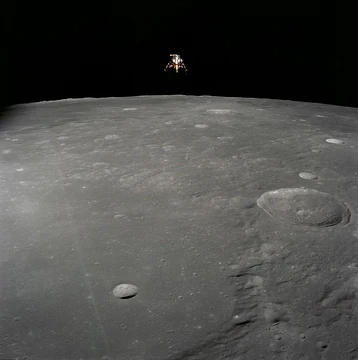
International Lunar Resources Exploration Concept
Proposed lunar base with Russian partnership, developed after Bush's SEI.

The International Lunar Resources Exploration Concept (ILREC) was a proposed mission architecture developed in the early 1990s, after President George H. W. Bush's Space Exploration Initiative (SEI) had effectively ended. Designed by NASA engineer Kent Joosten at the Johnson Space Center, the plan aimed to use international partners, primarily Russia, to assemble a lunar base and a sustainable lunar transportation service. It represented a post-Apollo vision for a permanent human presence on the Moon, leveraging in situ resource utilization and international cooperation.
- Nationality
- United States (with Russian/international partners)
Lore & Background
The ILREC was designed by Kent Joosten, an engineer at NASA's Johnson Space Center, in the early 1990s, following the effective demise of the Space Exploration Initiative announced by President George H. W. Bush on July 20, 1989. The initiative called for constructing Space Station Freedom, returning humans to the Moon 'to stay,' and eventually sending astronauts to Mars. A 90-Day Study estimated the SEI's long-term cost at approximately 500 billion dollars over 20 to 30 years, which drew hostile reaction from Congress, particularly from Democratic members like Senators Jim Sasser and Al Gore. The program was thought too expensive even for an international endeavor and did not survive into the Clinton administration.
The ILREC plan would use multiple lunar surface rendezvous (LSR) for refueling, rather than Apollo's lunar orbit rendezvous. Key vehicles included a one-way automated cargo vehicle delivering 11 tons of payloads, launched by Russian Energia rockets; a piloted lander with a crew compartment derived from the Apollo command module, which would land and launch using belly-mounted thrusters and burn lunar-produced oxygen during ascent; and a pressurized Moon Bus rover for two-person crews. The plan also relied on the Shuttle-C cargo launcher concept and the Russian Energia rocket, which had only two orbital flights (1987 and 1988).
The mission concept was divided into phases. Phase 1 would have been mostly robotic, setting up liquid oxygen plants and ISRU equipment, followed by a crew of two (one American astronaut, one Russian cosmonaut) landing for a few days. Phase 2 would have set up advanced equipment for further exploration.
Reader's Guide
The International Lunar Resources Exploration Concept is significant as a detailed, if unrealized, blueprint for international cooperation in lunar exploration during the post-Cold War era. It proposed using Soviet heavy-lift rockets (Energia) alongside American Shuttle-derived vehicles, and emphasized in situ resource utilization—specifically, producing oxygen from lunar materials for rocket fuel. This concept foreshadowed later NASA plans like the Artemis program, which also seeks a sustainable lunar presence with international partners. However, the ILREC was a victim of its time: the high cost estimate of the broader Space Exploration Initiative (500 billion dollars) and political opposition doomed it. Its legacy lies in demonstrating that even ambitious international lunar plans require sustained political and financial commitment. The plan's reliance on technologies like lunar oxygen production and surface rendezvous also influenced later mission architectures.
Did You Know?
- The ILREC would have used Russian Energia rockets to launch American-built cargo vehicles from Baikonur Cosmodrome.
- The piloted lander would burn Earth-made hydrogen and lunar-made oxygen during ascent from the Moon.
- The crew for the first piloted flight would have consisted of one American astronaut and one Russian cosmonaut.
- The plan called for multiple lunar surface rendezvous (LSR) for refueling, unlike Apollo's lunar orbit rendezvous.
Frequently Asked Questions
What is the International Lunar Resources Exploration Concept (ILREC)?
ILREC was a proposed mission framework created in the early 1990s that envisioned a permanent human presence on the Moon. It called for an international partnership to build a lunar base and establish a sustainable transportation service to the lunar surface.
Who developed the ILREC plan?
The concept was designed by NASA engineer Kent Joosten while working at the Johnson Space Center. He crafted it as a post-Apollo vision for sustained lunar exploration after the original Space Exploration Initiative lost its political backing.
Which nations were involved in the ILREC proposal?
The United States was the lead nation, with Russia identified as the primary international partner. The plan specifically called for joint assembly of the lunar base and shared operation of the transportation infrastructure.
Why is ILREC considered important in lunar exploration history?
It represented one of the first serious post-Apollo architectures for a permanent, resource-utilizing human settlement on the Moon. By emphasizing in situ resource utilization and multilateral cooperation, it laid conceptual groundwork that later international lunar programs drew upon.
What ultimately happened to the ILREC proposal?
The plan was never formally adopted or funded by any government, as it emerged after the political momentum behind the Space Exploration Initiative had collapsed. It remains a documented concept study rather than an active or completed program.
More in Exploration of the Moon 1-24
Spotted an error? Know more?
Reader corrections go straight into our review queue. Suggest an edit · How this site is sourced