Columbian exchange
Last updated

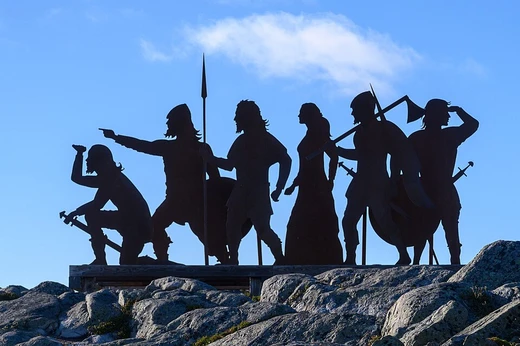
Warren LeMay from Chicago, IL, United States · CC BY-SA 2.0
Historian Alfred W. Crosby coined the term in his 1972 book The Columbian Exchange, which is considered a founding text in environmental history.[1] The exchange dramatically altered the biology and history of both hemispheres.[2]
Quick Facts
- Coined by
- Alfred W. Crosby
- Field
- Environmental history
- Nationality
- American
- Known for
- Mapping biological and cultural transfers between Old and New Worlds
Facts from the source article.
Key facts and history
The Columbian exchange began with Christopher Columbus's first voyage to the Americas in 1492.[3] Domestic dogs were brought by the earliest human settlers when they arrived in the New World from Siberia many millennia ago.[4] Potatoes, maize, tomatoes, and tobacco are examples of plants originating in the Americas that subsequently spread globally.[5] The arrival of potatoes and maize in the Old World led to better nutrition for people throughout Eurasia.[6]
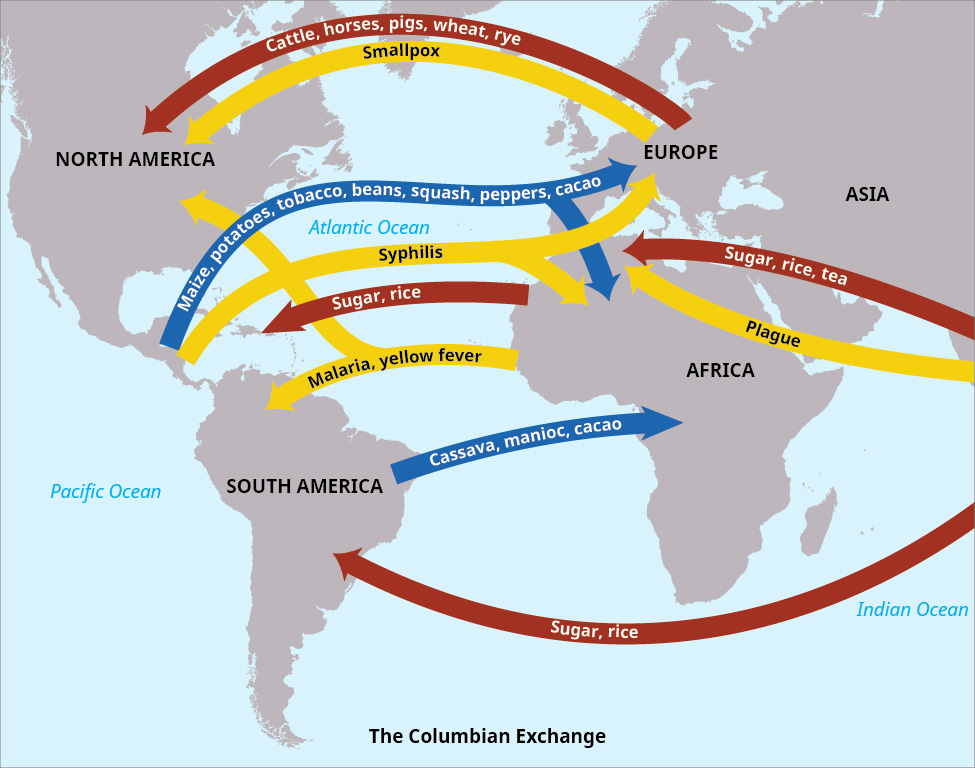
Disease transmission to the New World caused far more deaths; smallpox was documented for the first time in the Americas in 1518.[7][8] Within the first 100 to 150 years after 1492, epidemics killed an estimated 80 to 95 percent of the Native American population.[9]
What the cited sources add
The Smithsonian Magazine interview with Crosby notes that the Columbian Exchange was not taught in history courses for decades after his book appeared.[1] Crosby stated that the exchange of living organisms between the two worlds involves a great deal of economic, social, and political history.[1] The NCpedia account by McNeill emphasizes that the Columbian Exchange also began the Trans-Atlantic Slave Trade.[2] The Quartz article by Smith reports that general scholarly consensus holds that Columbus's men brought syphilis to Europe from the New World.[10]
References
- Gambino, "Alfred W. Crosby on the Columbian Exchange", Smithsonian Magazine, October 4, 2011. facts only, no text reused. smithsonianmag.com
- McNeill, "The Columbian Exchange", NCpedia. facts only, no text reused. ncpedia.org
- Wikipedia, "Columbian exchange" (CC BY-SA 4.0), which cites: Dunham, "Study shows ancient contact between Polynesian and South American peoples", Reuters, July 8, 2020; McNeill, "Columbian Exchange", Encyclopædia Britannica, Inc., September 30, 2019 (original not read by us) en.wikipedia.org
- Wikipedia, "Columbian exchange" (CC BY-SA 4.0), which cites: Ní Leathlobhair, "The evolutionary history of dogs in the Americas", Science, 2018-07-06, p. 81–85; "The Norse in the North Atlantic", Heritage: Newfoundland & Labrador; Edwards, "Biogeography in the Sub-Arctic", Wiley, April 20, 2021, p. 185–214 (we also read that source) en.wikipedia.org
- Wikipedia, "Columbian exchange" (CC BY-SA 4.0), which cites: Ley, "The Healthfull Aromatick Herbe", December 1965, p. 88–98 (original not read by us) en.wikipedia.org
- Wikipedia, "Columbian exchange" (CC BY-SA 4.0), which cites: Nunn, "The Potato's Contribution to Population and Urbanization: Evidence from a Historical Experiment", Quarterly Journal of Economics, 2011, p. 593–650; ; "Super-Sized Cassava Plants May Help Fight Hunger In Africa", Ohio State University; "Maize Streak Virus-Resistant Transgenic Maize: an African solution to an African Problem", Scitizen, August 7, 2007; "China's Population: Readings and Maps", Columbia University, East Asian Curriculum Project, September 24, 2009; ; Crosby 2003, p. 177 (we also read that source) en.wikipedia.org
- Wikipedia, "Columbian exchange" (CC BY-SA 4.0), which cites: Nunn Qian 2010; Nunn Qian 2010 (original not read by us) en.wikipedia.org
- Wikipedia, "Columbian exchange" (CC BY-SA 4.0), which cites: Gunderman, "How smallpox devastated the Aztecs – and helped Spain conquer an American civilization 500 years ago", PBS, February 23, 2019; D'Altroy, "The Incas", Blackwell Publishing, 2003, p. 76; Merrill, "Mexico: A Country Study", Library of Congress, 1996 (we also read that source) en.wikipedia.org
- Wikipedia, "Columbian exchange" (CC BY-SA 4.0), which cites: Denevan, "Demographic Collapse: Indian Peru, 1520–1630 by Noble David Cook", The Americas, October 1983, p. 281–284 (original not read by us) en.wikipedia.org
- Smith, "Thanks Columbus! The true story of how syphilis spread to Europe", Quartz, December 23, 2015. facts only, no text reused. qz.com
Each numbered sentence above was checked against the source it cites before publication. Sentences citing Wikipedia adapt text from the English Wikipedia article Columbian exchange (contributors), used under CC BY-SA 4.0; this entry is available under the same licence. Other sources were used for facts only; no text or images are copied from them.
More in Exploration & Colonization
Sources
Compiled from Wikipedia and the sources listed below. Text from Wikipedia is available under CC BY-SA 4.0; this entry is adapted from it.
- Wikipedia: Columbian exchange (CC BY-SA 4.0).
Spotted an error? Know more?
Reader corrections go straight into our review queue. Suggest an edit · How this site is sourced