Treaty of Tordesillas
The 1494 treaty that divided the non-European world between Portugal and Castile.
Last updated

Koppchen · CC BY 3.0
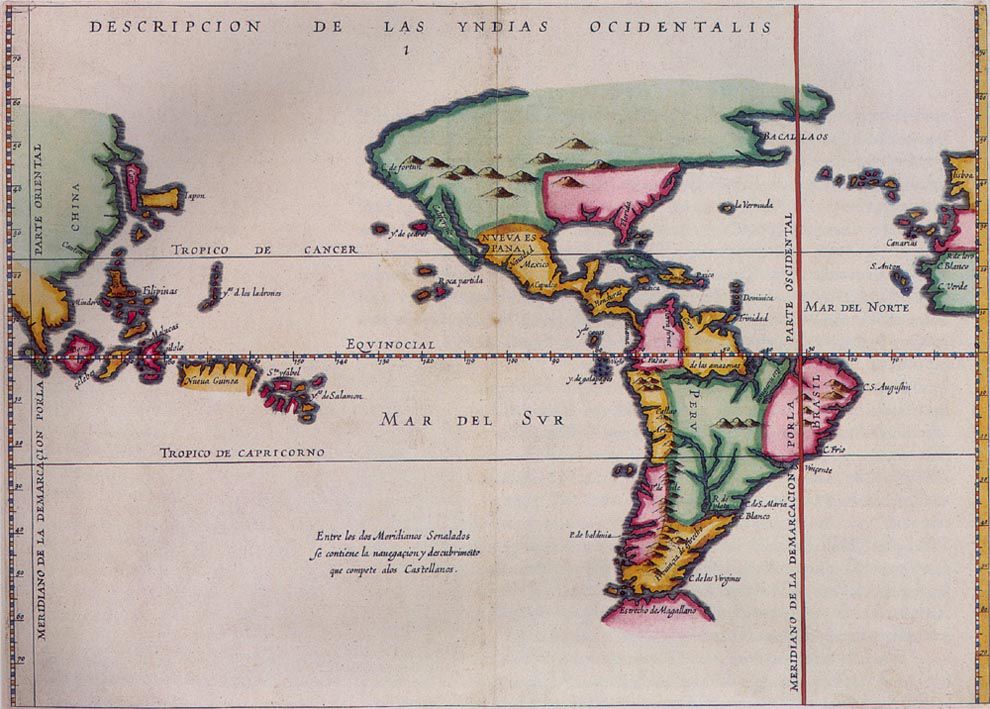
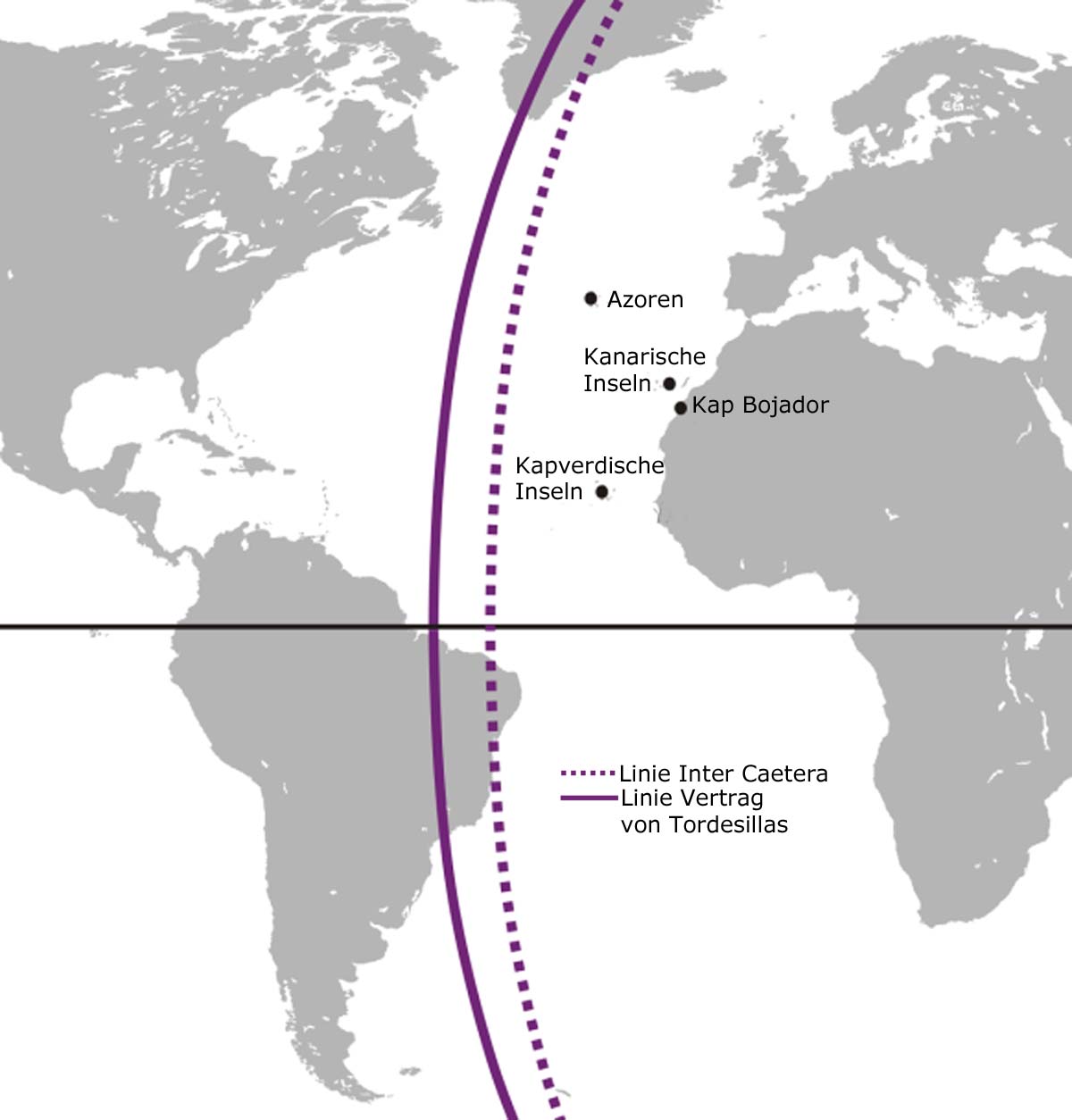
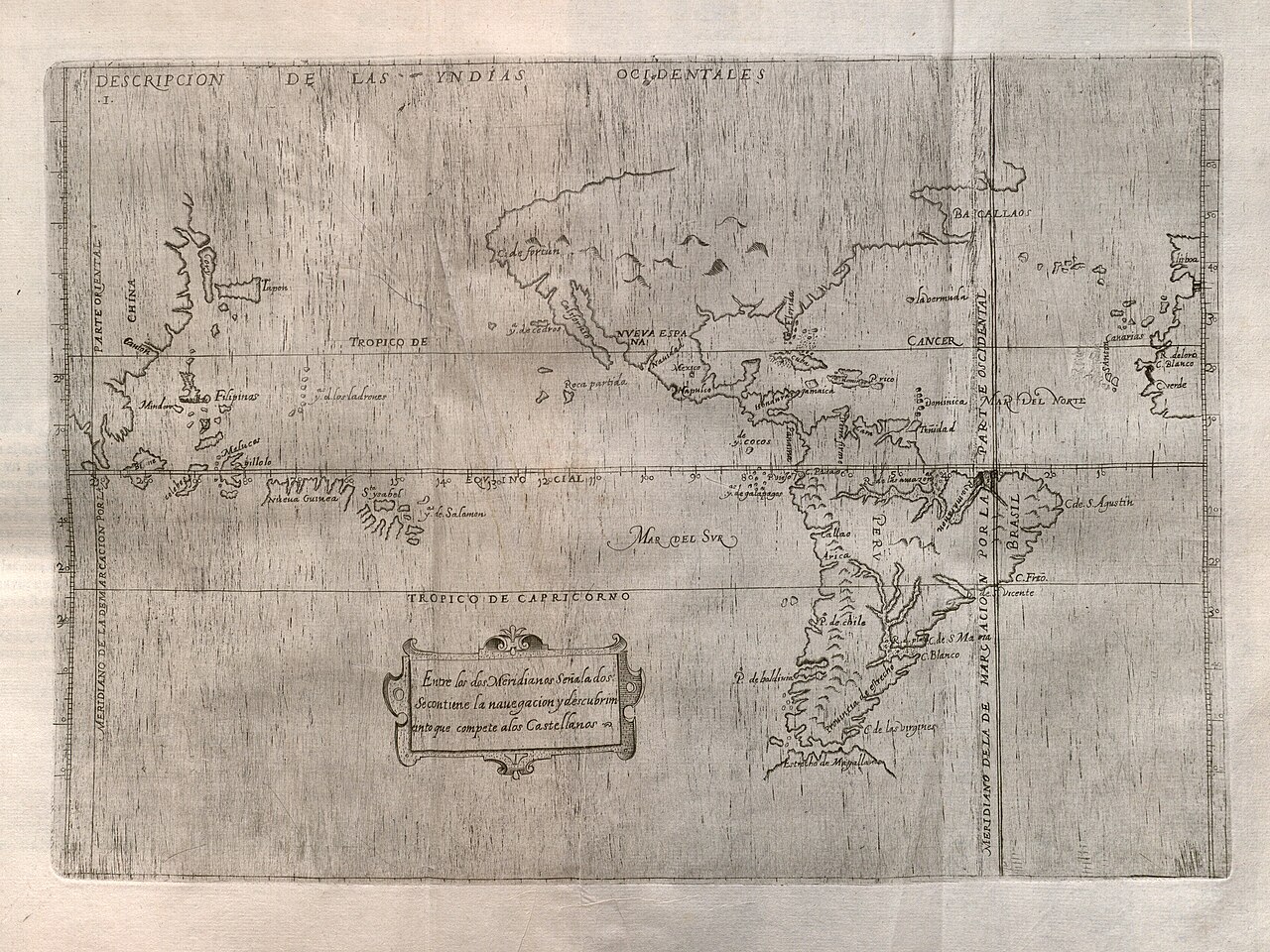
On June 7, 1494, in the Spanish town of Tordesillas, Portugal and Castile signed an agreement to split up any lands discovered beyond Europe. The line they drew ran 370 leagues west of the Cape Verde islands, off Africa’s west coast. Everything east of that meridian went to Portugal, everything west to Castile.
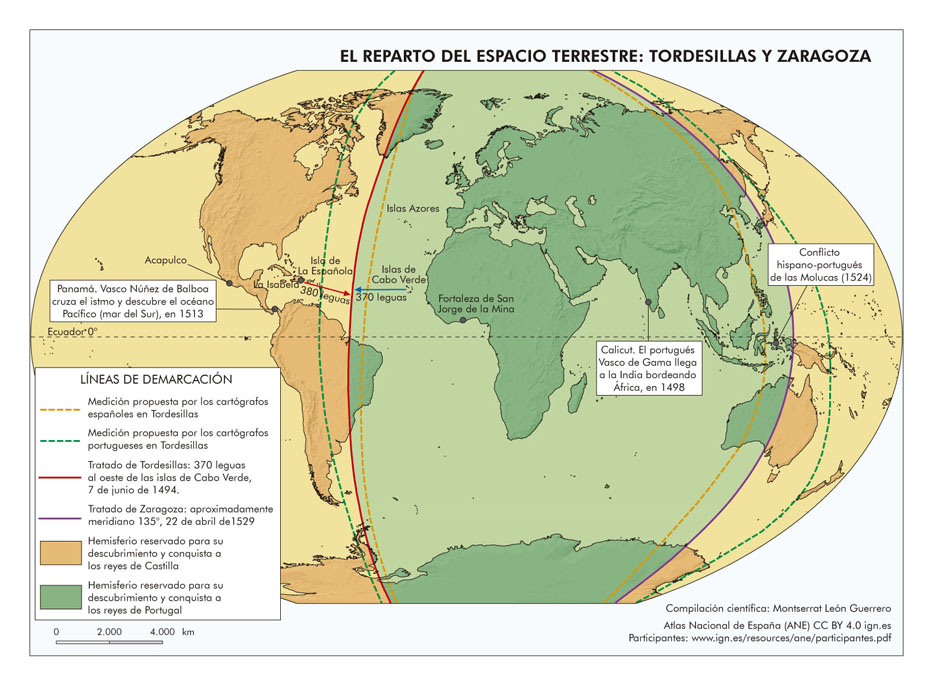
This deal replaced an earlier papal decree by Pope Alexander VI. Spain and Portugal later ratified the treaty, and Pope Julius II gave his official approval on January 24, 1506, through a bull called Ea quae pro bono pacis. Decades afterward, the Treaty of Zaragoza set the dividing line on the opposite side of the globe, marking the antimeridian of the Tordesillas line.
Both Spain and Portugal mostly stuck to these agreements, though the Indigenous peoples of the Americas never recognized them. In 2007, UNESCO added the Treaty of Tordesillas to its Memory of the World register. The original copies are kept in Spain at the General Archive of the Indies and in Portugal at the Torre do Tombo National Archive.
Lore & Background
The Treaty of Tordesillas was intended to solve the dispute that arose following the return in 1493 of Christopher Columbus and his crew, who had sailed under the Crown of Castile, from their first voyage. On his way back to Spain, he first stopped at Lisbon, where he requested another meeting with King John II to prove to him that there were more islands to the southwest of the Canary Islands. After learning of the Castilian-sponsored voyage, the Portuguese king sent a threatening letter to the Catholic Monarchs, King Ferdinand and Queen Isabella, stating that by the Treaty of Alcáçovas signed in 1479 and by the 1481 papal bull Aeterni regis—which granted Portugal all lands south of the Canary Islands—the new discoveries fell within Portugal's sphere. The Portuguese king also stated that he was already making arrangements for a fleet (an armada led by Francisco de Almeida) to depart shortly and take possession of the new lands.
The Spanish rulers replied that Spain owned the islands discovered by Columbus and warned King John II not to permit anyone from Portugal to go there. Finally, the rulers invited Portugal to send ambassadors to begin diplomatic negotiations aimed at settling the rights of each nation in the Atlantic. On 4 May 1493, Pope Alexander VI decreed in the bull Inter caetera that all lands west of a pole-to-pole line 100 leagues west of any of the islands of the Azores or the Cape Verde Islands should belong to Castile, although territory under Christian rule as of Christmas 1492 would remain untouched. The bull did not mention Portugal or its lands, so Portugal could not claim newly discovered lands even if they were east of the line.
Another bull, Dudum siquidem, dated 1493, gave all mainlands and islands, 'at one time or even still belonging to India' to Spain, even if east of the line. The Portuguese King John II was not pleased with that arrangement, feeling that it gave him far too little land—it prevented him from possessing India, his near-term goal. By 1493, Portuguese explorers had reached the southern tip of Africa, the Cape of Good Hope. The Portuguese were unlikely to go to war over the islands encountered by Columbus.
Reader's Guide
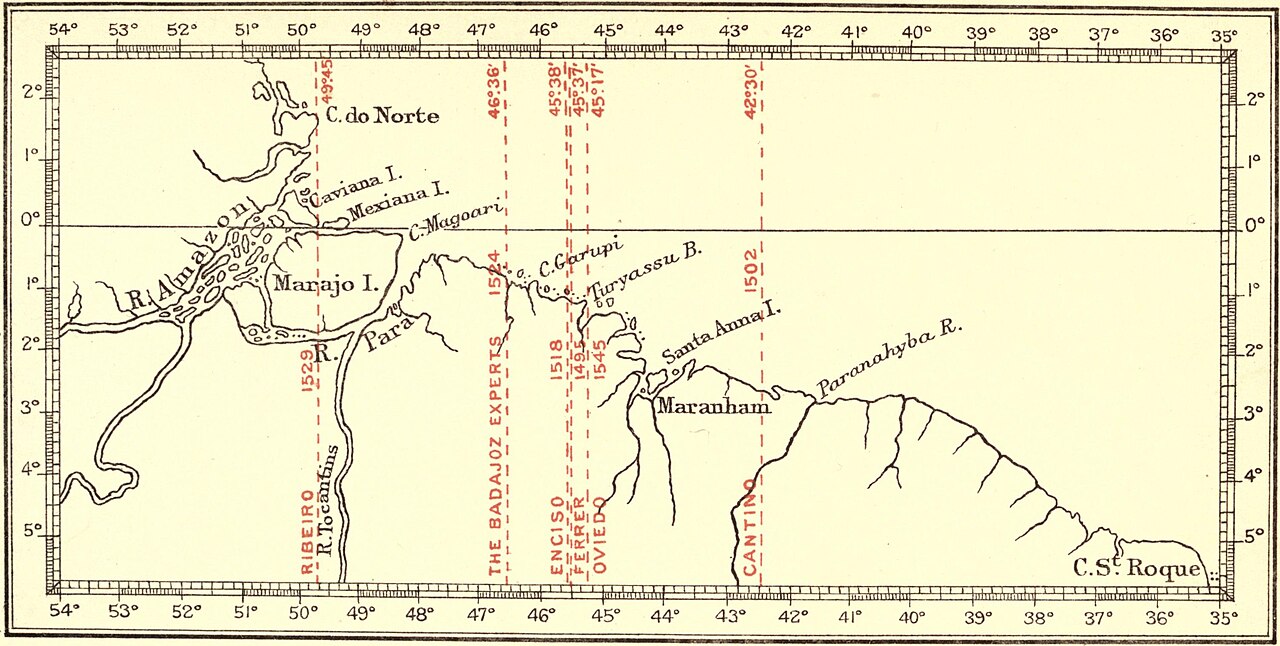
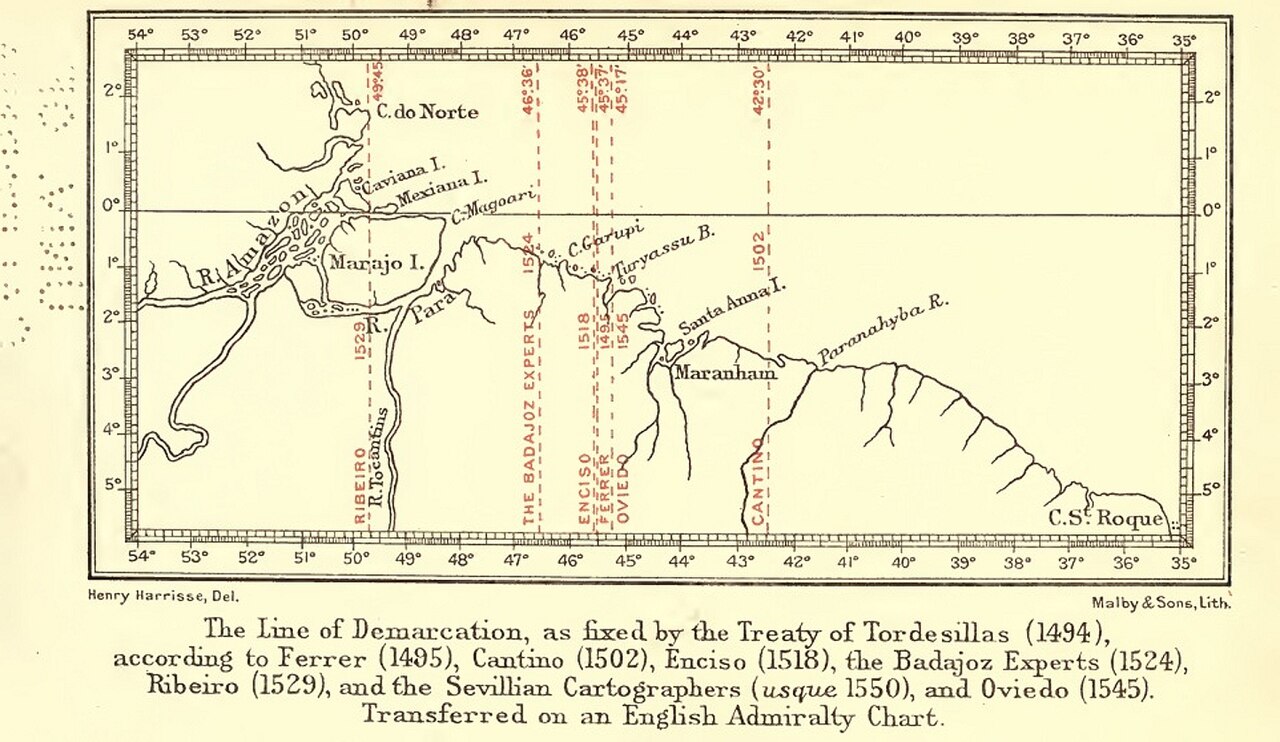
The Treaty of Tordesillas only specified the line of demarcation in leagues from the Cape Verde Islands. It did not specify the length of the league, its equivalent in equatorial degrees, or which of the Cape Verde islands was intended. Instead, the treaty provided that these matters were to be settled by a joint voyage.
This voyage never occurred, and instead there were only a series of nonbinding expert opinions produced over the next several decades. Their computations were further complicated by remaining uncertainty about the exact equatorial circumference of the earth. As such, each proposed line can be variously computed using geographical leagues defined in terms of a degree using a ratio which applies regardless of the size of the earth or using a specifically measured league applied to the actual equatorial circumference of the earth, with allowances necessary for the imperfect Portuguese and Spanish knowledge of its true dimensions. The earliest Aragonese opinion was provided by Jaime Ferrer in 1495 at the request of Ferdinand and Isabella.
He stated to them that the demarcation line was 18° west of the most central island of the Cape Verde Islands, equivalent to 24°25 west of Greenwich. (Harrisse concludes Ferrer must have meant Fogo as this central island.) Thus, Ferrer placed the line at 42°25 W. on his sphere, which was 21.1% larger than the actual size of the earth. Harrisse further concludes from Ferrer's claim that his league contained 32 Olympic stades, that his line if perfectly measured would have an unspecified result.
Did You Know?
- The line was not strictly enforced—the Spanish did not resist the Portuguese expansion of Brazil across the meridian.
- The treaty was superseded by the 1750 Treaty of Madrid.
Frequently Asked Questions
Who signed the Treaty of Tordesillas?
The agreement was concluded between the Kingdom of Portugal and the Crown of Castile, the two Iberian powers competing over newly encountered overseas territories.
What was the Treaty of Tordesillas?
It was a 1494 bilateral accord that drew an imaginary north-south meridian in the Atlantic to split undiscovered lands between the two signatory crowns. The line was meant to settle the territorial rivalry that erupted after Columbus's first voyage westward.
Why was the Treaty of Tordesillas created?
Columbus's 1492 voyage triggered a clash of claims between Portugal and Castile over which crown owned the new lands. The treaty was drafted to resolve that dispute and effectively superseded the earlier papal bull issued by Pope Alexander VI that had attempted a similar division.
What did the Treaty of Tordesillas actually do?
It established a meridian roughly 370 leagues west of the Cape Verde Islands, granting lands east of the line to Portugal and lands west of it to Castile. In practice this gave Portugal a legal foothold on the Brazilian coast while leaving most of the rest of the Americas under Castilian claim.
More in Exploration & Colonization
Sources
Compiled from Wikipedia and the sources listed below. Text from Wikipedia is available under CC BY-SA 4.0; this entry is adapted from it.
- Wikipedia: Treaty of Tordesillas (CC BY-SA 4.0).
Spotted an error? Know more?
Reader corrections go straight into our review queue. Suggest an edit · How this site is sourced