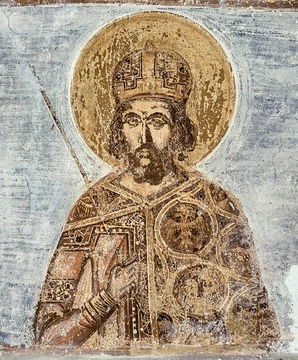
Constantine VIII
Longest-reigning de jure Byzantine emperor, whose sole rule saw decline.
Last updated

Jaqeli · CC BY-SA 4.0
He was known for his athletic pursuits and love of luxury, but his sole reign is described as a disaster for the empire.[1][2] Constantine VIII held the title of Byzantine emperor from 962 until his death in 1028, but he governed as the sole ruler only after 1025.[3][4]
Life and work
Tzimiskes exiled Theophano but left Constantine and his brother Basil as co-emperors.[5] After Tzimiskes died in 976, Basil became the senior emperor while Constantine avoided state business.[6] In his youth Constantine was tall, athletic, and skilled in rhetoric and wrestling.[1] He married Helena, daughter of Alypius, and had three daughters: Eudokia, Zoe, and Theodora.[1][7]
Theophano, Constantine's mother, formed an alliance with the general Nikephoros Phokas; she married him, and he was crowned emperor.[8][1]
What the cited sources add
A 1991 account by Norwich states that Constantine brought wrestling competitions back into fashion.[1] The same source notes that his later chronic gout impaired his ability to walk.[1] Ostrogorsky's 1957 history describes how Constantine's advisors preferred Romanos Argyros as successor, and Constantine acquiesced.[8] The same source states that Romanos was compelled to divorce his wife and marry Constantine's daughter Zoe.[8]
According to Norwich, Constantine's period as sole ruler lasted under three years, ending with his death on either 11 or 12 November 1028.[1]
References
- Wikipedia, "Constantine VIII" (CC BY-SA 4.0), which cites: Norwich 1991, p. 174 (original not read by us) en.wikipedia.org
- Wikipedia, "Constantine VIII" (CC BY-SA 4.0), which cites: Ostrogorsky 1957, p. 284; Norwich 1991, p. 174; Ostrogorsky 1957, p. 284 (original not read by us) en.wikipedia.org
- Wikipedia, "Constantine VIII" (CC BY-SA 4.0), which cites: Also called Porphyrogenitus ( ), although the epithet is almost exclusively used for Constantine VII. (original not read by us) en.wikipedia.org
- Wikipedia, "Constantine VIII" (CC BY-SA 4.0), which cites: Brand Cutler 1991, p. 503–504; Ostrogorsky 1957, p. 284 (original not read by us) en.wikipedia.org
- Wikipedia, "Constantine VIII" (CC BY-SA 4.0), which cites: Ash 1995, p. 248; Norwich 1991, p. 174 (original not read by us) en.wikipedia.org
- Wikipedia, "Constantine VIII" (CC BY-SA 4.0), which cites: Ostrogorsky 1957, p. 284; Norwich 1991, p. 174; Norwich 1991, p. 174 (original not read by us) en.wikipedia.org
- Wikipedia, "Constantine VIII" (CC BY-SA 4.0), which cites: Garland 1999, p. 165–66 (original not read by us) en.wikipedia.org
- Wikipedia, "Constantine VIII" (CC BY-SA 4.0), which cites: Ostrogorsky 1957, p. 284 (original not read by us) en.wikipedia.org
Each numbered sentence above was checked against the source it cites before publication. Sentences citing Wikipedia adapt text from the English Wikipedia article Constantine VIII (contributors), used under CC BY-SA 4.0; this entry is available under the same licence. Other sources were used for facts only; no text or images are copied from them.
More in Emperors Of The Byzantine And Roman World
Sources
Compiled from Wikipedia and the sources listed below. Text from Wikipedia is available under CC BY-SA 4.0; this entry is adapted from it.
- Wikipedia: Constantine VIII (CC BY-SA 4.0).
Spotted an error? Know more?
Reader corrections go straight into our review queue. Suggest an edit · How this site is sourced