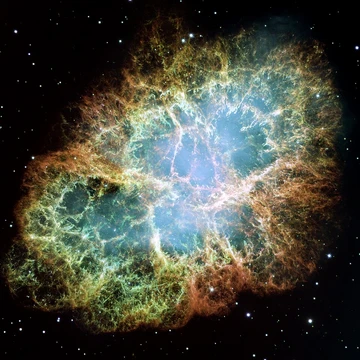
SN 1987A
Closest supernova since 1604, first studied in modern detail.
SN 1987A exploded as a Type II supernova in the Large Magellanic Cloud, a small galaxy orbiting the Milky Way. At roughly 51.4 kiloparsecs away, it was the nearest supernova seen since Kepler’s in 1604. Its light and neutrinos arrived on Earth on February 23, 1987, and it earned the designation SN 1987A because it was the first supernova found that year. By May, it reached peak brightness at an apparent magnitude of about 3, outshining Alpha Doradus, the brightest star in its constellation. This event became the first supernova astronomers could examine in fine detail, and the data greatly deepened understanding of core-collapse supernovae.
Quick Facts
- Host
- Large Magellanic Cloud
- Constellation
- Dorado
- Gal
- G279.7-31.9
- Discovery
- 24 February 1987
- Distance
- 51.4 kpc
- Progenitor
- Sanduleak -69 202
- B-v
- +0.085
Facts from the source article.
Lore & Background
SN 1987A was discovered independently by Ian Shelton and Oscar Duhalde at the Las Campanas Observatory in Chile on February 24, 1987, and within the same 24 hours by Albert Jones in New Zealand. Later investigations found photographs showing the supernova brightening rapidly early on February 23. On March 4–12, 1987, it was observed from space by Astron, the largest ultraviolet space telescope of that time. Four days after the event was recorded, the progenitor star was tentatively identified as Sanduleak -69 202, a blue supergiant. After the supernova faded, that identification was definitively confirmed, as Sanduleak -69 202 had disappeared. The possibility of a blue supergiant producing a supernova was considered surprising, and the confirmation led to further research which identified an earlier supernova with a blue supergiant progenitor. Some models of the progenitor attributed the blue color largely to its chemical composition rather than its evolutionary stage, particularly the low levels of heavy elements. There was some speculation that the star might have merged with a companion star before the supernova. However, it is now widely understood that blue supergiants are natural progenitors of some supernovae, although there is still speculation that the evolution of such stars could require mass loss involving a binary companion.
Reader's Guide
SN 1987A provided the first opportunity to confirm by direct observation the radioactive source of the energy for visible light emissions, by detecting predicted gamma-ray line radiation from two of its abundant radioactive nuclei. This proved the radioactive nature of the long-duration post-explosion glow of supernovae. Approximately two to three hours before the visible light reached Earth, a burst of neutrinos was observed at three neutrino observatories. This was the first time neutrinos known to be emitted from a supernova had been observed directly, which marked the beginning of neutrino astronomy. The observations were consistent with theoretical supernova models in which 99% of the energy of the collapse is radiated away in the form of neutrinos. The neutrino measurements allowed upper bounds on neutrino mass and charge, as well as the number of flavors of neutrinos and other properties. In 2019, indirect evidence for the presence of a collapsed neutron star within the remnants was discovered using the Atacama Large Millimeter Array telescope. Further evidence was subsequently uncovered in 2021 through observations conducted by the Chandra and NuSTAR X-ray telescopes. The supernova's ejecta have been observed interacting with a triple-ring system of circumstellar material, with the shock wave heating the inner ring and generating X-rays. A study reported in June 2015, using images from the Hubble Space Telescope and the Very Large Telescope taken between 1994 and 2014, shows that the emissions from the clumps of matter making up the rings are fading as the clumps are destroyed by the shock wave. It is predicted the ring would fade away between 2020 and 2030. In 2018, radio observations confirmed that the shockwave has now left the circumstellar material and re-accelerated to 3,600 km/s.
More in Supernova Remnants
Spotted an error? Know more?
Reader corrections go straight into our review queue. Suggest an edit · How this site is sourced