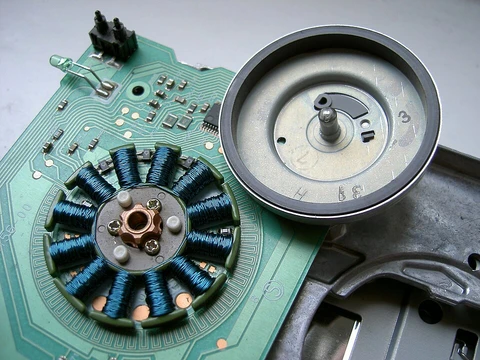
Shading coil
A conductor turn that maintains magnetic force during zero current crossings.

A shading coil or shading ring (also called Frager spire or Frager coil) is one or more turns of electrical conductor, usually copper or aluminum, located in the face of the magnet assembly or armature of an alternating current solenoid, and only encircles part of the magnetic path. The alternating current in the energized primary coil induces an alternating current in the shading coil, which creates an auxiliary magnetic flux that is 90 degrees out of phase from the magnetic flux created by the primary coil. This component is notable for its role in reducing noise, heat, and mechanical damage in relays and contactors by maintaining magnetic force during zero crossings of the primary current.
- Materials
- copper or aluminum
- Phase difference
- 90 degrees
- Also called
- Frager spire or Frager coil
- Application
- AC solenoid, shaded-pole AC motor
Lore & Background
The shading coil is a simple yet effective device used in alternating current solenoids and relays. It consists of one or more turns of copper or aluminum placed on the face of the magnet assembly, encircling only part of the magnetic path. When the primary coil is energized with alternating current, it induces a current in the shading coil, which in turn produces an auxiliary magnetic flux that is 90 degrees out of phase with the primary flux. This phase shift ensures that a magnetic flux and thus a force between the armature and the assembly is maintained even when the primary current crosses zero. Without the shading ring, the armature would tend to open each time the main flux goes through zero, causing noise, heat, and mechanical damage to the magnet faces. The shading coil thus reduces bouncing or chatter of relay or power contacts.
In the context of shaded-pole AC motors, the shading coil serves as an auxiliary winding composed of a copper ring (or multiple turns). This auxiliary winding produces a secondary magnetic flux that, together with the flux from the primary coil, forms a rotating magnetic field suitable for applying torque to and rotating the rotor. These motors are typically used as low-cost motors for microwave oven fans.
Reader's Guide
The shading coil is significant primarily for its function in alternating current solenoids and relays, where it prevents the armature from opening during zero crossings of the primary current. This reduces noise, heat, and mechanical damage to the magnet faces, and minimizes bouncing or chatter of relay or power contacts. The article notes that without the shading ring, the armature would tend to open each time the main flux goes through zero, leading to these undesirable effects. In shaded-pole AC motors, the shading coil acts as an auxiliary winding that helps create a rotating magnetic field, enabling the motor to apply torque to the rotor. These motors are described as low-cost devices, with a typical application being microwave oven fans. The legacy of the shading coil lies in its simplicity and effectiveness in improving the reliability and quiet operation of AC solenoids and low-cost induction motors, as described in the source article.
Did You Know?
- A shading coil is also called a Frager spire or Frager coil.
- The induced current in the shading coil creates an auxiliary magnetic flux 90 degrees out of phase from the primary flux.
- Without a shading ring, the armature of an AC solenoid would tend to open each time the main flux goes through zero.
- Shaded-pole AC motors with shading rings are used as low-cost motors for microwave oven fans.
More in Electric Motors, Part 3 1-24
Spotted an error? Know more?
Reader corrections go straight into our review queue. Suggest an edit · How this site is sourced