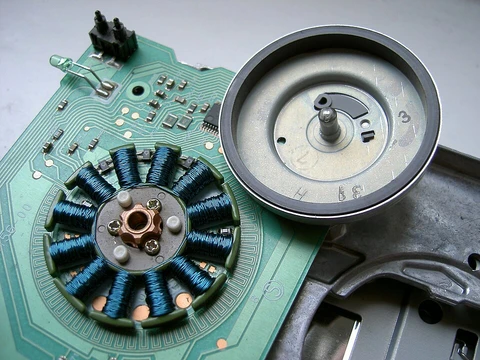
Torque motor
A DC motor that stalls safely while applying steady torque.

TTTNIS · CC0
A torque motor is a type of DC electric motor designed to run while stalled indefinitely without damage, delivering a steady torque to the load. If it cannot complete a full rotation, it is called a limited angle torque motor. Brushless versions exist, which can operate at higher speeds due to the absence of commutators and brushes.
These motors typically use a toroidal construction, giving them a wider diameter, higher torque, and improved heat dissipation. They stand out from other motors due to their high torque, thermal performance, and ability to draw high current while stalled.
A linear counterpart, called a force motor, produces motion in a straight line rather than rotation. Force motors are common in refrigeration compressors and ultra-quiet air compressors, where they create simple harmonic motion with a restoring spring.
In tape drives, torque motors control the supply and take-up reels. At low voltage, they maintain constant light tape tension regardless of capstan movement; at higher voltage, they provide fast-forward and rewind without extra gears or clutches. In computer gaming, they power force feedback steering wheels. For throttle control in internal combustion engines, a torque motor works against a return spring, adjusting the throttle based on an electronic governor that monitors engine speed via ignition pulses or a magnetic pickup. If the engine slows, current increases, opening the throttle; if it speeds up, current decreases, allowing the spring to close it. Torque motors also serve as direct-drive actuators in motion control systems and servomechanisms, converting controller commands into physical changes.
- Type
- DC electric motor
- Stall operation
- indefinite without damage
- Construction
- toroidal
- Linear equivalent
- force motor
- Applications
- tape drives, force feedback steering wheels, throttle control, direct-drive actuators
Lore & Background
Torque motors normally use toroidal construction, allowing them to have wider diameter, more torque, and better dissipation of heat. They differ from other motors in their higher torque, thermal performance, and ability to operate while drawing high current in a stalled state. A torque motor that cannot perform a complete rotation is known as a limited angle torque motor. Brushless torque motors are available; elimination of commutators and brushes allows higher speed operation. An analogous device moving linearly rather than rotating is described as a 'force motor', widely used for refrigeration compressors and ultra-quiet air compressors, where the force motor produces simple harmonic motion in conjunction with a restoring spring.
Reader's Guide
Torque motors are significant for their ability to apply constant tension in tape drives, enabling supply- and take-up reel motors to maintain light tape tension regardless of capstan operation, and to achieve fast-forward and rewind without gears or clutches. In computer gaming, they are used in force feedback steering wheels. For throttle control of an internal combustion engine, the motor works against a return spring, with an electronic governor adjusting current based on engine speed to open or close the throttle. Torque motors can also serve as actuators for direct-drive mechanisms in motion control systems or servomechanisms, replacing geared electric motors in some situations. Their legacy lies in providing reliable, stall-tolerant torque in applications requiring precise tension, force feedback, or direct-drive actuation.
Did You Know?
- A torque motor can operate indefinitely while stalled without damage.
- Brushless torque motors eliminate commutators and brushes for higher speed operation.
- A linear version of a torque motor is called a force motor.
The Physics of Rotating Torque
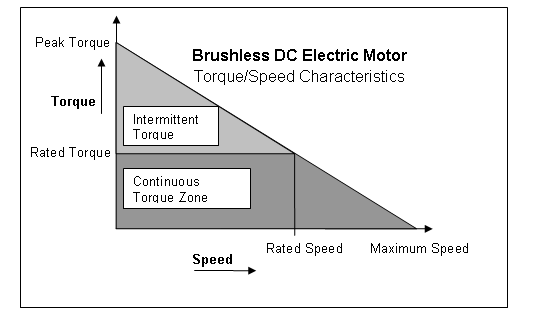
The fundamental mechanism behind a brushless DC motor rests on a deliberate exploitation of magnetic misalignment between two components. The rotor and the stator each present a magnetic field; one or both of these fields is produced by a coil of wire wound around an iron core, energized by a direct-current supply. Torque is generated by the natural tendency of opposing fields to snap into alignment, but the system prevents that alignment from completing by continuously redirecting which windings carry current. In a brushless arrangement, an electronic sensor continuously tracks the angular position of the rotor and commands semiconductor switches—typically transistors—to route current through the correct stator windings at precisely the right instant. The controller modulates both the phase and the amplitude of the current pulses, granting the operator near-instantaneous authority over rotational speed and output torque. Because the permanent magnets are mounted on the rotating element while the armature windings remain fixed to the housing, there is no need to deliver current across a moving boundary. This architectural choice eliminates the mechanical switching difficulties that defined earlier motor generations and opens the door to the efficiency and reliability gains that brushless technology is known for.
Why the Brush Commutator Failed
For much of the twentieth century, the workhorse of DC motor design was the brush commutator—a rotating cylinder segmented into metal contacts, pressed against by stationary graphite brushes. As the shaft turned, the brushes slid across successive segments, redirecting current to different windings and keeping the rotor's field perpetually misaligned with the stator's. Yet this elegant mechanical trick carried serious liabilities. The sliding friction bled power, particularly in low-output machines, and the soft brush material ground away into fine dust, making such motors incompatible with sealed environments like hard-disk drives. Each abrupt current reversal through the winding inductance threw tiny sparks at the contact points, a genuine fire risk in flammable atmospheres and a source of electromagnetic interference that could disrupt nearby microelectronics. Over the past century, high-power brushed DC motors yielded their industrial dominance to AC synchronous machines, and brushed designs retreated into low-power or DC-only niches. The electrical resistance of the sliding contact also produced a voltage drop that consumed usable energy, and the need for periodic brush replacement made these machines unsuitable wherever maintenance-free operation was required.
Architectural Diversity in Brushless Design
Although the term brushless DC motor often conjures a single image, the family encompasses a range of underlying electromagnetic topologies. The most common construction mirrors a permanent-magnet synchronous motor, but variants can be built around switched-reluctance or induction (asynchronous) principles as well. Magnet material matters too; neodymium permanent magnets are a popular choice for their high energy density. The spatial arrangement of rotor and stator also varies. In an outrunner layout the stator sits at the center and the magnet ring surrounds it; an inrunner reverses this, wrapping the stator around the rotor; and an axial configuration places both elements as flat, parallel discs. Each geometry trades off torque density, thermal management, and manufacturability. Because the windings are anchored to the stationary housing rather than spun at high speed, they are shielded from centrifugal stress and can shed heat through conduction into the frame, removing the need for internal airflow and simplifying sealing. This structural advantage is one reason brushless units can operate in environments where a brushed motor would quickly fail from particulate contamination or bearing degradation.
From Disk Drives to Laundry Rooms
The practical payoff of eliminating brushes is visible across an astonishing breadth of everyday machinery. In computer peripherals, brushless motors spin disk-drive platters and drive printer mechanisms where particulate-free, maintenance-free operation is non-negotiable. Hand-held power tools benefit from the high power-to-weight ratio and the near-instantaneous speed and torque control that the electronic commutator provides. In the automotive world, brushless units power everything from model aircraft to full-scale vehicles. Perhaps the most tangible domestic example is the modern washing machine: by adopting a direct-drive brushless motor, manufacturers have dispensed with rubber drive belts and multi-stage gearboxes, letting the motor turn the drum directly. The motor's longer service life—limited now only by bearing wear rather than brush erosion—means fewer service calls and quieter operation. The trade-off, of course, is a more complex and somewhat costlier solid-state controller, but for most applications the reliability and efficiency gains far outweigh that premium. The elimination of ionizing sparks and the overall reduction in electromagnetic interference further cement the brushless motor's place in precision and safety-critical settings.
Gallery
More in Electric Motors, Part 3 1-24
Spotted an error? Know more?
Reader corrections go straight into our review queue. Suggest an edit · How this site is sourced