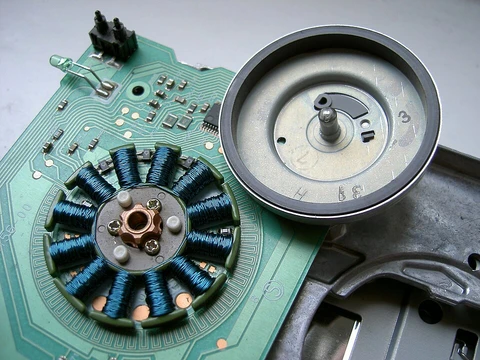
Motor controller
A device coordinating electric motor performance including start, stop, speed, and protection.

A motor controller is a device or set of devices that manages an electric motor's operation according to a preset sequence. It can provide manual or automatic control for starting and stopping the motor, switching between forward and reverse rotation, adjusting and maintaining speed, regulating or limiting torque, and guarding against overloads and electrical faults. Controllers can rely on electromechanical switches or power electronics to manage speed and direction.
Motor controllers work with both DC and AC motors. They include components to connect the motor windings to the power supply and often incorporate protection against overloads, over-current, and overheating, sometimes as part of a magnetic starter. They may also oversee the motor's field circuit or detect issues like low voltage, wrong polarity, incorrect phase sequence, or excessive motor temperature. Some controllers limit the initial inrush current, allowing the motor and its load to accelerate more gradually than a direct connection would. Operation can be manual, requiring an operator to step through a starting sequence, or fully automatic, using timers or current sensors to handle acceleration.
For speed control, DC motor controllers can adjust the voltage applied to the motor or the current in its field winding. AC motors typically don't respond well to voltage changes for speed, so their controllers instead adjust rotor circuit resistance (for wound rotor motors) or change the AC frequency using power electronics or electromechanical frequency changers.
The physical design of motor controllers varies widely. A simple wall-mounted toggle switch with proper ratings may suffice for a household ventilation fan. Power tools and appliances often use a trigger switch that only turns the motor on and off. Industrial motors may connect to complex controllers linked to automation systems, and factories often group many controllers in a motor control center. Controllers for electric cranes or vehicles are mounted on the equipment itself. The largest controllers, used for pumped storage hydroelectric plant pumps, can handle tens of thousands of horsepower.
Motor controllers can be operated manually, remotely, or automatically. They may only start and stop the motor, or include additional functions.
- Starting current ratio
- 6-7 times greater than full load current for asynchronous motors
- Typical dol motor size limit
- 10 kW for rural customers per utility requirements
- Largest motor controller ratings
- tens of thousands of horsepower (kilowatts)
- Motor types controlled
- DC motors, AC motors, brush, brushless, servo, stepper
Lore & Background
Motor controllers are used with both DC and AC motors. They include means to connect motor windings to the power supply and may provide overload, over-current, and overheating protection. Some controllers limit inrush starting current, allowing slower acceleration than direct connection. Controllers may be manual, requiring an operator to sequence a starting switch, or fully automatic using timers or current sensors.
For DC motors, controllers may adjust applied voltage or field winding current. For AC motors, speed control may involve adjusting rotor circuit resistance (for wound rotor motors) or changing the frequency of applied AC using power electronics or electromechanical frequency changers. Physical designs vary widely from wall-mounted toggle switches for household fans to complex controllers in motor control centers for industrial applications, and large units for pumped storage hydroelectric plants.
Motor starters are a specialized type of controller. A direct on line (DOL) starter applies full line voltage and is used for smaller motors where high inrush current does not cause excessive voltage drop. Larger motors may use reduced-voltage starters or star-delta starters to reduce inrush current. Reversing starters contain two DOL circuits with interlocks to prevent simultaneous closure.
Reader's Guide
Motor controllers are significant because they enable safe and efficient operation of electric motors across a vast range of applications. The article describes how they provide essential functions such as starting, stopping, reversing, speed regulation, torque limiting, and protection against overloads and faults. Their design varies from simple switches for household ventilation fans to sophisticated units in industrial motor control centers and mobile equipment like electric cranes and vehicles. The largest controllers, used in pumped storage hydroelectric plants, handle tens of thousands of horsepower. Motor starters, a subset of controllers, include DOL starters for small motors and reduced-voltage starters for larger ones to manage inrush current. Protection features like thermal overload and no-volt release ensure safety and prevent unintended restart after power loss. The choice of controller type—DOL for quick starts with uneven loads, star-delta for larger motors or those with flywheels—demonstrates the tailored approach required for different mechanical loads and power supply constraints.
Did You Know?
- A motor controller may include manual or automatic means for starting, stopping, reversing, speed regulation, torque limiting, and protection.
- For AC motors, speed control can be achieved by adjusting rotor circuit resistance or changing the frequency of the applied AC.
- A direct on line (DOL) starter applies full line voltage and is typically used for smaller motors to avoid excessive voltage drop.
- Thermal overload protection uses a heating element on each power wire to heat a bimetallic strip that trips the contactor solenoid.
More in Electric Motors, Part 3 1-24
Spotted an error? Know more?
Reader corrections go straight into our review queue. Suggest an edit · How this site is sourced