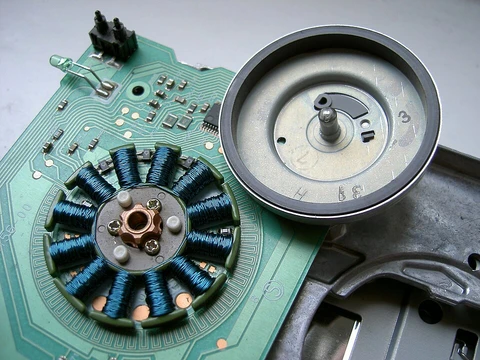
Electronic speed control
An electronic circuit that controls electric motor speed.

An electronic speed control (ESC) is a circuit that manages the speed of an electric motor, and it can also reverse the motor's direction or apply dynamic braking. Small-scale versions are found in radio-controlled models, while larger systems handle the drive motors in full-sized electric vehicles.
The ESC takes a speed reference signal—from a throttle, joystick, or similar manual input—and adjusts how quickly it switches a network of field-effect transistors (FETs). By changing the duty cycle or switching frequency of these transistors, the motor’s speed changes. The rapid switching of current through the motor produces a characteristic high-pitched whine, most noticeable at lower speeds.
Brushed and brushless DC motors require different control methods. For a brushed motor, speed is controlled by varying the voltage on its armature. (In industrial motors with electromagnetic field windings, speed can also be adjusted by changing the field current.) Brushless motors work differently: their speed is controlled by altering the timing of current pulses sent to the motor’s multiple windings. Brushless ESC systems generate three-phase AC power, similar to a variable frequency drive, to run these motors. Hobbyists favor brushless motors in radio-controlled airplanes for their efficiency, power, longevity, and lighter weight compared to brushed motors. Brushless DC motor controllers are far more complex than brushed ones.
The ESC must deliver current in the correct phase relative to the motor’s rotation. Usually, back EMF from the motor windings is used to detect rotation, though some systems use separate Hall effect sensors or optical detectors. Computer-programmable ESCs often let users set options like low voltage cut-off, timing, acceleration, braking, and rotation direction. Reversing the motor can be done by swapping any two of the three leads between the ESC and the motor.
ESCs are rated by maximum current, such as 25 amperes. Higher ratings generally mean larger, heavier units, which matters for mass and balance in aircraft. Many modern ESCs support nickel metal hydride, lithium ion polymer, and lithium iron phosphate batteries with adjustable input and cut-off voltages. The battery type and cell count affect the choice of a battery eliminator circuit (BEC), whether built-in or standalone.
- Maximum current rating example
- 25 amperes (25 A)
- Example vehicle motor power
- Nissan Leaf uses a 160 kW motor that produces up to 340 Nm torque
- Typical pwm input signal frequency
- 50 Hz
- Pulse width range
- 1 ms to 2 ms
Lore & Background
An electronic speed control follows a speed reference signal derived from a throttle lever, joystick, or other manual input and varies the switching rate of a network of field effect transistors (FETs). By adjusting the duty cycle or switching frequency of the transistors, the speed of the motor is changed. The rapid switching of the current flowing through the motor causes the motor itself to emit its characteristic high-pitched whine, especially noticeable at lower speeds. Different types of speed controls are required for brushed DC motors and brushless DC motors. A brushed motor can have its speed controlled by varying the voltage on its armature. A brushless motor requires a different operating principle, with speed varied by adjusting the timing of pulses of current delivered to the several windings of the motor. Brushless ESC systems basically create three-phase AC power, like a variable frequency drive, to run brushless motors. Brushless motors are popular with radio controlled airplane hobbyists because of their efficiency, power, longevity and light weight in comparison to traditional brushed motors. Brushless DC motor controllers are much more complicated than brushed motor controllers. The correct phase of the current fed to the motor varies with the motor rotation, which is to be taken into account by the ESC: Usually, back EMF from the motor windings is used to detect this rotation, but variations exist that use separate magnetic (Hall effect) sensors or optical detectors. Computer-programmable speed controls generally have user-specified options which allow setting low voltage cut-off limits, timing, acceleration, braking and direction of rotation. Reversing the motor's direction may also be accomplished by switching any two of the three leads from the ESC to the motor.
Reader's Guide
ESCs are normally rated according to maximum current, for example, 25 amperes. Generally the higher the rating, the larger and heavier the ESC tends to be, which is a factor when calculating mass and balance in airplanes. Many modern ESCs support nickel metal hydride, lithium ion polymer and lithium iron phosphate batteries with a range of input and cut-off voltages. The type of battery and number of cells connected is an important consideration when choosing a battery eliminator circuit (BEC), whether built into the controller or as a stand-alone unit. A higher number of cells connected will result in a reduced power rating and therefore a lower number of servos supported by an integrated BEC, if it uses a linear voltage regulator. A well designed BEC using a switching regulator should not have a similar limitation. Most modern ESCs contain a microcontroller interpreting the input signal and appropriately controlling the motor using a built-in program, or firmware. In some cases it is possible to change the factory built-in firmware for an alternate, publicly available, open source firmware. This is done generally to adapt the ESC to a particular application. Some ESCs are factory built with the capability of user upgradable firmware. Others require soldering to connect a programmer. ESC are usually sold as black boxes with proprietary firmware. As of 2014, a Swedish engineer named Benjamin Vedder started an open source ESC project later called VESC. The VESC project has since attracted attention for its advanced customization options and relatively reasonable build price compared to other high end ESCs.
Did You Know?
- Large, high-current ESCs are used in electric cars such as the Nissan Leaf, Tesla Roadster (2008), Model S, Model X, Model 3, and the Chevrolet Bolt.
- Most mass-produced electric cars feature ESCs that capture energy when the car coasts or brakes, using the motor as a generator (regenerative braking).
- ESCs designed for radio-control helicopters do not require a braking feature nor reverse direction.
- The ESC generally accepts a nominal 50 Hz PWM servo input signal whose pulse width varies from 1 ms to 2 ms.
More in Electric Motors, Part 3 1-24
Spotted an error? Know more?
Reader corrections go straight into our review queue. Suggest an edit · How this site is sourced