AC motor
AC motors convert alternating current into rotational or linear motion.

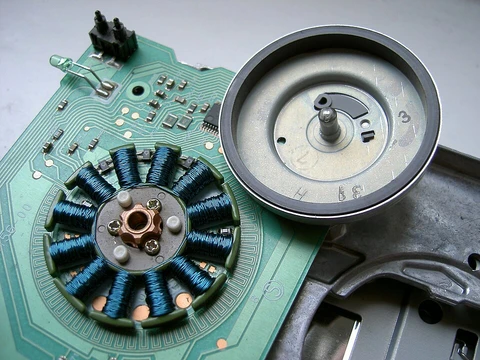
An AC motor is an electric motor driven by an alternating current (AC). It commonly consists of an outside stator with coils supplied with alternating current to produce a rotating magnetic field, and an inside rotor attached to the output shaft that produces a second rotating magnetic field. AC motors are notable for their widespread use in domestic and industrial applications, with the induction motor and synchronous motor being the two main types.
- Synchronous speed formula
- Ns = 120 * F / p
- Typical slip standard motors
- 2–3%
- Typical slip special motors
- up to 7%
- Torque motor slip
- 100% (0 rpm, full stall)
- Example four pole motor 60hz
- nameplate 1725 rpm at full load, calculated 1800 rpm
- First alternator creator
- Hippolyte Pixii
- First alternator year
- 1832
Lore & Background
Alternating current technology was rooted in Michael Faraday's and Joseph Henry's 1830–31 discovery that a changing magnetic field can induce an electric current. In 1832, Hippolyte Pixii generated a crude form of alternating current with the first alternator. The first person to conceive of a rotating magnetic field was Walter Baily, who demonstrated a battery-operated polyphase motor in 1879. French engineer Marcel Deprez published a paper in 1880 on the rotating magnetic field principle, though his design was flawed. Elihu Thomson built an AC motor in 1886 using the induction-repulsion principle, and Charles Schenk Bradley patented a two-phase AC power transmission in 1887. Commutatorless induction motors were independently invented by Galileo Ferraris and Nikola Tesla; Ferraris demonstrated a single-phase induction motor in 1885, and Tesla built a two-phase induction motor in 1887. Mikhail Dolivo-Dobrovolsky introduced the first three-phase induction motor in 1890, which became the prototype used in Europe and the U.S. The three-phase motor design was also worked on by Charles Eugene Lancelot Brown, Friedrich August Haselwander, and Jonas Wenström.
Reader's Guide
The AC motor's significance lies in its foundational role in modern electromechanical systems. The article describes two main types: induction motors, which rely on slip to induce rotor current and cannot produce torque near synchronous speed, and synchronous motors, which operate at exactly synchronous speed using permanent magnets, salient poles, or independently excited rotor windings. The induction motor, particularly the squirrel-cage rotor design, is found in virtually all domestic and light industrial AC motors. The speed of an AC motor is determined by the AC supply frequency and the number of stator poles, with slip increasing under load. Historically, speed was altered by switching additional coil sets, but power electronics now allow variable frequency control. The article also notes that AC linear motors operate on similar principles but produce linear motion. The legacy of AC motors includes their use in induction regulators, which are an exception where the rotating magnetic field is used as a pure electrical application. The three-phase induction motor, introduced by Dolivo-Dobrovolsky, became the standard prototype, and the brushless wound-rotor doubly fed synchronous motor can function at sub to super multiples of the supply frequency.
Did You Know?
- The first alternator was built by Hippolyte Pixii in 1832, consisting of a revolving horseshoe magnet passing over two wound-wire coils.
- Walter Baily demonstrated a battery-operated polyphase motor with a commutator in 1879 to the Physical Society of London.
- A typical four-pole motor running on 60 Hz has a calculated synchronous speed of 1800 rpm but a nameplate rating of 1725 rpm at full load.
More in Electric Motors, Part 3 1-24
Spotted an error? Know more?
Reader corrections go straight into our review queue. Suggest an edit · How this site is sourced