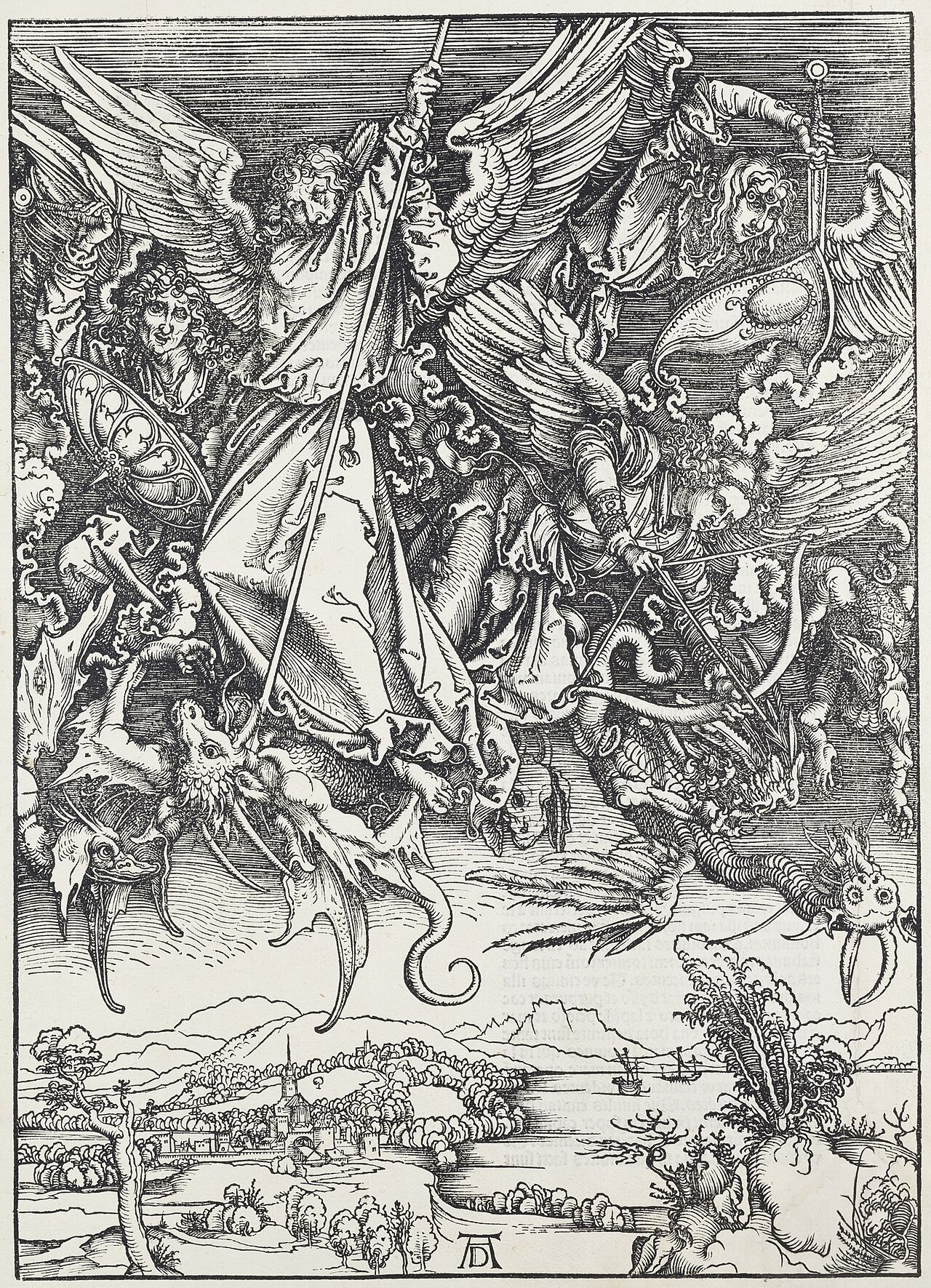
Saint Michael Fighting the Dragon
1498 woodcut by Albrecht Dürer from his Apocalypse series.

Albrecht Dürer · CC0
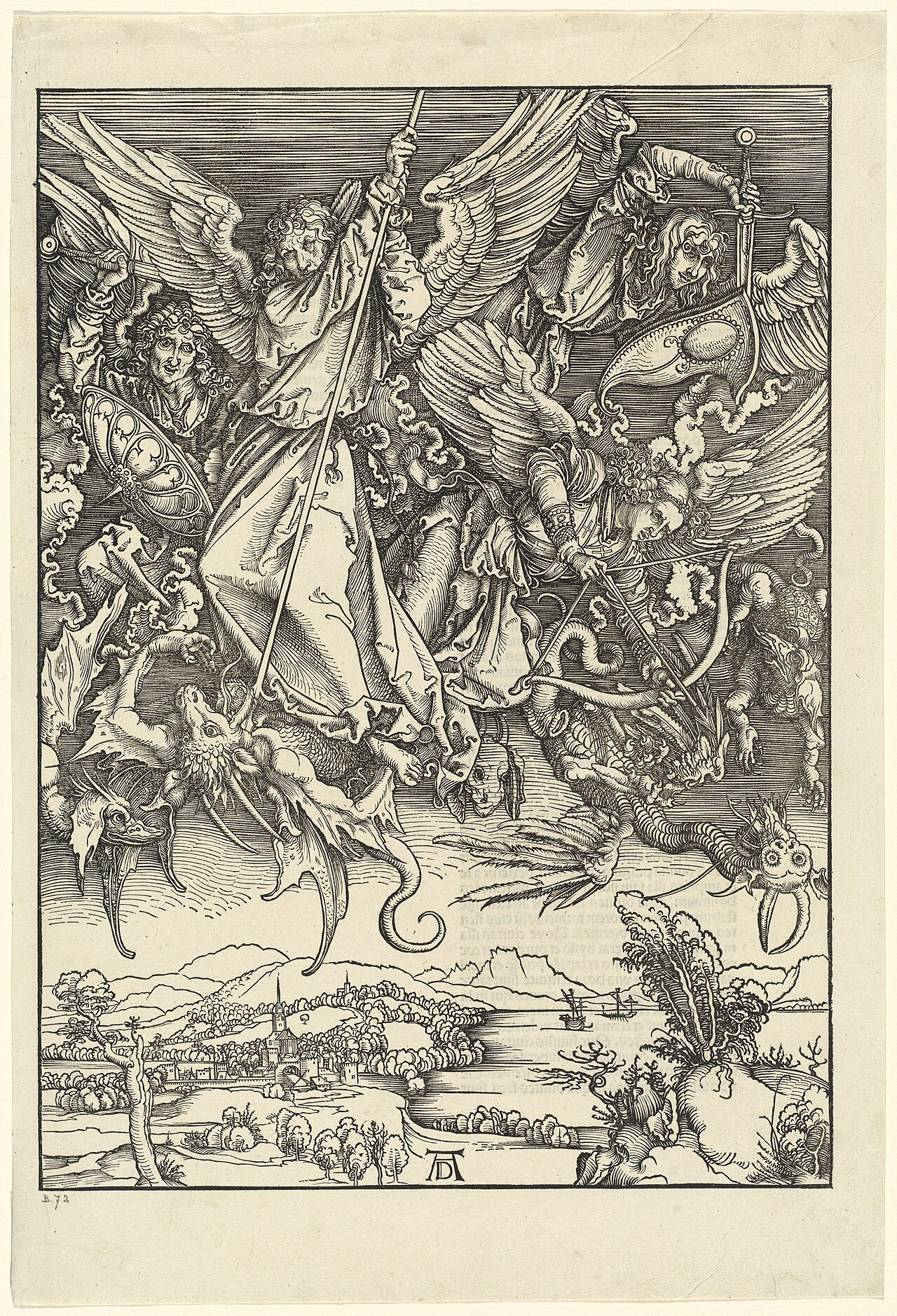
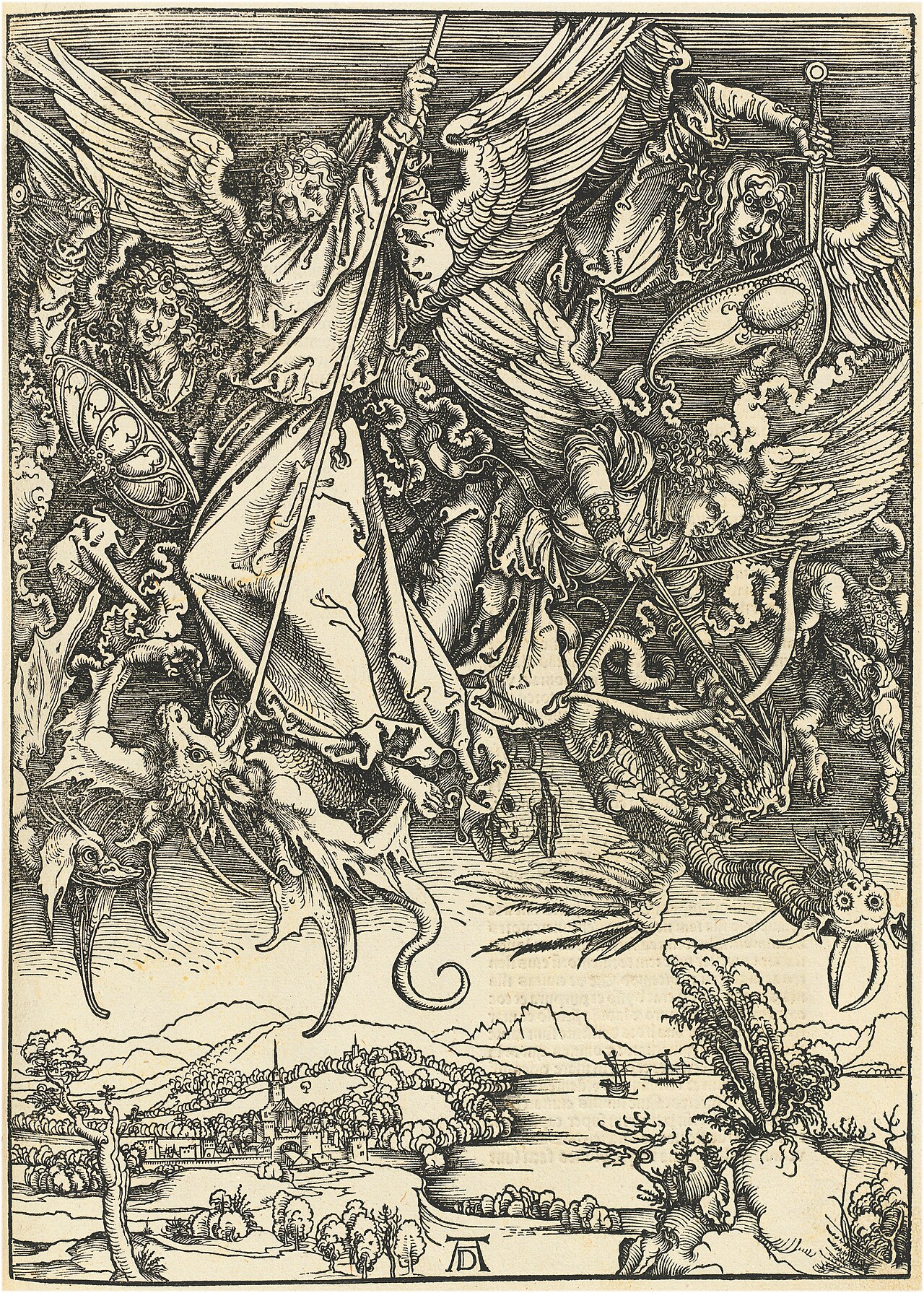
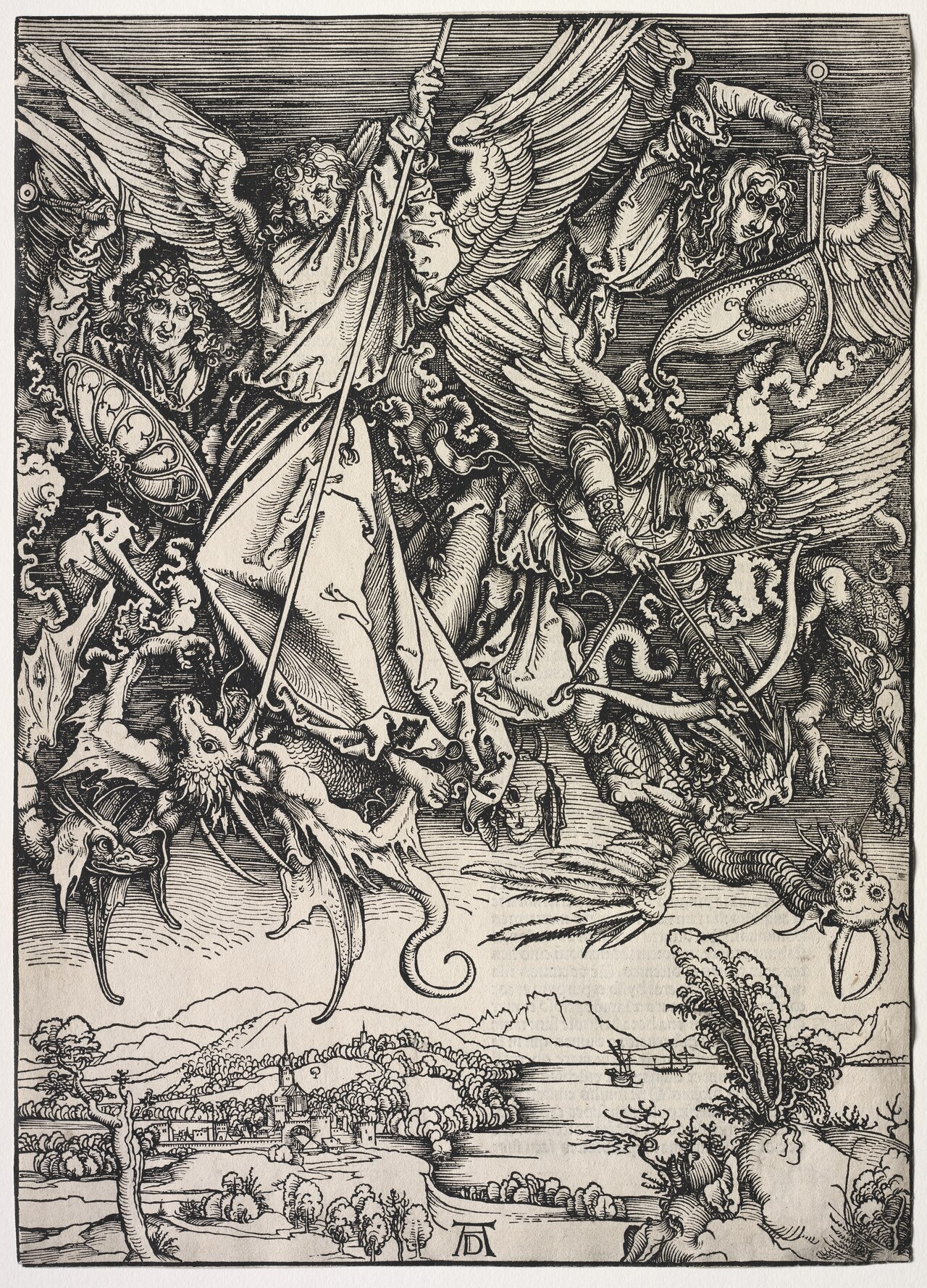
Saint Michael Fighting the Dragon is a woodcut of 1498 by Albrecht Dürer, part of his Apocalypse series, illustrating the Book of Apocalypse or Revelation of St. John. The image depicts the war in heaven between Archangel Michael and a seven-headed dragon, each head representing one of the seven deadly sins, with Michael thrusting his spear into one head while three other angels prepare to attack. Below the battle lies a calm landscape with mountains and a small town featuring a church with a tall spire.
- Artist
- Albrecht Dürer
- Year
- 1498
- Medium
- woodcut
- Series
- Apocalypse
- Subject
- Saint Michael fighting the dragon (Revelation 12:7)
- Material
- pear wood (original woodcuts)
- Monogram
- AD
Lore & Background
Albrecht Dürer considered printmaking one of the most important art forms, possibly equal to painting. His technical skill is demonstrated in the vast detail of Saint Michael Fighting the Dragon, from small trees to the furrowed brows of Michael. Dürer used atmospheric perspective to create depth, depicting distant mountains with less detail, and created light and dark tones through line work. He broke with traditional heroic poses, instead showing Michael in a pose that captures the magnitude of the task, thrusting a spear into the dragon's mouth.
Reader's Guide
Dürer's exposure to humanism during his 1494 trip to Italy, where he met Italian humanists and visited workshops of artists like Andrea Mantegna and Giovanni Bellini, influenced his fascination with human proportions, evident in this woodcut. The rise of Nuremberg as an intellectual center and leader in engravings, spurred by the 1493 Nuremberg Chronicle with illustrations from Dürer's teacher Michael Wolgemut, also shaped Dürer's work. Better printing presses in Nuremberg allowed for greater detail and easier distribution of his prints. Saint Michael Fighting the Dragon exemplifies Dürer's integration of humanist ideals and technical mastery, marking a significant contribution to printmaking and religious art of the period.
Did You Know?
- The dragon has seven heads, each representing one of the seven deadly sins.
- Dürer placed his distinctive 'AD' monogram at the bottom center of the page.
- All original woodcuts in the Apocalypse series were made on pear wood.
- Dürer broke with traditional heroic poses by depicting Saint Michael with furrowed brows and thrusting a spear into the dragon's mouth.
The Celestial Battle and Its Symbolic Architecture
The woodcut depicts the eschatological war described in Revelation 12:7, where Archangel Michael leads God's army against the dragon and its angels, who are ultimately cast out of heaven. Dürer seized the precise instant when Michael drives his spear into one of the creature's seven heads, each symbolizing a deadly sin. Three additional angels flank the archangel, poised to strike. What makes the composition striking is the contrast between the violent struggle above and the tranquil landscape below: rolling mountains, a small town, and a church with a tall spire sit undisturbed beneath the chaos. Dürer anchored the image with his familiar AD monogram at the bottom center, a signature he included across his engraved works. The scene transforms a theological narrative into a visually layered meditation on the triumph of good over evil, with the peaceful earth below suggesting the world that the celestial conflict ultimately protects.
Technical Brilliance and a New Heroic Language
Dürer regarded printmaking as an art form rivaling painting itself, and this woodcut on pear wood stands as a testament to that conviction. Trained under Michael Wolgemut, he carried forward a tradition of extraordinary detail, rendering everything from the tiny trees encircling the distant town to the individual curls of Michael's hair and the fine features of his face. He employed atmospheric perspective, softening the mountain forms as they recede to create convincing depth, while varying line density to produce a full range of light and shadow. Perhaps most boldly, Dürer departed from the conventional, graceful stance traditionally given to a hero battling evil. Instead, Michael's brow is knitted in fierce concentration, his hands grip the sword tightly, and his whole body conveys the sheer physical magnitude of the task. The result is a figure that feels less like an idealized icon and more like a warrior caught in the raw effort of combat.
Humanist Currents and the Italian Connection
By the late fifteenth century, humanist ideals rooted in Petrarch's fourteenth-century revival of classical learning had permeated European intellectual life. In northern Europe, Christian Humanists wove these values together with scriptural devotion, emphasizing both education and a deep engagement with sacred texts. Dürer absorbed this spirit during his autumn 1494 journey to Italy, where he conversed with Italian humanists and studied in the workshops of artists such as Andrea Mantegna and Giovanni Bellini. That exposure ignited a lasting preoccupation with the proportions and anatomy of the human body, a concern visible throughout his engravings, including the muscular tension in Michael's face and posture. Years later, in 1520 and 1521, Dürer visited the Netherlands and formed a friendship with Desiderius Erasmus, one of the era's foremost Christian Humanists. The woodcut thus sits at the intersection of scriptural illustration and a humanist fascination with the physical form, capturing both the spiritual drama of Revelation and the embodied reality of the figures within it.
Nuremberg as a Printmaking Powerhouse
The creation of this woodcut was inseparable from the broader cultural and technological momentum of Nuremberg in the 1490s. The city had already established its reputation for printmaking through the 1493 Nuremberg Chronicle, a landmark volume containing approximately 650 original illustrations produced by Michael Wolgemut and his workshop. That publication not only showcased the capabilities of the emerging printing press but also laid the groundwork for the next generation of artists. Dürer himself had apprenticed under Wolgemut, absorbing the technical disciplines of engraving from one of the era's most celebrated practitioners. Improvements in Nuremberg's printing technology enabled artists to render far greater detail—Dürer could depict the tiny sails of two distant boats or the individual curls framing Michael's face—and to distribute their work more widely. The city thus functioned as both an intellectual hub and a practical engine of artistic production, and the Apocalypse series, including this 1498 woodcut, emerged directly from that fertile environment.
Gallery
Frequently Asked Questions
What is Saint Michael Fighting the Dragon?
It is a 1498 woodcut by Albrecht Dürer that belongs to his Apocalypse series. The print visualizes the heavenly battle described in Revelation 12:7, in which the Archangel Michael confronts a multi-headed dragon.
What do the seven heads of the dragon represent in Dürer's print?
Each head stands for one of the seven deadly sins. Dürer shows Michael driving his spear into one head while three additional angels brace themselves to strike the others.
Which series does Saint Michael Fighting the Dragon belong to?
It is one plate in Dürer's Apocalypse series, a set of prints illustrating key scenes from the Book of Revelation. The series, finished around 1498, is widely regarded as a landmark of Northern Renaissance printmaking.
Why is there a calm landscape beneath the heavenly battle?
The serene valley with mountains, a small town, and a church bearing a tall spire contrasts sharply with the violent struggle above. It grounds the cosmic conflict in an earthly setting, hinting that the battle's outcome reaches down into the human world.
What material was the original woodcut block carved from?
Dürer cut the image into a block of pear wood, a material favored for fine woodcut printing in the late fifteenth century. Its fine grain allowed the crisp, detailed linework that characterizes the finished print.
More in Dragons in art 1-20
Spotted an error? Know more?
Reader corrections go straight into our review queue. Suggest an edit · How this site is sourced