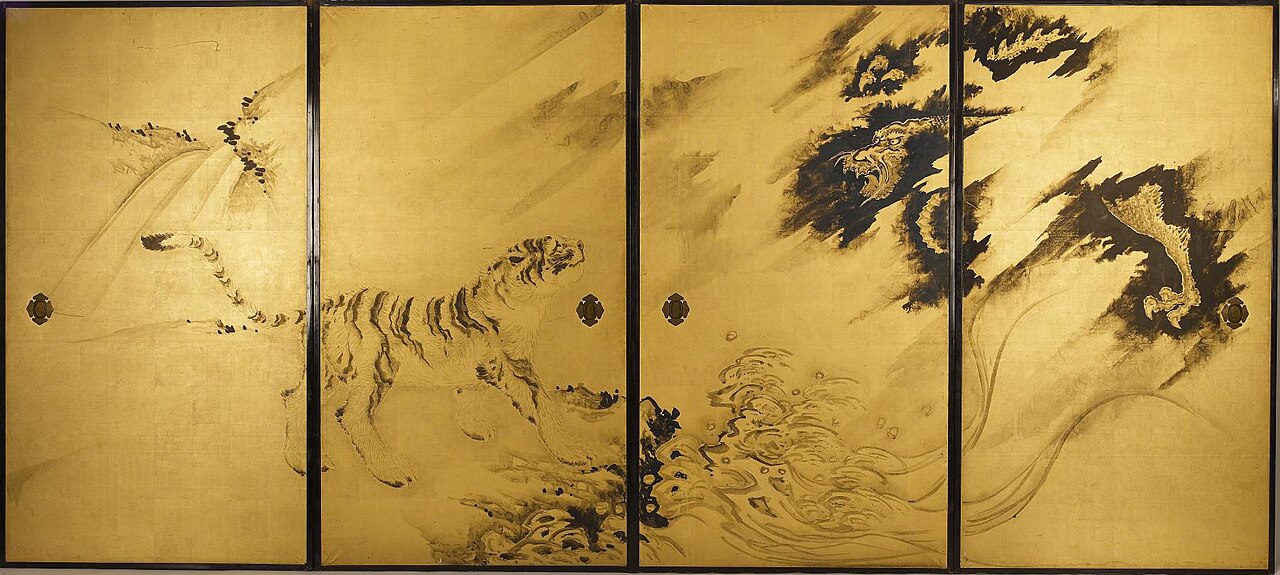
Dragon Fusuma
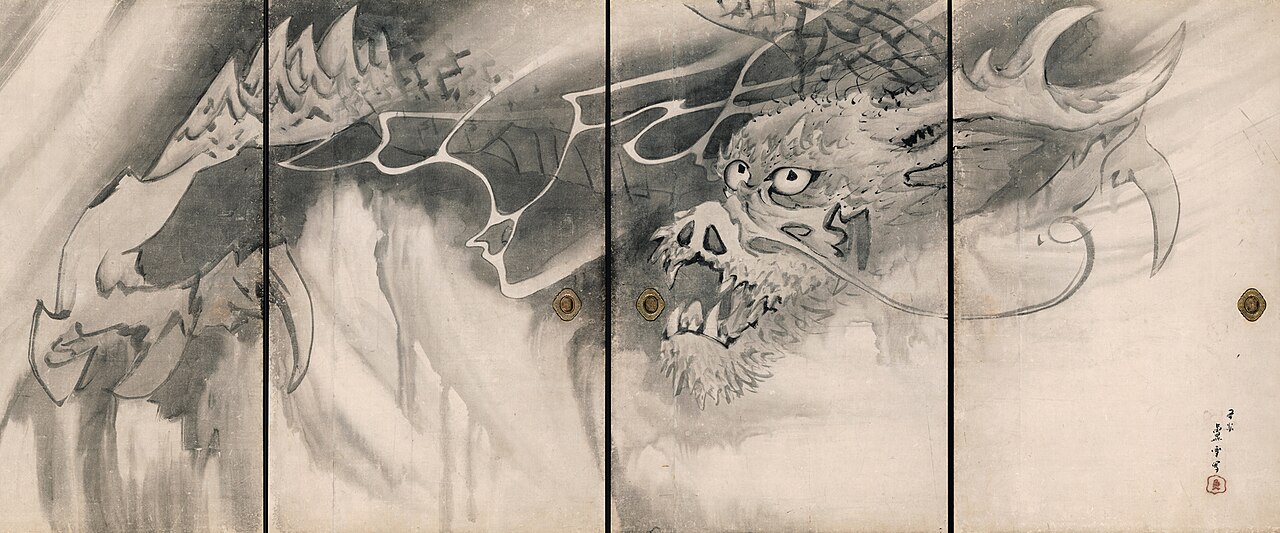
Edo-period ink dragon on sliding door, painted in 1786.

Sidney McCall · Public domain
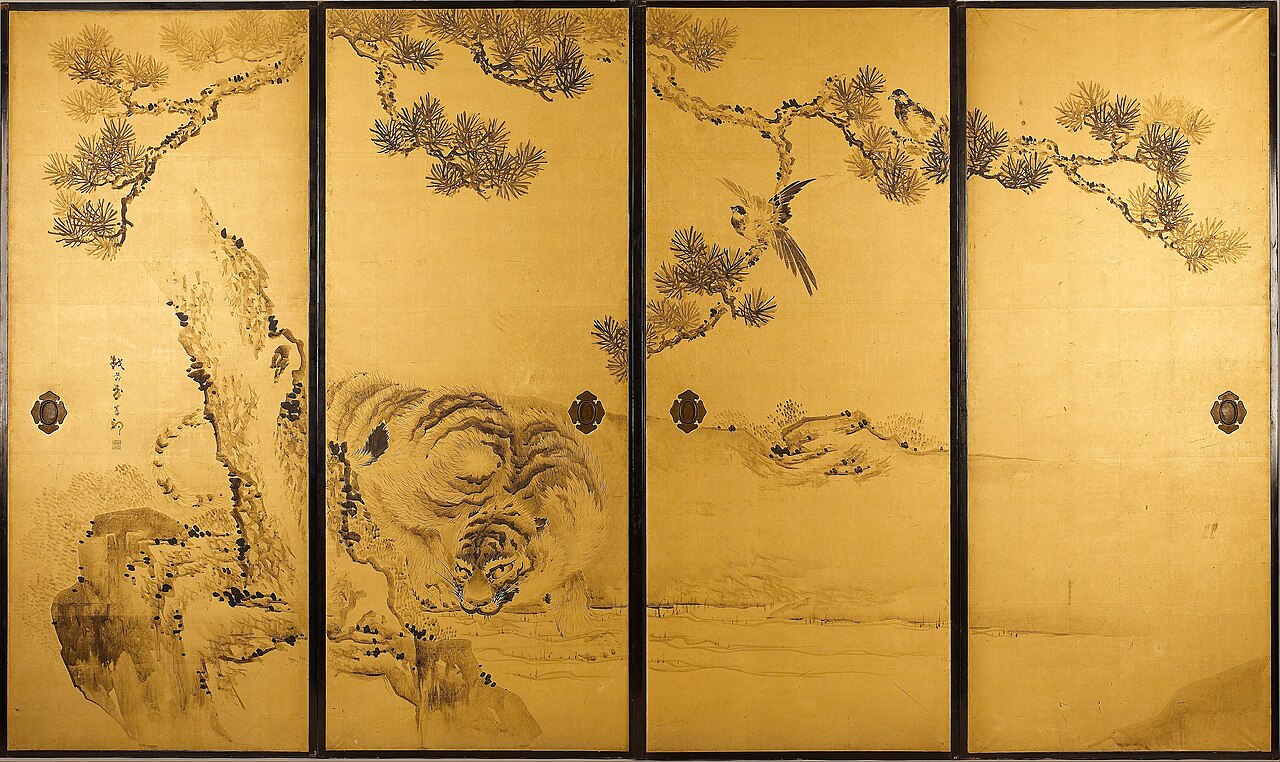
The Dragon Fusuma (龍図襖, Ryū zu Fusuma) is an Edo period sliding door ink painting created in 1786 by artist Nagasawa Rosetsu, a student of Maruyama Ōkyo of the Maruyama school in Kyoto. It is a counterpart to the Tiger Fusuma, painted adjacent to it, and is classified as a Prefectural Cultural Property of Wakayama. The work is housed at Muryō-ji in Kushimoto, Wakayama.
Quick Facts
- Title
- Dragon Fusuma
- Artist
- Nagasawa Rosetsu
- Year
- 1786
- Subject
- Dragon on Fusuma
- Dimensions
- Right Four Sides: 183.5 x 115.5 cm each / Left Two Sides: 180.0 x 87.0 cm each
- Designation
- Important Cultural Property (Japan)
- Museum
- Kushimoto Ōkyo Rosetsu Art Museum, Muryō-ji
- City
- Kushimoto, Wakayama Prefecture
Facts from the source article.
Lore & Background
In 1786, Rosetsu left his residence of Kyoto—though the exact reason is not definitively recorded as a direct order from Ōkyo—and conducted commissions for Muryō-ji, Sodo-ji, and Joju-ji. Local legend has it that he completed the Tiger Fusuma and the Dragon Fusuma in one night. The Dragon Fusuma corresponds to the Tiger Fusuma on the opposite side of Muryō-ji's Buddhist altar room, in the East Hall. It is composed of six panels, with the main detail on the four panels of the fusuma. The front half of the dragon's body dominates the canvas, with only the front claw and its head peeping out of the mist, staring back, depicted in black ink, as to convey the size and scale of the dragon.
Reader's Guide
Prior to his stay in Muryō-ji, Rosetsu completed another Dragon Fusuma panel at Saiko-ji, in Matsue, Shimane Prefecture. In Wakayama, however, he was able to scale up and produce his own independent style that diverges from his school's work along with his previous styles. The pair of fusuma, as iconic pieces of Rosetsu's work, have been frequently exhibited together when taken abroad, including multiple exhibitions around Japan, such as at the Aichi Prefectural Museum of Art in 2017. From 6 September to 4 November 2018, both panels from Muryō-ji spent time abroad on special exhibit at the Rietberg Museum in Zürich as part of a retrospective exhibit of his works. Subsequently, from 7 October to 3 December 2023, the first retrospective of his works in Osaka University including the panels were put on display at the Nakanoshima Museum of Art.
Did You Know?
- The Dragon Fusuma was painted in 1786 by Nagasawa Rosetsu, a student of Maruyama Ōkyo.
- Local legend claims Rosetsu completed both the Tiger Fusuma and Dragon Fusuma in one night.
- The dragon is depicted in black ink, with only its front claw and head emerging from mist.
- The work is classified as a Prefectural Cultural Property of Wakayama and housed at Muryō-ji in Kushimoto, Wakayama.
The Commission and the Legend
In the year 1786, Nagasawa Rosetsu—a Kyoto-based painter trained under the renowned Maruyama Ōkyo—undertook a journey that would produce one of his most celebrated works. Acting on the direct request of his teacher Ōkyo, Rosetsu departed his Kyoto residence to fulfill painting commissions at three temples: Muryō-ji, Sodo-ji, and Joju-ji. It was during this sojourn at Muryō-ji in Kushimoto, Wakayama, that he produced the Dragon Fusuma alongside its companion piece, the Tiger Fusuma. A local legend that has persisted since that era claims Rosetsu finished both the tiger and the dragon panels in a single night, lending an almost mythic quality to the creation of these works. The story underscores how the painting emerged not from a quiet studio in Kyoto but from a period of active, itinerant work at sacred sites, where the demands of temple decoration and the artist's personal ambition converged to produce something extraordinary.
Composition and Artistic Breakthrough
The Dragon Fusuma is structured across six panels, with the principal imagery concentrated on the four central fusuma panels. Rather than depicting the full serpentine body of the dragon, Rosetsu chose to show only the front half of the creature, its massive form filling the canvas while the head and a single front claw emerge from swirling mist, gazing back at the viewer. Rendered entirely in black ink, this partial reveal is a deliberate compositional strategy: by withholding the dragon's full length, the artist conveys an overwhelming sense of scale and mystery. This approach marked a significant departure from Rosetsu's earlier work. Before his Wakayama commission, he had painted a smaller dragon panel at Saiko-ji in Matsue, Shimane Prefecture. However, the larger format and the freedom of the temple setting allowed him to scale up his vision and forge an independent visual language that broke away from the conventions of the Maruyama school and his own prior styles.
Sacred Setting and Cultural Designation
The Dragon Fusuma occupies a specific and reverent position within the East Hall of Muryō-ji, a Zen temple in Kushimoto, Wakayama Prefecture. It is positioned directly opposite the Buddhist altar room, where its counterpart—the Tiger Fusuma—hangs on the adjacent wall, creating a paired composition that frames the sacred space. Together, these two ink paintings form a visual dialogue of opposing mythological creatures, a pairing that has become inseparable in both artistic and devotional contexts. The painting holds the formal designation of Important Cultural Property (jūyō bunkazai), a classification that recognizes its outstanding artistic and historical value within Japan's cultural heritage framework. It is housed in the Kushimoto Ōkyo Rosetsu Art Museum, an institution that forms part of the Muryō-ji temple complex. This institutional home ensures that the work remains accessible to the public while preserving its connection to the very temple for which it was originally commissioned in the late eighteenth century.
Exhibition Journey and Enduring Iconic Status
As one of the most recognizable works in Nagasawa Rosetsu's oeuvre, the Dragon Fusuma has traveled extensively, almost always accompanied by its Tiger Fusuma counterpart. The pair has been featured in numerous exhibitions across Japan, including a notable showing at the Aichi Prefectural Museum of Art in 2017. Their international reach expanded significantly when both panels were loaned to the Rietberg Museum in Zürich, Switzerland, for a retrospective of Rosetsu's works that ran from 6 September to 4 November 2018. More recently, the panels featured in the first-ever retrospective of his works in Osaka, displayed at the Nakanoshima Museum of Art in connection with Osaka University from 7 October to 3 December 2023. These repeated journeys—across prefectures, across oceans—attest to the painting's status as an iconic touchstone of Edo-period ink art, one that continues to draw audiences and scholars to Rosetsu's singular vision more than two centuries after its creation.
Gallery
Frequently Asked Questions
What is Dragon Fusuma?
Dragon Fusuma is a monochrome ink painting of a swirling dragon rendered on a traditional Japanese sliding door (fusuma). It was produced in 1786 during the Edo period and is a prime example of dynamic brushwork applied to an architectural element.
Who painted Dragon Fusuma?
The work was executed by Nagasawa Rosetsu, a Kyoto-based artist who studied under the celebrated Maruyama Ōkyo and practiced within the Maruyama school of painting.
Where is Dragon Fusuma kept today?
The painting is preserved at Muryō-ji, a temple in Kushimoto, Wakayama Prefecture. It carries the official designation of a Prefectural Cultural Property of Wakayama, which protects it from damage or removal.
How does Dragon Fusuma relate to Tiger Fusuma?
Dragon Fusuma was created as the companion piece to the Tiger Fusuma, and the two doors were installed directly adjacent to one another. Together they form a paired set of Edo-period ink paintings celebrating powerful animals.
Why does Dragon Fusuma matter to art history?
It is a rare surviving instance of 18th-century Maruyama-school ink technique applied to a functional architectural surface rather than a scroll or panel. Its protected cultural-property status reflects the consensus among Japanese authorities that the work represents a significant link to Ōkyo's artistic legacy.
More in Dragons in art 1-20
Spotted an error? Know more?
Reader corrections go straight into our review queue. Suggest an edit · How this site is sourced