Flag of Bhutan
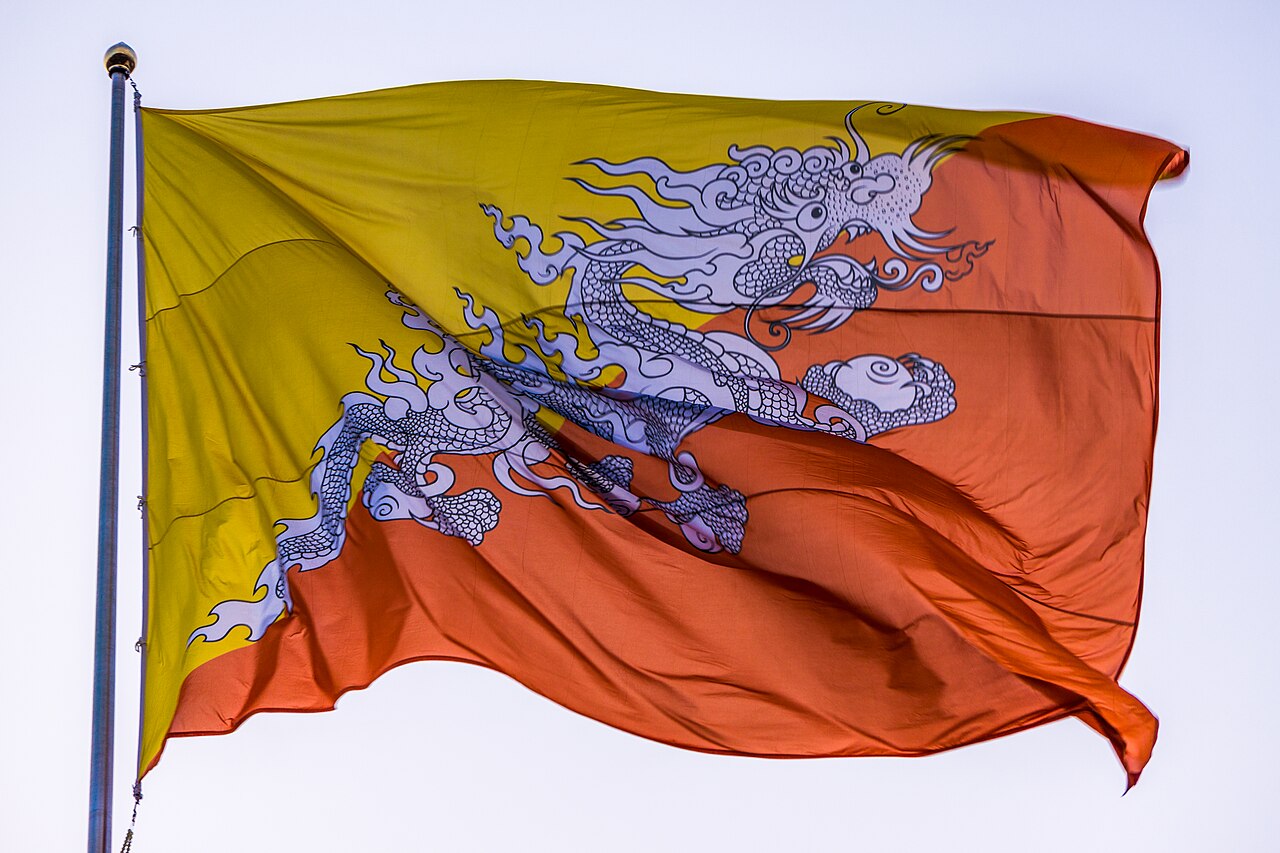
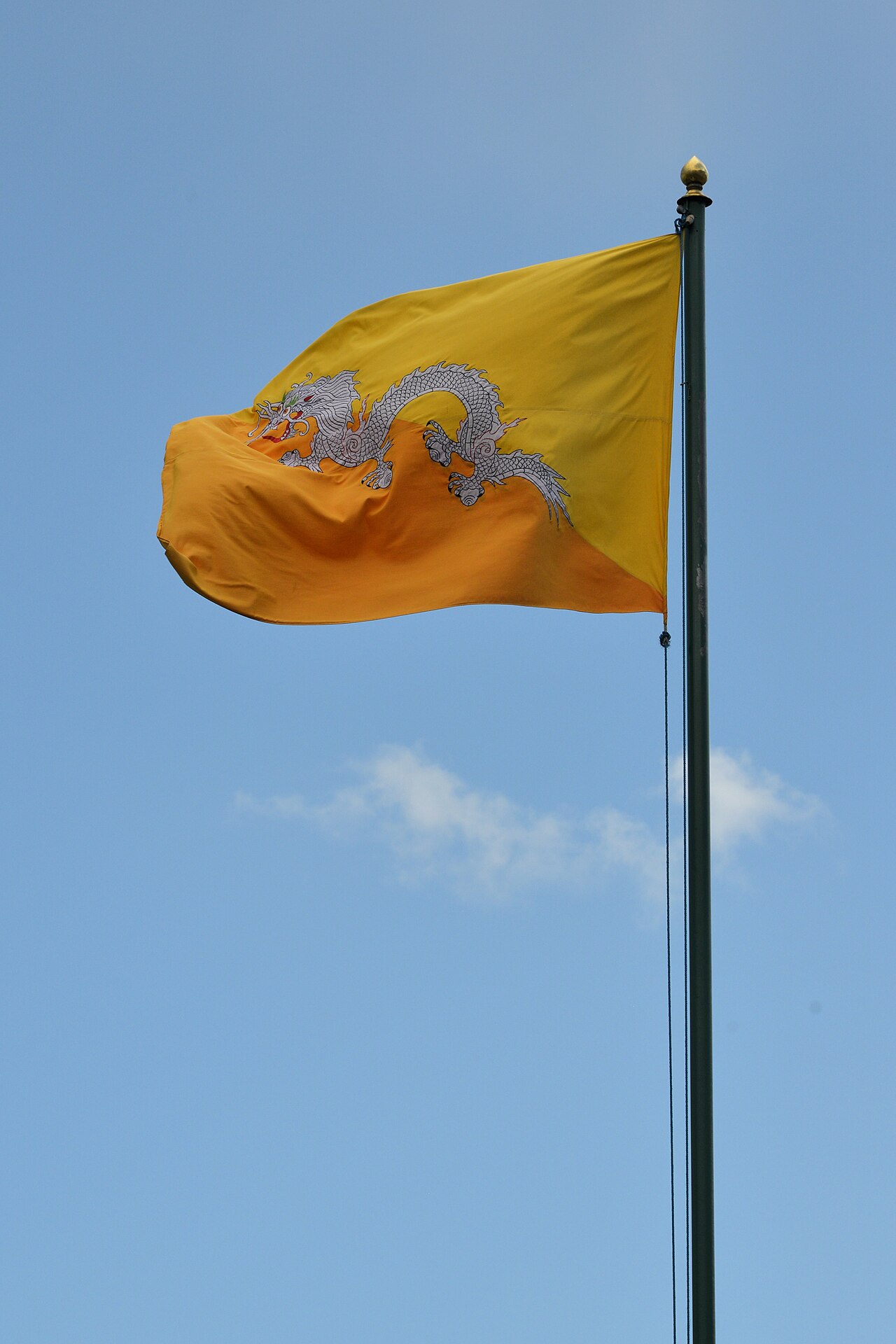
National flag of Bhutan, featuring the Thunder Dragon.

Christopher J. Fynn · CC BY-SA 4.0
The national flag of Bhutan (Dzongkha: འབྲུག་ཡུལ་རྒྱལ་དར) is a national symbol. It shows the Druk, a dragon from Bhutanese mythology, which references the country's Dzongkha name, Druk Yul, meaning "The Thunder Dragon Kingdom," and also the Drukpa Lineage of Tibetan Buddhism, Bhutan's main religion. The flag's original design was created by Mayum Choying Wangmo Dorji in 1947. A version appeared in 1949 at the signing of the Indo-Bhutan Treaty. A second version, based on photos of the 1949 flag and featuring a white Druk instead of the original green, was introduced in 1956 for a visit by Druk Gyalpo Jigme Dorji Wangchuck to eastern Bhutan. The current design was created by Dasho Shingkhar Lam, secretary to the third king, who was asked to redesign the flag. It has remained unchanged since 1969. The design was adjusted to match the proportions of the flag of India, which was thought to flutter better. Other changes, including switching the red background to orange, led to the final version. In 1972, the National Assembly of Bhutan codified a code of conduct to formalize the existing design and establish rules for acceptable sizes and flying conditions, without altering the design itself.
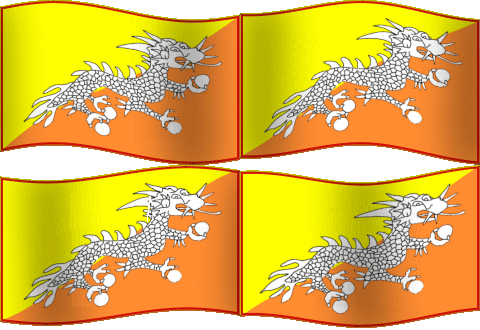
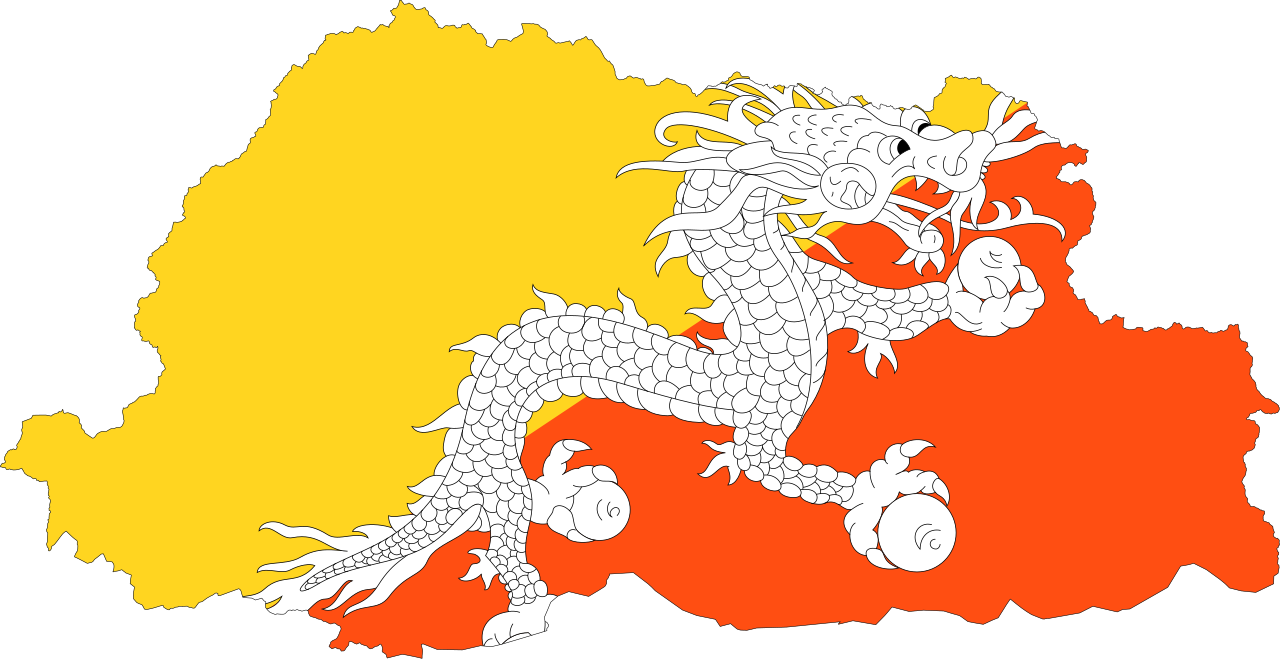
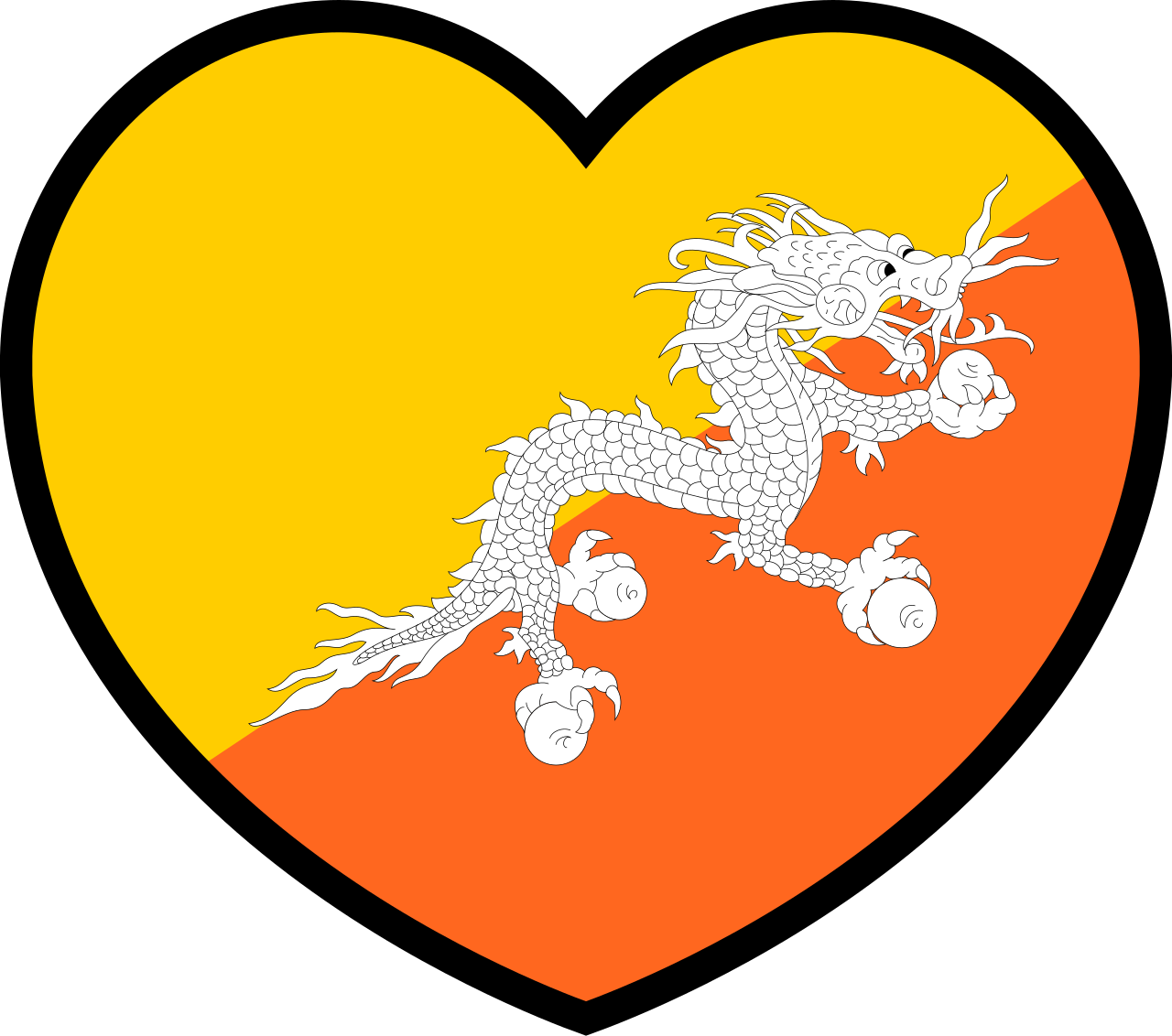
The current flag is divided diagonally from the lower hoist-side corner, with a yellow upper triangle and an orange lower triangle. A large black and white dragon, facing away from the hoist, is centered along the dividing line. The dragon holds a norbu, or jewel, in each claw. The yellow and orange background colors are Pantone 116 and 165, respectively, with other matching system equivalents specified for the dragon's white. The flag must have a 3:2 ratio. Standard sizes declared by the government are 21 ft × 14 ft, 12 ft × 8 ft, 6 ft × 4 ft, 3 ft × 2 ft, and 9 in × 6 in for car flags.
According to a 1972 National Assembly resolution, restated in the 2008 Constitution, the yellow signifies civil tradition and temporal authority embodied in the Druk Gyalpo, whose royal garb includes a yellow kabney (scarf). The orange half represents Tibetan Buddhist spiritual tradition, especially the Drukpa Kagyu and Nyingma schools. The dragon spreads equally over the line between the colors, signifying the equal importance of civic and monastic traditions and the bond between sovereign and people.
Quick Facts
- Use
- 111000
- Symbol
- 111000 normal Mirror
- Proportion
- 2:3
- Designer
- Mayum Choying Wangmo Dorji and Dasho Shingkhar Lam Kuenzang Wangchuk
Facts from the source article.
Lore & Background
The first national flag was designed upon the request of Jigme Wangchuck, the second Druk Gyalpo, and introduced in 1949 during the signing of the Indo-Bhutan Treaty. The design is credited to Mayum Choying Wangmo Dorji in 1947, and Lharip Taw Taw is said to have embroidered the flag. The original flag was a bicolour square divided diagonally, with a green Druk, but black-and-white photos from 1949 show discrepancies with the CBS document's description, such as the flag's proportions appearing closer to 4:5 and the dragon facing the hoist rather than the fly.
Reader's Guide
The flag of Bhutan is a key national symbol, representing the country's identity as the Thunder Dragon Kingdom. Its design evolved from a square green-dragon flag to the current rectangular orange-and-yellow flag with a white dragon, influenced by the desire for better fluttering similar to the flag of India. The dragon's placement over the diagonal line signifies the equal importance of civic and monastic traditions, while the yellow and orange represent temporal authority and Buddhist spiritual tradition, respectively. The flag's protocol was codified by the National Assembly in 1972, and it remains a central emblem of Bhutanese sovereignty and cultural heritage.
Did You Know?
- The flag's basic design dates to 1947, created by Mayum Choying Wangmo Dorji.
- A version of the flag was displayed in 1949 at the signing of the Indo-Bhutan Treaty.
- The dragon's colour was changed from green to white in 1956.
- The flag's dimensions were altered to match the measurements of the flag of India.
Origins and Design Evolution
The flag's story begins in 1947, when Mayum Choying Wangmo Dorji conceived the basic design at the request of Jigme Wangchuck, the second Druk Gyalpo of that era. The first physical version was embroidered by Lharip Taw Taw, one of the few court painters available, and it featured a green dragon—a nod to the traditional Dzongkha term yu druk ngon ma, meaning 'turquoise druk.' This inaugural banner was unfurled in 1949 during the signing of the Indo-Bhutan Treaty. A revised edition appeared in 1956 for the eastern Bhutan visit of Druk Gyalpo Jigme Dorji Wangchuck, reconstructed from photographs of the 1949 original but swapping the green dragon for a white one. The definitive redesign came through Dasho Shingkhar Lam Kuenzang Wangchuk, secretary to the third king, who was tasked with creating a new version. The team adjusted proportions to mirror India's flag, reasoning it fluttered more gracefully, and shifted the red field to orange. The result, in continuous use since 1969, is the flag Bhutan knows today.
Symbolism and Meaning
Every element of the flag carries deliberate meaning. The yellow upper triangle, specified as Pantone 116, represents civil tradition and the temporal authority of the Druk Gyalpo, the Dragon King, whose ceremonial attire traditionally includes a yellow kabney scarf. The orange lower triangle, Pantone 165, honours the spiritual heritage of Tibetan Buddhism, specifically the Drukpa Kagyu and Nyingma schools that dominate Bhutanese religious life. The dragon itself straddles the diagonal dividing line, signifying that civic and monastic traditions hold equal weight in the Kingdom of Druk and reflecting the sacred bond between ruler and subjects. Its white colour speaks to the purity of thought and action that unites Bhutan's ethnically and linguistically diverse population. In each claw the Druk grips a norbu jewel, symbolising national wealth and the protection of its people, while its snarling mouth conveys the deities' fierce commitment to guarding the kingdom.
Official Codification and Protocol
The flag's legal status was formalised in 1972 when the National Assembly of Bhutan adopted a code of conduct through Resolution 28 of its 36th Session, held on 8 June of that year. This document locked down the exact design, prescribed acceptable flag sizes, and established the conditions under which the banner may be flown. The same provisions were later restated in Bhutan's 2008 Constitution, embedding the flag's specifications into the nation's supreme law. The flag must maintain a strict 3:2 width-to-height ratio, and the government has declared five standard dimensions: 21 by 14 feet, 12 by 8 feet, 6 by 4 feet, 3 by 2 feet, and a compact 9 by 6 inch version intended for vehicle flags. The background colours are precisely identified as Pantone 116 for yellow and Pantone 165 for orange, with equivalent values provided under other colour-matching systems to ensure consistency across reproductions.
Historical Documentation and Sources
Understanding how the flag evolved is complicated by the scarcity of surviving records. The most comprehensive account comes from a 2002 paper published by the Centre for Bhutan Studies and GNH Research, an independent Bhutanese institution. That document relies heavily on first-hand interviews with individuals who personally participated in creating and modifying the flag between the late 1940s and the adoption of the current design around 1970. Because it draws on these oral testimonies alongside the handful of existing government records, it stands as a vital primary source for an otherwise poorly documented history. However, the paper's description of the 1949 flag does not fully align with the black-and-white photographs taken at the Indo-Bhutan Treaty signing. For instance, the document calls the flag 'square,' yet the photos suggest proportions closer to 4:5, and it states the dragon faced the fly end while the images show it oriented toward the hoist. A modern reproduction of the original, adapted to reflect the contemporary design, now hangs behind the throne in the National Assembly Hall in Thimphu.
Gallery

Frequently Asked Questions
Who is the dragon featured on the Flag of Bhutan?
The Druk is a mythical thunder dragon drawn from Bhutanese folklore, and it serves as the nation's central heraldic symbol. It embodies the country's very name, Druk Yul, which translates to 'Thunder Dragon Kingdom.'
What does the Druk look like on the Flag of Bhutan?
The dragon is rendered in white, shown in a coiled pose with four claws, each clutching a norbu (treasure jewel). It sits against a diagonal split background of yellow (Pantone 116) and orange (Pantone 165).
Who created the dragon design on the Flag of Bhutan?
Mayum Choying Wangmo Dorji produced the original 1947 concept, and the version seen today was finalized by Dasho Shingkhar Lam. The current design was officially adopted in 1969 and codified in 1972.
Why is the Druk dragon culturally important to Bhutan?
Beyond naming the country, the dragon ties into the Drukpa Lineage, the dominant school of Tibetan Buddhism practiced there. It functions as both a spiritual and national identity marker.
What are the flag's proportion and color scheme?
The flag uses a 3:2 ratio and features three colors: yellow, orange, and white. The white Druk holding norbu jewels is the sole figurative element on the field.
More in Dragons in art 1-20
Spotted an error? Know more?
Reader corrections go straight into our review queue. Suggest an edit · How this site is sourced