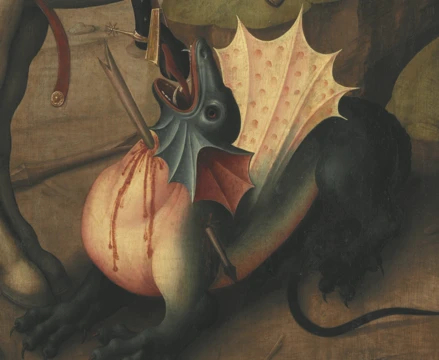
Dragon (M. C. Escher)
Wood engraving of a folded paper dragon biting its tail.

Charles J. Sharp · CC BY-SA 4.0
M. C. Escher's *Dragon* (1952) is a wood engraving that shows a paper dragon, folded and resting on a heap of crystals. The work belongs to a series of Escher prints that explore ambiguous dimensionality, alongside pieces like *Three Spheres I*, *Doric Columns*, *Drawing Hands*, and *Print Gallery*. Escher himself noted that the dragon, though confined to two dimensions, stubbornly behaves as if it has three. Two slits cut into the paper—similar to kirigami—reveal the creature's flatness: its head and neck push through one opening, its tail through the other, and the head bites the tail in the shape of an ouroboros. In *Gödel, Escher, Bach*, Douglas Hofstadter reads this tail-bite as a symbol of self-reference, and the dragon's failure to become fully three-dimensional as a visual metaphor for the impossibility of "jumping out of the system." The image has also been cited in scientific writing as a cautionary example of what can go wrong when trying to describe four-dimensional space-time with higher dimensions. Copies of the print are held by the U.S. National Gallery of Art and the National Gallery of Canada.
Quick Facts
- Title
- Dragon
- Artist
- M. C. Escher
- Year
- 1952
- Height Metric
- 32
- Metric Unit
- cm
Facts from the source article.
Lore & Background
Escher wrote that 'this dragon is an obstinate beast, and in spite of his two-dimensions he persists in assuming that he has three.' Two slits in the paper from which the dragon is folded open up like kirigami, forming holes that make the dragon's two-dimensional nature apparent. His head and neck pokes through one slit, and the tail through the other, with the head biting the tail in the manner of the ouroboros.
In Gödel, Escher, Bach, Douglas Hofstadter interprets the dragon's tail-bite as an image of self-reference, and his inability to become truly three-dimensional as a visual metaphor for a lack of transcendence, the inability to 'jump out of the system.' The same image has also been called out in the scientific literature as a warning about what can happen when one attempts to describe four-dimensional space-time using higher dimensions.
A copy of this print is in the collections of U.S. National Gallery of Art and the National Gallery of Canada.
Reader's Guide
Dragon is a notable work within Escher's sequence of images exploring ambiguous dimension, alongside Three Spheres I, Doric Columns, Drawing Hands, and Print Gallery. The print's self-referential ouroboros motif has been interpreted by Douglas Hofstadter as a symbol of self-reference and a metaphor for the inability to transcend a system. In scientific literature, the image has been cited as a cautionary example regarding attempts to describe four-dimensional space-time using higher dimensions. The work's presence in major museum collections underscores its enduring relevance in art and interdisciplinary thought.
Did You Know?
- The dragon is folded from paper with two slits that open like kirigami, revealing its two-dimensional nature.
- Escher described the dragon as 'an obstinate beast' that persists in assuming it has three dimensions despite being two-dimensional.
- Douglas Hofstadter interpreted the dragon's tail-bite as an image of self-reference in Gödel, Escher, Bach.
The Craft of a Paper Beast
Dragon (Dutch: Draak) is a wood engraving that M. C. Escher completed in April 1952. The image presents a dragon rendered as though it were folded from a single sheet of paper, perched atop a cluster of crystals. What makes the composition so striking is the way Escher reveals the creature's flatness through two deliberate slits cut into the paper. These openings behave almost like kirigami, splitting open to expose the dragon's fundamentally two-dimensional construction. The head and neck thread through one gap while the tail emerges from the other, and the head locks onto the tail in the ancient ouroboros gesture. The result is a paradox made visible: a creature that appears to occupy three-dimensional space yet is continuously betrayed by the flat sheet from which it is cut. Escher himself described the dragon as an obstinate beast that, despite being limited to two dimensions, stubbornly insists on behaving as though it possesses a third.
A Thread Through Escher's Dimensional Obsessions
The 1952 dragon is not an isolated experiment. It belongs to a broader sequence of prints in which Escher explored objects whose dimensionality resists easy classification. Fellow works in this family include Three Spheres I, Doric Columns, Drawing Hands, and Print Gallery, each of which plays with the boundary between two and three dimensions or with the impossibility of certain spatial relationships. The dragon fits naturally into this lineage: it is a creature that straddles the plane and the volume, that seems to occupy space yet is perpetually flattened back into the sheet. By grouping these images together, Escher reveals a sustained intellectual project rather than a single clever trick. The dragon, with its paper body and crystal perch, crystallizes the recurring question that runs through his mid-century output: what happens when a form insists on a dimension it does not actually possess?
Self-Reference and the Limits of Systems
The dragon's most celebrated reading comes from Douglas Hofstadter, who in Gödel, Escher, Bach treats the tail-bite as a visual emblem of self-reference. The creature gnaws its own tail, a closed loop that mirrors the way a formal system can contain a description of itself. More pointedly, Hofstadter reads the dragon's failure to become genuinely three-dimensional as a metaphor for the inability to transcend one's own framework, the impossibility of jumping out of the system. The beast is trapped in the plane no matter how convincingly it mimes volume. This interpretation has resonated well beyond art history. In scientific literature, the same image has been invoked as a cautionary illustration of what goes wrong when one tries to model four-dimensional space-time by reaching into still higher dimensions: the act of description can become a trap, and the observer remains locked inside the very structure they are attempting to map.
A Print in Permanent Residence
Though Escher produced Dragon as a single wood engraving in 1952, its afterlife has been secured through institutional collecting. Copies of the print now reside in the permanent collections of two major national galleries: the National Gallery of Art in Washington, D.C., and the National Gallery of Canada. Their presence in these repositories signals that the image has crossed from the niche of printmaking enthusiasts into the broader canon of twentieth-century visual art. For visitors in Washington or Ottawa, the dragon is no longer a curiosity about paper and dimension but a recognized artifact of modern artistic thought, sitting alongside works that explore perception, logic, and the boundaries of representation. The fact that two national institutions have deemed it worthy of long-term stewardship underscores how a small, flat, folded creature can carry philosophical weight that outlasts its medium.
Gallery
Frequently Asked Questions
What is Dragon (M. C. Escher)?
It is a 1952 wood engraving by Dutch artist M. C. Escher that depicts a paper dragon folded into a compact shape and perched on a cluster of crystals. The creature's head and neck thread through one cut slit in the sheet while its tail exits through a second, and the head clamps down on the tail in an ouroboros-like loop.
What medium and date are associated with Dragon (M. C. Escher)?
Escher produced the image as a wood engraving print, a technique in which the design is carved into a wooden block before being inked and pressed onto paper. The work was completed in April 1952.
What is the central concept behind Dragon (M. C. Escher)?
The print stages a conflict between flatness and volume: the dragon is literally a two-dimensional sheet of paper, yet its posture and the way it pushes through two slits make it seem to occupy solid three-dimensional space. Escher himself remarked that the creature stubbornly behaves as though it has a third dimension despite being confined to a plane.
Which other prints belong to the same series as Dragon (M. C. Escher)?
It is part of Escher's 'objects of ambiguous dimension' group, which also includes Three Spheres I, Doric Columns, Drawing Hands, and Print Gallery. Each piece in that set interrogates how a flat surface can suggest, contradict, or collapse spatial depth.
Why is Dragon (M. C. Escher) significant in the study of dragons in art?
It strips the dragon down to a folded sheet of paper, turning the mythical creature into a vehicle for exploring geometry, perception, and dimensionality rather than narrative or heraldic power. Its two-slit construction, reminiscent of kirigami, also draws a bridge between Western printmaking traditions and East Asian paper-folding techniques.
More in Dragons in art 1-20
Spotted an error? Know more?
Reader corrections go straight into our review queue. Suggest an edit · How this site is sourced