Paumgartner altarpiece
Early Dürer triptych damaged by acid in 1988.

Albrecht Dürer · CC BY-SA 4.0
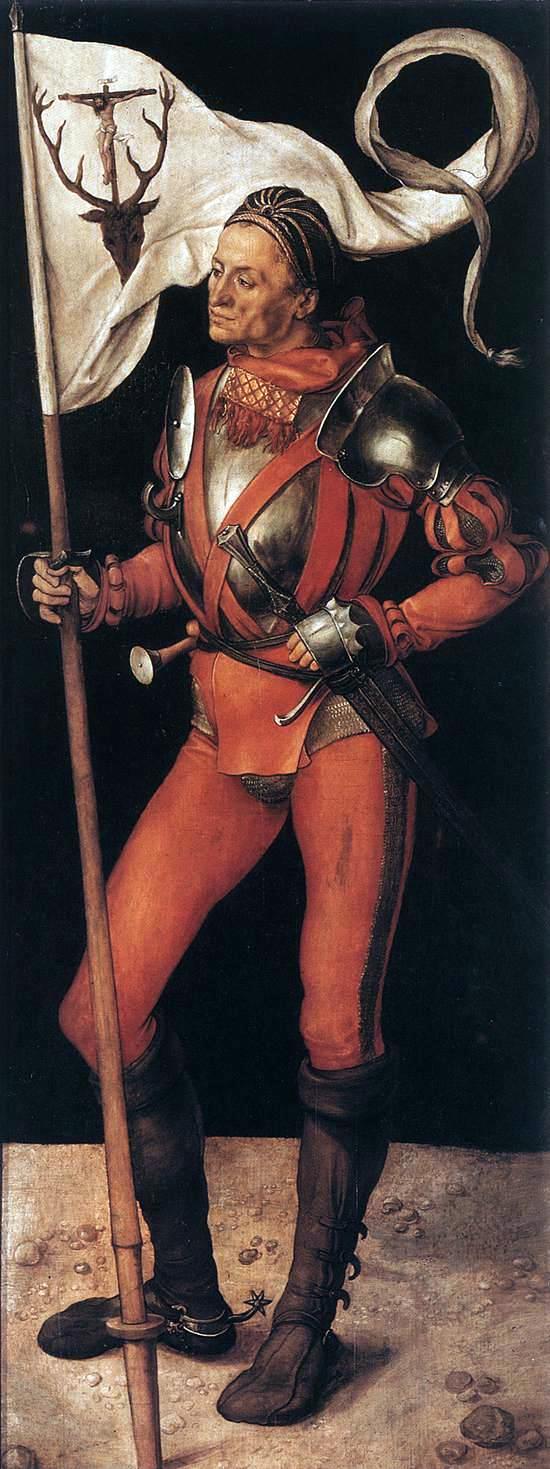
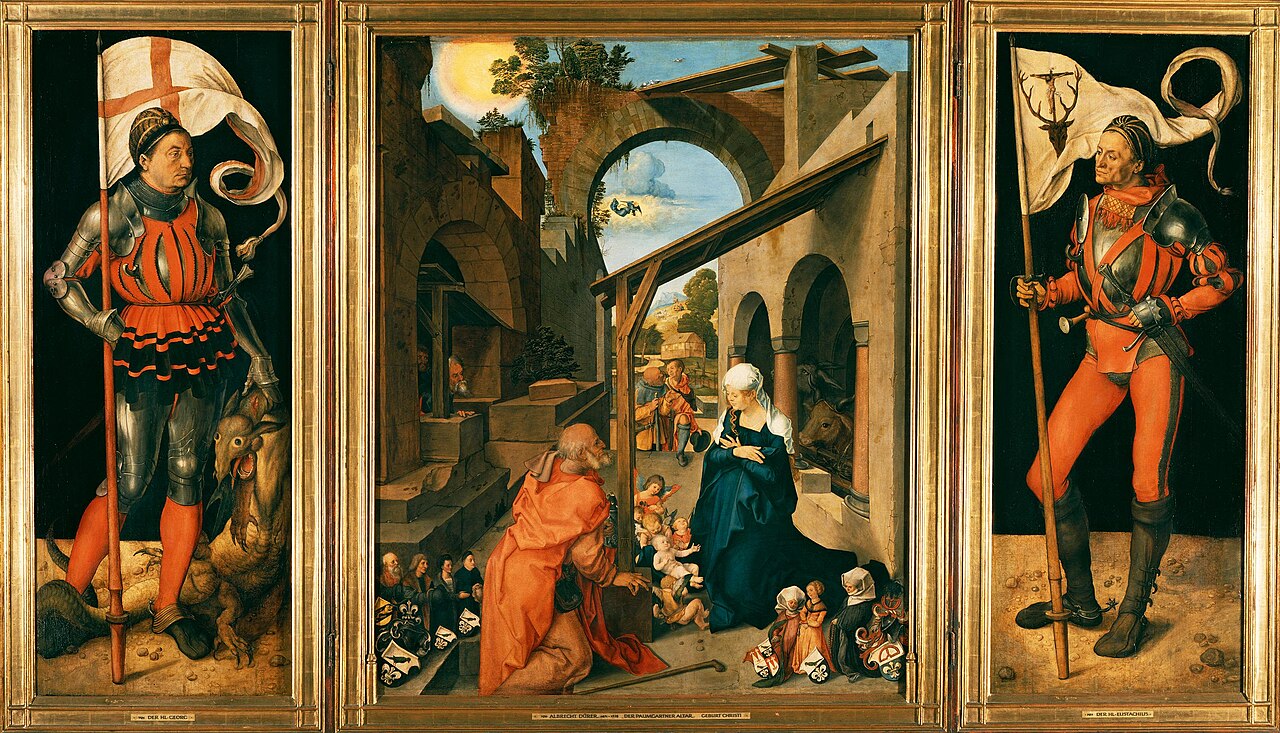
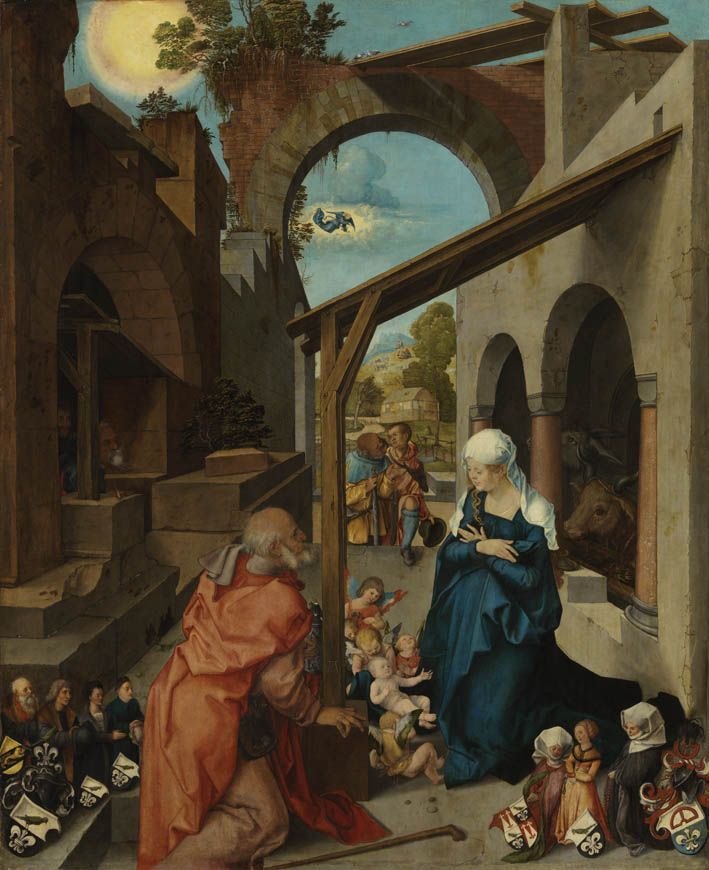
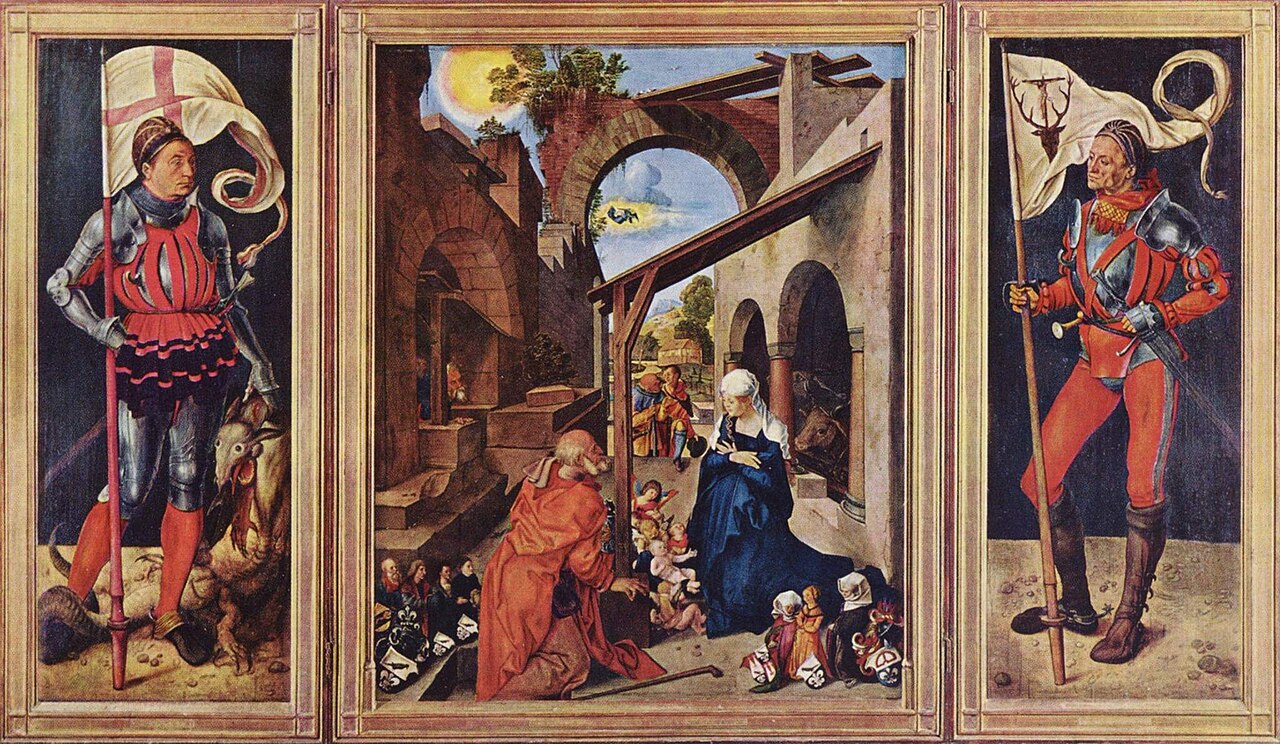
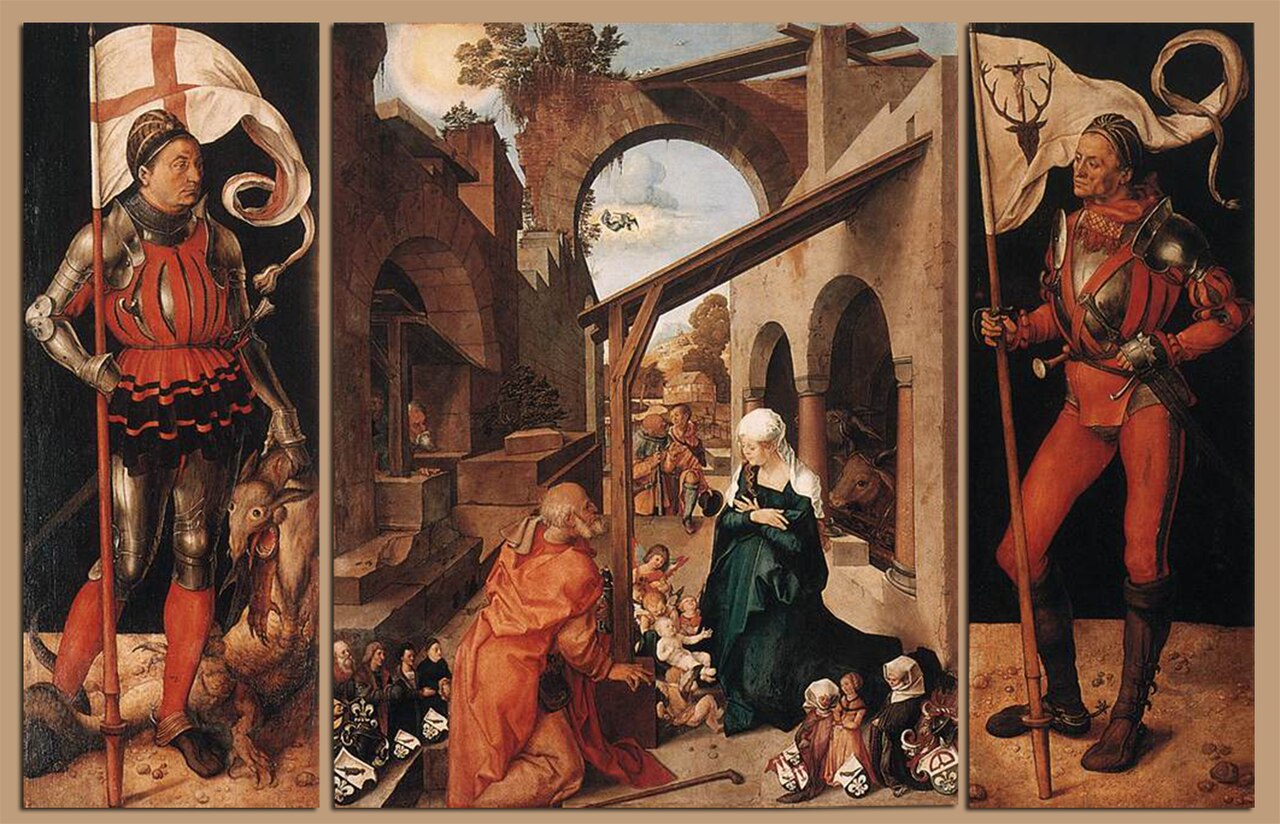
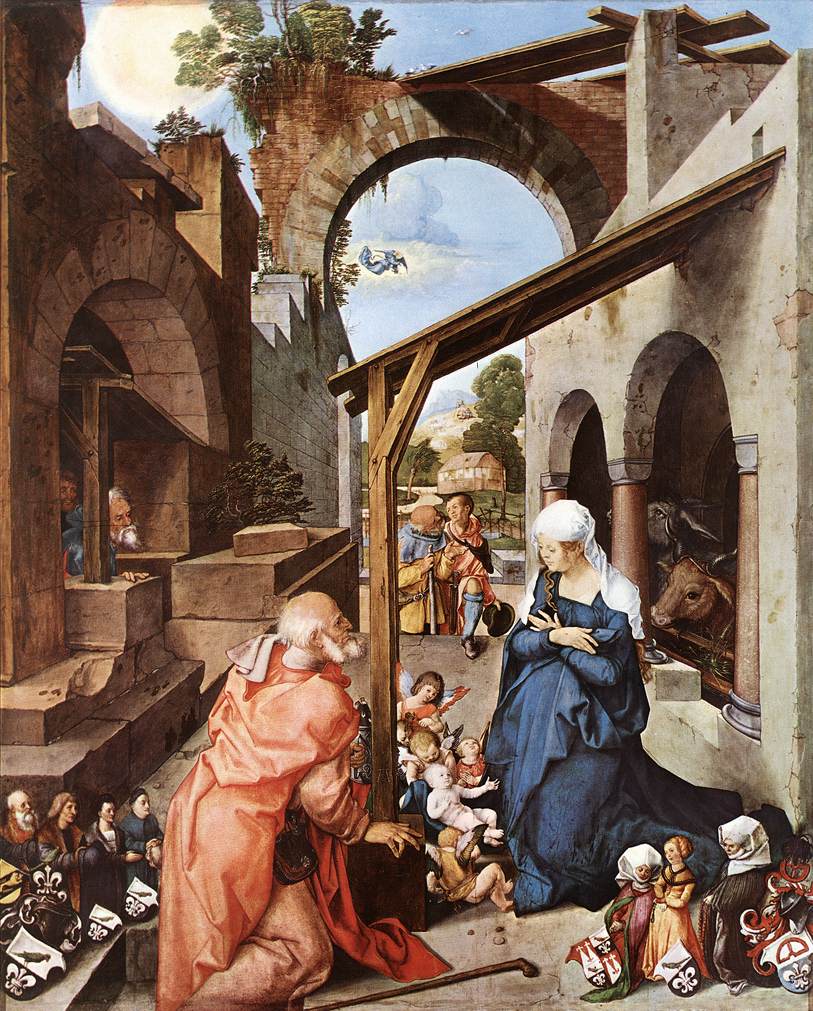
Albrecht Dürer painted the Paumgartner altarpiece around 1500, an early triptych made for the Paumgartner family of Nuremberg. The central panel shows a nativity scene, and the side panels depict Saint George on the left and Saint Eustace on the right. The faces of these saints are actually donor portraits: George bears the likeness of Stephan Paumgartner, and Eustace that of his brother Lukas. Smaller figures of other family members appear in the center panel.
In 1616, Maximilian I, Elector of Bavaria, bought the painting and moved it to Munich. There, it was altered to fit 17th-century tastes: helmets, horses, and landscape backgrounds were added to the saints’ portraits, and the small donor figures in the center were painted over. Restorers removed these additions in 1903.
On 20 April 1988, the altarpiece was one of three works at the Alte Pinakothek attacked with concentrated sulfuric acid by the serial art vandal Hans-Joachim Bohlmann. It alone suffered at least $12 million in damage. After 21 years of restoration, it returned to public display in 2010.
- Artist
- Albrecht Dürer
- Date
- c. 1500
- Medium
- Oil on panel (triptych)
- Subject
- Nativity scene with saints George and Eustace
- Commissioned by
- Paumgartner family of Nuremberg
- Current location
- Alte Pinakothek, Munich
Lore & Background
The altarpiece was created around 1500 for the Paumgartner family of Nuremberg. Its central panel shows a nativity scene, while the wings depict Saint George (left) and Saint Eustace (right), with the saints' faces being donor portraits of the brothers Stephan and Lukas Paumgartner. Other family members appear as small figures in the center panel.
Reader's Guide
In 1616 the painting was bought by Maximilian I, Elector of Bavaria and taken to Munich, where it was altered to suit 17th-century tastes: helmets, horses, and landscape backgrounds were added to the saints, and the small donor figures in the center panel were painted over. These embellishments were removed by restorers in 1903. On 20 April 1988, the altarpiece was one of three paintings at the Alte Pinakothek attacked with concentrated sulfuric acid by serial art vandal Hans-Joachim Bohlmann. It alone suffered at least $12 million in damage. After 21 years of restoration, it was returned to display in 2010. The work is significant as an early example of Dürer's triptych form and for its layered history of alteration, vandalism, and restoration.
Did You Know?
- The faces of Saints George and Eustace are donor portraits of the brothers Stephan and Lukas Paumgartner.
- It was altered in the 17th century with added helmets, horses, and landscape backgrounds, later removed in 1903.
- On 20 April 1988, it was attacked with concentrated sulfuric acid by serial vandal Hans-Joachim Bohlmann, causing at least $12 million in damage.
Composition and the Language of Family Portraiture
Created around 1500, the Paumgartner altarpiece is an early triptych by Albrecht Dürer, commissioned by the Paumgartner family of Nuremberg. The central panel presents a nativity scene, flanked by two hinged wings: Saint George on the left and Saint Eustace on the right. What elevates this work beyond a standard devotional commission is its deeply personal layer of portraiture. The faces of the two saints are not generic holy figures but rather donor portraits of the Paumgartner brothers—Stephan rendered as George and Lukas as Eustace. Beyond the wings, other members of the Paumgartner family appear as small figures woven into the central nativity scene, embedding the family's identity directly within the sacred narrative. This layered approach to portraiture transforms the altarpiece into a family memorial rendered in Dürer's early masterful hand, giving the viewer an intimate glimpse into how a Nuremberg household understood its place within the divine story.
Bavarian Acquisition and Seventeenth-Century Redecoration
After serving the Paumgartner family in Nuremberg, the altarpiece entered the orbit of the Bavarian court when Maximilian I, Elector of Bavaria, acquired it in 1616 and transported it to Munich. Once under the Elector's ownership, the painting was subjected to modifications designed to align it with the aesthetic preferences of the seventeenth century. The alterations were considerable: helmets were added to the saints, horses were introduced into their compositions, and painted landscape backgrounds were placed behind the previously plain saint portraits. Even more invasively, the small donor figures of the Paumgartner family members in the central nativity panel were painted over entirely, erasing the family's presence from the sacred scene. These additions and overpaintings remained in place for nearly three centuries, fundamentally altering the viewer's experience of Dürer's original design. It was not until 1903 that conservators undertook the careful removal of all these later embellishments, revealing the altarpiece much closer to its early-sixteenth-century appearance.
The 1988 Sulfuric Acid Attack
On 20 April 1988, the Paumgartner altarpiece became the target of a devastating act of vandalism at the Alte Pinakothek in Munich. The serial art vandal Hans-Joachim Bohlmann struck at three paintings in the gallery, dousing them with concentrated sulfuric acid. Of those three works, the Dürer altarpiece sustained the most catastrophic damage, with losses estimated at no less than twelve million dollars. The corrosive acid tore through the paint layers, destroying Dürer's delicate early work in a matter of moments. The attack represented one of the most significant losses to a major museum collection in modern European history. The painting was removed from public view immediately and entered a painstaking restoration process. The severity of the chemical damage meant that conservators faced an extraordinarily complex challenge in stabilizing the surviving paint and reconstructing what the acid had obliterated, making this one of the most technically demanding conservation projects in the institution's history.
Twenty-One Years Toward Recovery
The restoration of the Paumgartner altarpiece following the 1988 acid attack became a marathon effort that consumed twenty-one years of dedicated conservation work. The concentrated sulfuric acid had inflicted damage valued at at least twelve million dollars, and the complexity of repairing a work from Dürer's earliest period—where paint layers are thin and the original materials are particularly fragile—meant that progress was necessarily slow and methodical. Conservators had to work through the chemical aftermath, stabilizing what remained of the original paint, and carefully reconstructing the areas where the acid had destroyed the surface entirely. The triptych's multiple panels—the central nativity and the two saint wings—each presented distinct challenges depending on the extent of damage they had sustained. After more than two decades of this painstaking work, the altarpiece was finally returned to public display in 2010. Its return marked not merely the completion of a conservation project but the survival of one of Dürer's earliest known paintings against a threat that could have erased it entirely.
Gallery
Frequently Asked Questions
Who made the Paumgartner altarpiece and what is it?
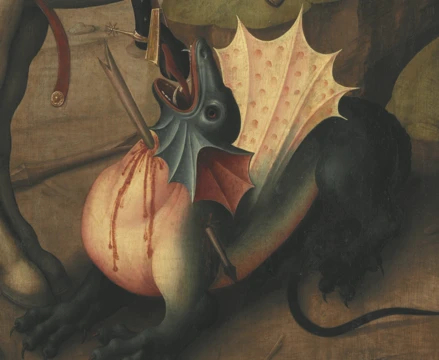
Albrecht Dürer painted this oil-on-panel triptych around 1500 for the Paumgartner family of Nuremberg. It pairs a central Nativity scene with two saint panels, one of which features the classic dragon-slaying Saint George.
What dragon imagery appears in the Paumgartner altarpiece?
The left wing panel shows Saint George in his traditional dragon-slaying pose, making the beast a focal point of the work's iconography. The saint's face doubles as a portrait of the donor Stephan Paumgartner, merging family likeness with the legendary hero.
What roles do the saints play in the Paumgartner altarpiece?
Saint George on the left embodies the dragon-slayer archetype, while Saint Eustace on the right represents the hunter-saint tradition. Both faces are donor portraits of brothers Stephan and Lukas Paumgartner, so the family is literally cast as legendary heroes.
How does the dragon story resolve in the Paumgartner altarpiece?
Saint George is depicted in his canonical victory over the dragon, fulfilling the familiar narrative of the holy knight triumphing over the beast. This resolution frames the entire altarpiece as a visual statement of faith overcoming evil.
Why is the Paumgartner altarpiece important for dragon art history?
As one of Dürer's earliest triptychs, it offers a key early-Renaissance take on the George-and-dragon motif that shaped Northern European dragon iconography. The work now hangs in Munich's Alte Pinakothek, though it suffered acid damage in 1988.
More in Dragons in art 1-20
Spotted an error? Know more?
Reader corrections go straight into our review queue. Suggest an edit · How this site is sourced