Color Graphics Adapter
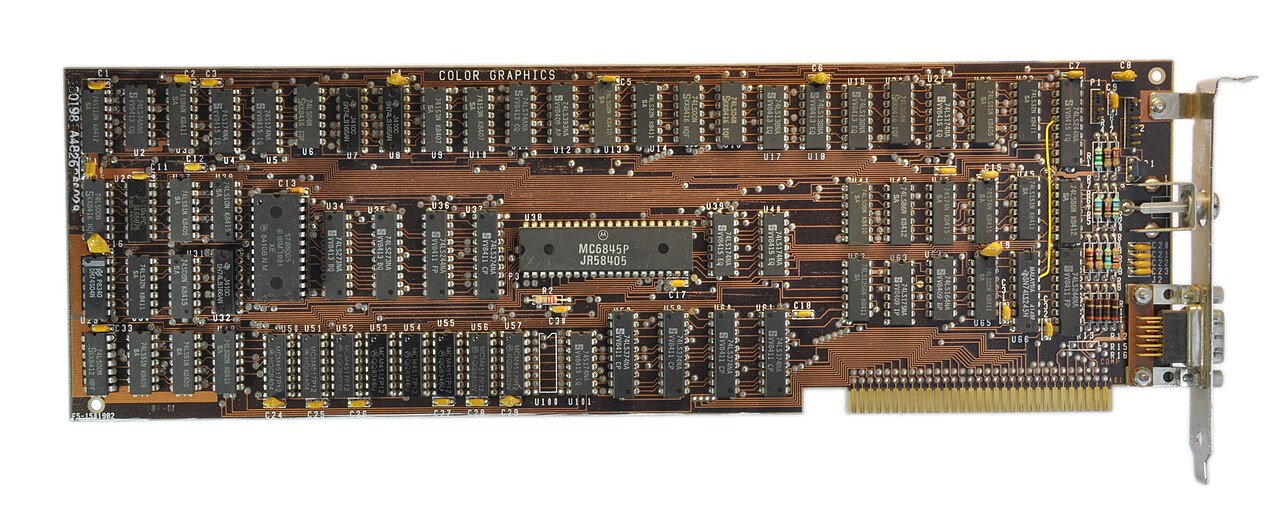
IBM's first color graphics card for the IBM PC.

Muhammad Avdol · CC BY-SA 4.0
The Color Graphics Adapter, also known as the Color/Graphics Adapter or IBM Color/Graphics Monitor Adapter, debuted in 1981 as IBM's initial color graphics card for the IBM PC, setting a de facto standard for computer displays. Its hardware centered on a Motorola 6845 display controller and included 16 kilobytes of onboard video memory, supporting multiple graphics and text modes. The highest resolution available was 640×200, with a maximum color depth of 4 bits, or 16 colors.
Connection options included a direct-drive CRT monitor via a 4-bit digital RGBI interface, such as the IBM 5153 color display, or an NTSC-compatible television or composite monitor through an RCA connector. The RCA output carried only baseband video, so connecting to a TV without a composite input required a separate RF modulator. IBM's own 5153 color display was not available at launch, arriving in March 1983. Until then, users could rely on the composite output (with an RF modulator if needed) or third-party monitors supporting RGBI and the correct scan rate. Some third-party displays lacked the intensity input, limiting colors to eight, and many lacked IBM's circuitry that rendered dark yellow as brown, causing software using brown to display incorrectly.
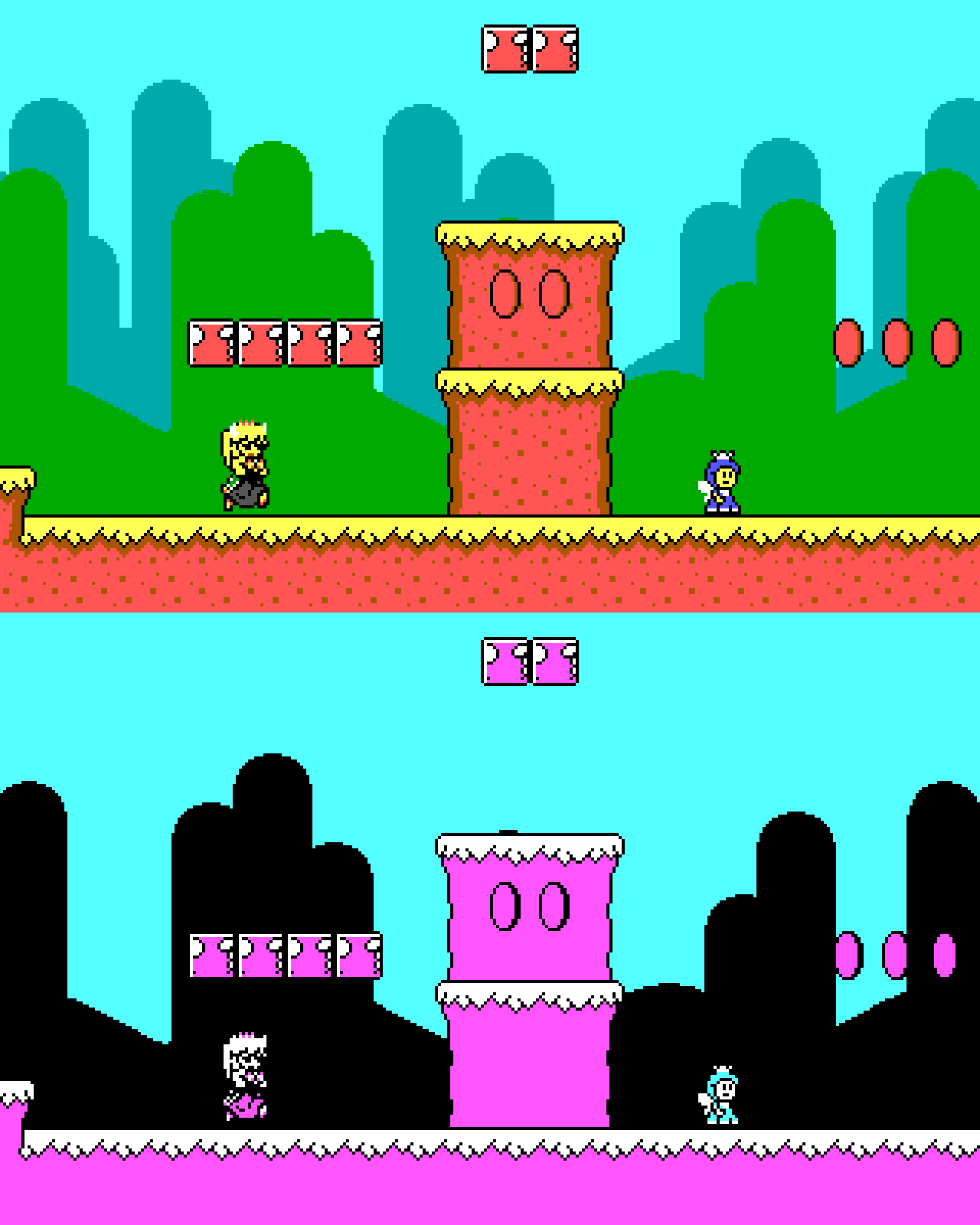
CGA offered several video modes. Graphics modes included 160×100 in 16 colors from a 16-color palette, using 4 bits per pixel and 8 kilobytes of memory; 320×200 in 4 colors from three fixed palettes with high- and low-intensity variants, using 2 bits per pixel and 16 kilobytes; and 640×200 in 2 colors (one black, one from a 16-color palette), using 1 bit per pixel and 16 kilobytes. Some software achieved more colors through artifact color on composite monitors. Text modes were 40×25 with an 8×8 pixel font (effective 320×200) and 80×25 with the same font (effective 640×200). IBM designed CGA for home television compatibility: the 40×25 text and 320×200 graphics modes worked with a TV, while the 80×25 text and 640×200 modes required a monitor.
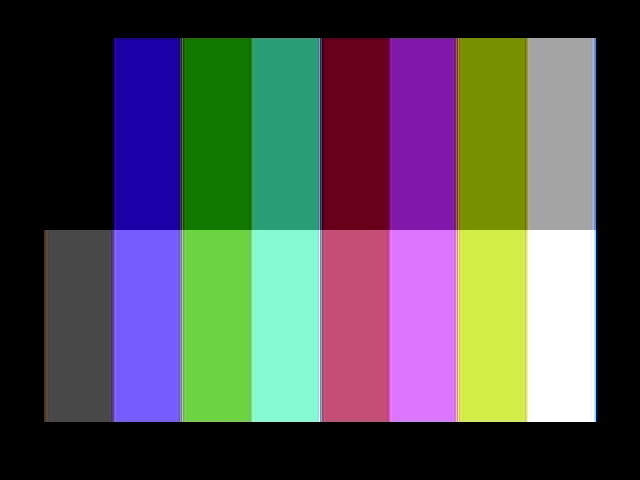
The color palette used a 4-bit RGBI 16-color gamut, but not all colors were always available. In medium- and high-resolution modes, colors were stored at lower bit depths and selected by fixed palette indexes. When four bits were used, they followed the RGBI model: the lower three bits represented red, green, and blue, and the fourth intensifier bit increased brightness of all three.
Quick Facts
- Architecture
- Motorola 6845, ATI CW16800
- Entry
- IBM Color Graphics Adapter, ATi Graphics Solution Rev 3, ATi Color Emulation Card, Tseng Labs ColorPAK
- Midrange
- ATi Graphics Solution plus, ATi Graphics Solution Plus SP, ATi Graphics Solution SR, Number Nine Graphics System
- Highend
- ATi Small Wonder Graphics Solution, Tseng Labs EVA/480
- Enthusiast
- ATi Small Wonder Graphics Solution with game port
- Successor
- Plantronics / PCjr/Tandy / EGA / MCGA / PGC
Facts from the source article.
Lore & Background
The original IBM CGA graphics card was built around the Motorola 6845 display controller, came with 16 kilobytes of video memory, and featured several graphics and text modes. The highest display resolution was 640×200, and the highest color depth was 4-bit (16 colors). The card could be connected either to a direct-drive CRT monitor using a 4-bit digital RGBI interface, such as the IBM 5153 color display, or to an NTSC-compatible television via an RCA connector. The RCA connector provided only baseband video, so connecting to a television without composite input required a separate RF modulator. IBM produced the 5153 Personal Computer Color Display for use with the CGA, but it was not available until March 1983.
CGA offered several video modes: graphics modes included 160×100 in 16 colors, 320×200 in 4 colors from fixed palettes, and 640×200 in 2 colors. Text modes included 40×25 and 80×25 with an 8×8 pixel font. The card used a 4-bit RGBI color gamut, but not all colors were available in all modes. When using a direct-drive monitor, color 6 was treated specially: most RGBI monitors, starting with the IBM 5153, changed its hue from dark yellow to brown by reducing the green signal's amplitude. The exact reduction differed between monitor models. For composite output, colors were encoded into an NTSC signal using flip-flops and delay lines, not a standard RGB-to-YIQ converter, resulting in hues lacking purity.
Reader's Guide
The CGA established a de facto computer display standard for the IBM PC. Its RGBI color palette, including the specially tweaked brown for color 6, was retained as the default palette of later PC graphics standards such as EGA and VGA, which could select colors from much larger gamuts but defaulted to these until reprogrammed. The card's composite output allowed compatibility with home television sets, though the 80×25 text and 640×200 graphics modes were intended for monitors. Third-party monitors sometimes lacked the intensity input, reducing available colors to eight, and many lacked IBM's circuitry for rendering brown, causing software using brown to display incorrectly. The card's fixed bitmap fonts, stored in ROM, could not be modified or selected from software, only by a jumper on the board. Later video cards and monitors in CGA emulation modes approximated the CGA colors using a specific formula. The CGA's limitations and quirks, such as artifact color achieved by some software on composite monitors, shaped early PC graphics development.
Did You Know?
- The CGA's highest display resolution was 640×200, and its highest color depth was 4-bit (16 colors).
- Color 6 was specially treated by most RGBI monitors to appear brown instead of dark yellow, by reducing the green signal's amplitude.
- The CGA could be connected to an NTSC-compatible television via an RCA connector, but required a separate RF modulator if the TV lacked composite video input.
- The IBM 5153 Personal Computer Color Display was not available at the CGA's release; it was released in March 1983.
Hardware Architecture and the Dual-Output Philosophy
The Color Graphics Adapter shipped in 1981 as IBM's inaugural color graphics solution for the IBM PC, and its internal architecture reflected a pragmatic, cost-conscious engineering approach. At its core sat a Motorola 6845 display controller paired with sixteen kilobytes of onboard video memory, a combination that defined the card's ceiling for both resolution and color depth. What made the design particularly interesting was its dual-output strategy. On one side, a DE-9 connector carried a four-bit digital TTL RGBI signal intended for direct-drive CRT monitors like the IBM 5153. On the other, an RCA jack delivered a baseband composite video signal compatible with NTSC televisions, though connecting to a set without a composite input required a separate RF modulator. This dual-path design created real-world complications: the IBM 5153 color display was not actually available until March 1983, leaving early buyers to rely on third-party RGBI monitors or composite setups. Some of those third-party displays omitted the intensifier input, cutting the usable palette to eight colors, and many also lacked the special circuitry that rendered color six as brown rather than dark yellow, causing software that depended on that hue to display incorrectly.
Display Modes and the Resolution-Color Tradeoff
One of CGA's defining characteristics was its tiered set of video modes, each representing a deliberate tradeoff between spatial detail and chromatic richness. In the lowest-resolution graphics mode, the screen displayed 160 by 100 pixels with a full sixteen-color palette, storing four bits per pixel and consuming eight kilobytes of the card's memory. Stepping up to 320 by 200 pixels, the palette shrank to four colors drawn from one of three fixed palettes, with two bits per pixel and a sixteen-kilobyte memory footprint. At the highest resolution of 640 by 200, only two colors were available—one black and one chosen from the sixteen-color set—using a single bit per pixel but still requiring sixteen kilobytes. On the text side, the 40-by-25 and 80-by-25 character modes mapped to effective resolutions of 320 by 200 and 640 by 200 respectively, using 8-by-8 pixel fonts. IBM explicitly designed the lower-resolution modes for television compatibility while reserving the higher-resolution modes for dedicated monitors. A handful of programs even exploited composite-signal artifacts to squeeze additional apparent colors beyond the hardware's nominal limits.
The RGBI Color Model and the Brown Problem
CGA's color system was built on a four-bit RGBI scheme in which the lower three bits addressed red, green, and blue components, while a fourth intensifier bit boosted the brightness of all three simultaneously. This produced a sixteen-color gamut, but the palette was not uniformly accessible across all modes; in the medium- and high-resolution graphics modes, colors were selected through fixed palette indexes rather than direct four-bit specification. The most notorious quirk involved color six. In the RGBI model, that combination should yield dark yellow, but IBM wanted a more aesthetically pleasing brown. Special circuitry in the 5153 monitor reduced the green signal's amplitude by roughly one third to shift the hue, while the later 5154 Enhanced Color Display halved the green amplitude by converting four-bit values to six-bit equivalents. Tandy's CM-2, CM-4, and CM-11 monitors went further, offering a physical potentiometer labeled "BROWN ADJ." for user adjustment. On composite output, the situation was different: the onboard hardware used flip-flops and delay lines rather than a proper RGB-to-YIQ converter, producing impure hues with a greenish cast on cyan and yellow, and color six appeared as dark yellow rather than brown.
Enduring Legacy in PC Graphics Standards
Although CGA was superseded within a few years by more capable adapters, its influence on the architecture of personal computer graphics proved remarkably durable. The "RGBI with tweaked brown" palette that emerged from the interplay between the card's four-bit color encoding and the monitors' special green-reduction circuitry became the default color set for both EGA and VGA. Those later standards could address vastly larger color gamuts, yet they shipped with the CGA-derived palette as their starting point, requiring explicit reprogramming to access the full range. Even in CGA emulation modes on modern hardware, the canonical palette is reproduced through a specific mathematical formula: each RGB channel is computed as a weighted sum of the red, green, blue, and intensifier bits, with red and blue each receiving two-thirds weight from their own bit and one-third from the intensifier, and green receiving the same split. A special case then multiplies the green channel by two-thirds whenever the color index equals six, faithfully recreating the brown that IBM's original circuitry produced. This persistence of a 1981 color scheme as a default reference point underscores how deeply the CGA's design choices were embedded in the PC ecosystem.
Gallery
Frequently Asked Questions
What is the Color Graphics Adapter (CGA)?
CGA was IBM's first dedicated color graphics card, introduced in 1981 alongside the original IBM PC. It went on to set a de facto industry standard for how personal computers rendered color on a screen.
What were CGA's maximum resolution and color capabilities?
At its top graphics mode the card displayed 640×200 pixels with a 4-bit palette, allowing up to 16 colors on screen at once. All of this was handled by 16 kilobytes of onboard video memory.
Which display controller chip did CGA use?
The card's timing and signal generation were driven by a Motorola 6845 CRTC. That same controller appeared in a wide range of 1980s video hardware, making it a familiar component for retro-computing enthusiasts.
How did CGA connect to a monitor?
It output a 4-bit digital RGBI signal that drove a direct-connection CRT, with IBM's 5153 color monitor being the reference display. This digital interface was one of the earliest ways a PC delivered true color to a screen.
Why is CGA still important in display-standard history?
As the first color card shipped with the IBM PC, CGA established the baseline for resolution, palette depth, and memory layout that later standards like EGA and VGA had to surpass. Its 1981 debut effectively launched the modern PC display lineage.
More in Display Standards 1-24
Spotted an error? Know more?
Reader corrections go straight into our review queue. Suggest an edit · How this site is sourced