Amiga Halfbrite mode
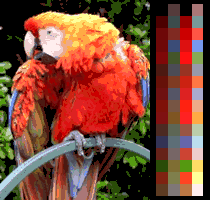
Amiga planar mode with 64 colors using half-brightness bit.

Extra Half Brite (EHB) is a planar display mode of the Amiga computer that uses six bit planes (six bits per pixel). The first five bit planes index 32 colors selected from a 12-bit color space of 4096 possible colors, while the sixth bit plane, when set, halves the brightness of the corresponding color component. This allows 64 simultaneous colors (32 arbitrary colors plus 32 half-bright components) using only 32 color registers, a hardware limitation of pre-AGA chipsets.
- Bit planes
- 6
- Bits per pixel
- 6
- Color space
- 12-bit (4096 colors)
- Simultaneous colors
- 64
- Color registers used
- 32
- Hardware limitation
- pre-AGA chipsets
Lore & Background
Extra Half Brite (also referred to as Extra-Half-Brite, Extra-Halfbrite, or EHB) is a planar display mode of the Amiga computer. This mode uses six bit planes (six bits per pixel). The first five bit planes index 32 colors selected from a 12-bit color space of 4096 possible colors. If the bit on the sixth bit plane is set, the display hardware halves the brightness of the corresponding color component. This way 64 simultaneous colors are possible (32 arbitrary colors plus 32 half-bright components) while using only 32 color registers. The number of color registers is a hardware limitation of pre-AGA chipsets in Amiga computers.
Some contemporary games (Fusion, Defender of the Crown, Agony, Lotus II, or Unreal) and animations (HalfBrite Hill) use EHB mode as a hardware-assisted means to display shadows or silhouettes. EHB is often used as general-purpose 64 color mode with its own restrictions. Some early versions of the first Amiga, the Amiga 1000, sold in the United States, lack the EHB video mode, which is present in all later Amiga models.
Reader's Guide
EHB mode is notable for enabling 64 simultaneous colors on pre-AGA Amiga chipsets while using only 32 color registers, a hardware limitation. This was achieved by dedicating a sixth bit plane to halve the brightness of any color, effectively creating a half-bright version of each of the 32 base colors. The mode was used in contemporary games such as Fusion, Defender of the Crown, Agony, Lotus II, and Unreal, as well as animations like HalfBrite Hill, primarily for hardware-assisted shadows or silhouettes. It also served as a general-purpose 64-color mode with its own restrictions. A significant historical detail is that some early versions of the first Amiga model, the Amiga 1000, sold in the United States, lacked EHB support, while all later Amiga models included it. This inconsistency highlights the evolving nature of the Amiga's Original Chip Set before the introduction of AGA.
Did You Know?
- EHB uses six bit planes, with the sixth bit plane halving the brightness of the corresponding color component.
- Games such as Fusion, Defender of the Crown, and Unreal used EHB for hardware-assisted shadows or silhouettes.
The Six-Plane Trick
Extra Half Brite is a planar display mode on the Amiga that squeezes 64 simultaneous colors out of hardware that only provides 32 color registers. It works by dedicating six bit planes to each pixel. The first five planes act as an index into a palette of 32 colors drawn from a 12-bit color space containing 4,096 possible shades. The sixth plane is where the cleverness lies: when that bit is set, the display hardware automatically halves the brightness of whatever color the first five planes selected. The result is 32 arbitrary colors plus 32 dimmed counterparts, all achievable with just 32 registers. This was a direct workaround for a hard limitation in pre-AGA Amiga chipsets, which physically could not address more than 32 color registers at once. Rather than requiring additional hardware, EHB coaxed a second shade out of every existing color, effectively doubling the visible palette without a single extra register.
Shadows, Silhouettes, and Gameplay
Several well-known Amiga titles leaned on EHB as a hardware-assisted shortcut for rendering shadows and silhouettes without consuming extra color registers. Games such as Fusion, Defender of the Crown, Agony, Lotus II, and Unreal all employed the mode to darken specific elements on screen, giving depth and contrast that would otherwise have demanded a full 64-register palette. Beyond games, the animated demo HalfBrite Hill showcased the mode's visual potential in a purely artistic context. In practice, though, EHB was frequently treated as a general-purpose 64-color mode rather than strictly a shadow tool. Developers accepted its specific restrictions—the halved-brightness pairing of colors—and built entire scenes around that constraint. The mode thus occupied a middle ground: more flexible than a plain 32-color display, yet more constrained than a true 64-color mode would be, making it a pragmatic choice for programmers working within pre-AGA hardware limits.
The Amiga 1000 Exception
Not every Amiga shipped with Extra Half Brite. Early production units of the Amiga 1000, specifically those sold in the United States, lacked the EHB video mode entirely. This omission made those particular machines a notable exception in an otherwise consistent hardware lineage. Every Amiga model produced after those initial US 1000s included EHB as a standard feature of the display hardware. The absence in the early 1000s meant that software relying on the sixth bit plane for brightness halving simply would not function on those specific units, creating a small but real compatibility gap for developers targeting the Amiga platform. The fact that the mode was present in all later models underscores how quickly it became an assumed part of the Amiga graphics toolkit. For programmers and gamers in the early 1980s, encountering a 1000 without EHB was an unusual edge case, but one that highlighted how tightly the mode was woven into the broader expectations of Amiga visual design.
Naming, Context, and the Broader Graphics Ecosystem
The mode carries several interchangeable names—Extra Half Brite, Extra-Half-Brite, Extra-Halfbrite, and the shorthand EHB—all referring to the same planar display mode. It sits within the broader family of Amiga graphics capabilities tied to the Original Chip Set, the pre-AGA hardware generation that defined the platform's early visual identity. EHB is also conceptually related to Hold-And-Modify, another technique for managing limited color resources on the same chipsets. Together, these modes and tricks formed a toolkit that let developers and demoscene artists push well beyond the raw register count the hardware provided. The existence of dedicated resources like the Amiga Graphics Archive, which catalogs EHB specifically, and animated Java demos demonstrating the mode in action, speaks to the lasting technical interest the community has maintained in these early display techniques. EHB remains a concrete example of how clever bit-level manipulation could stretch modest hardware into something visually richer than its specifications would suggest.
Gallery
Frequently Asked Questions
What is Amiga Halfbrite mode?
Extra Half Brite (EHB) is a planar display mode on the Amiga that fits 64 simultaneous colors into a 6-bit-per-pixel format. It dedicates five bit planes to color indexing and a sixth to a brightness-reduction flag.
How does Amiga Halfbrite mode's half-brightness bit work?
The sixth bit plane acts as a per-pixel toggle: when set, the hardware renders that pixel's color at half its original luminance. This gives each of the 32 selectable colors an automatic dimmer companion, doubling the visible palette without consuming extra color registers.
How many colors can Amiga Halfbrite mode display at once?
The mode shows 64 colors on screen simultaneously—32 full-brightness entries chosen from a 4096-color (12-bit) space plus 32 corresponding half-bright variants. All of this fits within the 32 color registers that pre-AGA Amiga hardware provides.
Why was Amiga Halfbrite mode created?
Pre-AGA Amiga chipsets capped planar modes at 32 distinct color registers, limiting on-screen palettes. EHB was designed as a clever workaround that doubles the visible palette by exploiting a brightness dimension rather than adding new color entries.
What hardware does Amiga Halfbrite mode require?
EHB runs on the original Amiga chipset (OCS/ECS) that predates the Advanced Graphics Architecture. It needs six bit planes of video memory and the 32-register color lookup hardware those early boards provide.
More in Display Standards 1-24
Spotted an error? Know more?
Reader corrections go straight into our review queue. Suggest an edit · How this site is sourced