Peripheral
Auxiliary hardware device that transfers information to or from a computer.

DataBase Center for Life Science (DBCLS) · CC BY 4.0
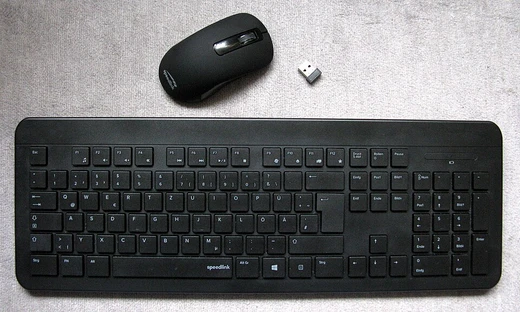
A peripheral device, or simply peripheral, is an auxiliary hardware device that a computer uses to transfer information externally. It is a hardware component that is accessible to and controlled by a computer but is not a core component of the computer, and it can communicate through wired or wireless connections. Many modern electronic devices, such as Internet-enabled digital watches, video game consoles, smartphones, and tablet computers, have interfaces for use as a peripheral.
- Earliest known peripheral
- punched card, introduced into computing in the late 1880s by Herman Hollerith
- First mass produced peripheral
- punched card tabulator
- First commercial magnetic tape drive
- UNISERVO I, created for the UNIVAC I computer in the early 1950s
- First computer with hard disk
- IBM 305 RAMAC (1956), with the IBM Model 350 hard disk storing 5 MB on fifty 24-inch magnetic disks spinning at 1200 RPM
- Rs-232 standard developed
- early 1960s by the Electronic Industries Association
- Flash memory invented
- 1984
Lore & Background
One of the earliest known computer peripherals was the punched card, introduced into computing in the late 1880s by American engineer Herman Hollerith. The punched card tabulator, the first computer peripheral to be mass-produced, could read the cards. In 1901, the punched card led to the Hollerith Type 001 Mechanical Card Punch, which became the basis of computer keyboards, allowing operators to punch digits 0-9 without knowing the corresponding card codes. Punched tape later replaced punched cards due to lower cost and higher storage capacity; the first documented computer to use punched tape as storage was the Zuse Z1 in 1938, which read source code on punched tape.
In the early 1950s, the UNISERVO I, created for the UNIVAC I computer, became the first commercially available magnetic tape drive, capable of both reading and writing to magnetic tape. In 1956, the IBM 305 RAMAC was the first commercial computer to ship with a hard disk, the IBM Model 350, which stored 5 MB on fifty double-sided magnetic disks 24 inches in diameter spinning at 1200 RPM. The RS-232 standard was developed in the early 1960s by the Electronic Industries Association to allow reliable serial connections between devices from different manufacturers using a D25 connector.
Personal computers became widespread from the 1970s onward, and existing peripherals such as keyboards and mice became standard, while new peripherals like scanners and webcams began development. IBM began using semiconductor memory in 1970, which could store twice as much data as core memory, and flash memory was invented in 1984.
Reader's Guide
Peripherals are categorized by the direction of information flow relative to the computer: input, output, or storage. Input devices convert incoming data (user instructions or environmental information such as temperature or pressure) into binary code expressed through electrical signals. They can be categorized by modality of output (e.g., mechanical motion, audio, visual), whether output is discrete (e.g., key press) or continuous (e.g., mouse position), and the number of degrees of freedom (e.g., two-dimensional mice or three-dimensional navigators for CAD). Examples include mouse, keyboard, scanner, game controller, microphone, and webcam.
Output devices reverse the process, turning binary code into comprehensible input for a user. The most common form is a display device, which presents output visually on a screen; the output appears temporarily and can be easily altered or erased. Display devices form images by illuminating a desired configuration of a two-dimensional matrix with rows and columns, refreshed many times per second (typically 60, 75, 120, or 144 Hz on consumer devices). Other examples include monitor, printer, headphones, and speakers.
Many external storage devices double as input/output devices, as they store information and also need facilities for loading information on and off memory (input) and showing the user what is being stored (output). Examples include disk drives, solid-state drives, USB flash drives, memory cards, tape drives, modems, routers, gateways, and network adapters.
Did You Know?
- The punched card tabulator was the first computer peripheral to be mass-produced.
- The Hollerith Type 001 Mechanical Card Punch, introduced in 1901, became the basis of computer keyboards.
- The IBM Model 350 hard disk, released in 1956, stored 5 MB using fifty 24-inch magnetic disks.
Gallery




Frequently Asked Questions
What is a Peripheral?
A peripheral is an auxiliary hardware component that a computer uses to exchange information with the outside world. It sits outside the core system, is controlled by the computer, and can link up either through a wired cable or a wireless connection.
What was the earliest known peripheral in computing history?
The punched card holds that title, introduced into computing in the late 1880s by Herman Hollerith. It served as both the first peripheral and the first mass-produced one in the form of the punched card tabulator.
What was the first computer to ship with a hard disk?
The IBM 305 RAMAC, released in 1956, was the first. Its IBM Model 350 drive stored 5 MB across fifty 24-inch magnetic platters spinning at 1,200 RPM.
What was the first commercial magnetic tape drive?
The UNISERVO I, built in the early 1950s specifically for the UNIVAC I computer, is recognized as the first commercially available magnetic tape drive.
How do modern devices act as peripherals?
Devices like smartphones, tablets, game consoles, and even Internet-enabled digital watches can plug into a computer and function as peripherals through their built-in interfaces. They don't need to be dedicated hardware; any device with a compatible connection can serve that role.
More in Computer Peripherals 1-24
Spotted an error? Know more?
Reader corrections go straight into our review queue. Suggest an edit · How this site is sourced