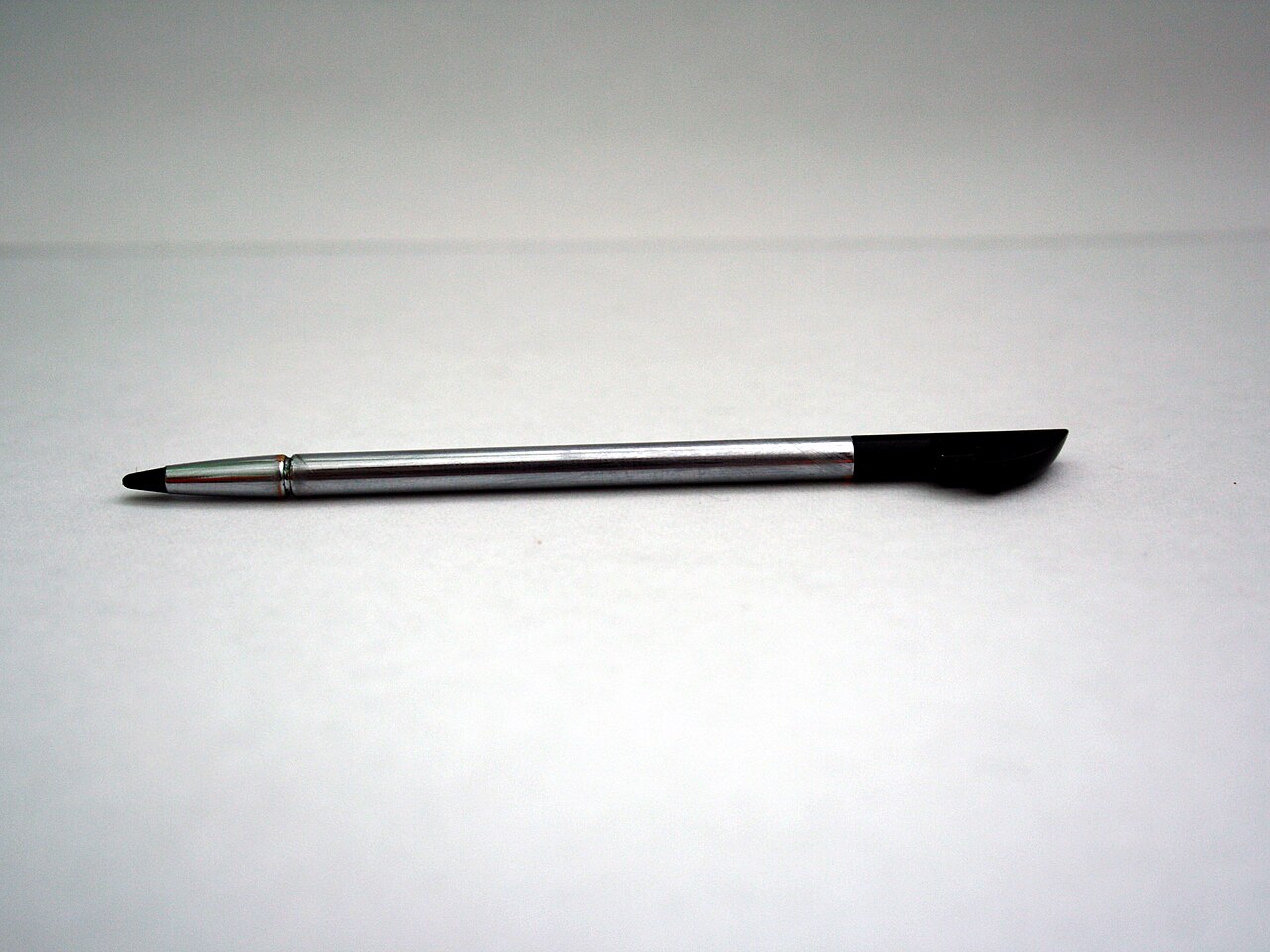
Digital pen
A digital pen converts handwritten analog input into digital data.

Frettie · CC BY 3.0
A digital pen is an input device that turns handwritten or drawn strokes into digital data, which can then be used in different software applications. It works alongside a graphics tablet, tablet computer, smartphone, or digital notebook. Once the handwriting is captured and digitized, the result can appear on a screen.
Common protocols for digital pens include Microsoft Pen Protocol (MPP, formerly N-trig), Wacom AES 1.0 and 2.0, Wacom EMR, Universal Stylus Initiative (USI), Apple Pencil Active Projected Capacitive (APC), and Bluetooth. Examples of such pens are the Microsoft Surface Pen (MPP), Samsung S Pen (Wacom EMR), Google Pixelbook Pen (Wacom AES), and Apple Pencil (APC).
Digital pens fall into several technology groups. Active pens, like N-trig's DuoSense Pen, contain electronic components whose signals are picked up by a device's built-in digitizer and sent to its controller, relaying data on location, pressure, button presses, and other functions. Active Electrostatic (AES) pens are battery-powered styluses that actively communicate with a touchscreen by emitting a weak electrical signal detected by the digitizer, offering high precision.
Position-based pens detect the tip's location during writing. Some models appear on graphics tablets from Wacom and on tablet computers using Wacom's Penabled technology. Electromagnetic Resonance (EMR) pens contain a circuit that resonates with the tablet's digitizer. Accelerometer-based pens detect movement and contact with the writing surface. Camera-based pens use special digital paper to detect where the stylus touches, as seen in NeoLAB or Anoto technology. Trackball pens use a sensor on the pen to detect the motion of a trackball.
A smart pen shares the basic traits of a digital pen but adds features like voice recording or a text scanner. It is generally larger and more feature-rich than an active pen. Digital pens usually have internal electronics, touch sensitivity, input buttons, memory for storing handwriting data, and transmission capabilities. Smartphone pens have become a popular tool for note-taking, drawing, or creating digital art on a device.
- Common protocols
- Microsoft Pen Protocol (MPP), Wacom AES 1.0 and 2.0, Wacom EMR, Universal Stylus Initiative (USI), Apple Pencil Active Projected Capacitive (APC), Bluetooth
- Example pens
- Microsoft Surface Pen (MPP), Samsung S Pen (Wacom EMR), Google Pixelbook Pen (Wacom AES), Apple Pencil (APC)
Lore & Background
Digital pens are grouped into several technology categories. Active pens, such as N-trig's DuoSense Pen, include electronic components whose signals are picked up by a mobile device's built-in digitizer and transmitted to its controller, providing data on pen location, pressure, button presses, and other functionality. Active Electrostatic (AES) pens are battery-powered styluses that actively communicate with the device's touchscreen by emitting a weak electrical signal detected by the digitizer, offering high precision.
Position-based digital pens use a facility to detect the location of the tip during writing. Some models are found on graphics tablets made popular by Wacom and on tablet computers using Wacom's Penabled technology. Electromagnetic Resonance (EMR) pens contain a circuit that resonates with the tablet's digitizer. Accelerometer-based digital pens contain components that detect movement of the pen and contact with the writing surface. Camera-based pens use special digital paper to detect where the stylus contacts the writing surface, such as those using NeoLAB or Anoto technology. Trackball pens use a sensor located on the pen to detect the motion of the trackball.
A smart pen has the same basic characteristics as a digital pen but also includes other features like voice recording or a text scanner. A smart pen is generally larger and has more features than an active pen. Digital pens typically contain internal electronics and have features such as touch sensitivity, input buttons, memory for storing handwriting data, and transmission capabilities. Smartphone pens have become a popular tool for smartphone users who want to take notes, draw, or create digital art on their device.
Reader's Guide
Digital pens serve as a bridge between traditional handwriting and digital workflows, allowing users to capture analog input and convert it into data usable across applications. Their significance lies in enabling natural input methods on devices that otherwise rely on touch or keyboard, supporting tasks from note-taking to digital art. The variety of protocols—such as Microsoft Pen Protocol, Wacom AES and EMR, Universal Stylus Initiative, Apple Pencil APC, and Bluetooth—reflects the diversity of device ecosystems and the need for interoperability. Technology groups like active, positional, accelerometer, camera, and trackball pens illustrate different engineering approaches to achieving accurate digitization. The emergence of smart pens adds voice recording and text scanning, expanding the utility beyond simple input. Smartphone pens have further popularized digital pen use, making stylus input accessible on mobile devices. The legacy of digital pens is their role in making handwriting and drawing a seamless part of digital interaction, supported by a range of protocols and form factors that continue to evolve.
From Tally Sticks to Transistors: The Long Arc of Computing
Long before silicon chips existed, human beings devised tools to make counting and calculation easier. Tally sticks likely represent the earliest such devices, followed by clay spheres and cones sealed in hollow containers across the Fertile Crescent to track livestock or grain. The abacus, traceable to Babylonian origins around 2400 BCE, became a staple for arithmetic, while the Antikythera mechanism—discovered in 1901 in a shipwreck off a Greek island and dated to roughly 100 BCE—stands as what scholars call the earliest known mechanical analog computer, designed for astronomical calculations. No device of comparable complexity would reappear until the fourteenth century. The Industrial Revolution brought mechanical loom-guiding devices, and the early twentieth century saw specialized analog electrical calculators. True digital electronic computing emerged during World War II, progressing through electromechanical systems in the 1930s, thermionic valves, then semiconductor transistors in the 1940s, MOS transistors in the 1950s, and finally monolithic integrated circuits. Each leap produced smaller, more efficient circuits, culminating in the microprocessor and the microcomputer revolution of the 1970s. Moore's observation that transistor counts doubled roughly every two years became the engine behind the Digital Revolution of the late twentieth and early twenty-first centuries.
The Word, the Women, and the Machine
The word we now use to describe a programmable electronic device has a surprisingly human history. In 1613, English writer Richard Brathwait used the term in his book The Yong Mans Gleanings to describe a person who reduced a lifespan into a short number—a human calculator. For centuries, "computer" meant exactly that: a person performing calculations by hand. The Online Etymology Dictionary traces the first attested use to the 1640s as an agent noun derived from the verb "compute." It was not until 1897 that the term began to shift toward meaning a calculating machine of any type, and the modern sense—a programmable digital electronic computer—did not appear until 1945, with a theoretical antecedent in 1937 tied to the Turing machine concept. What is perhaps most striking is who filled those early human-computer roles. During the latter half of the period when the word still meant a person, women were frequently hired for the work because they could be paid less than men. By 1943, women made up the majority of those performing calculations by hand, a fact that underscores how the transition from people to machines was not merely technological but deeply social.
Anatomy of a Modern Machine
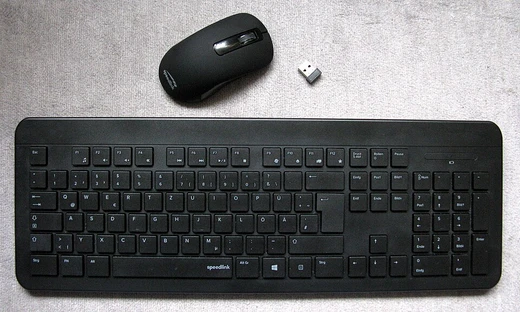
A conventional modern computer is built around a small but powerful core: at least one processing element, usually a central processing unit in the form of a microprocessor, paired with some form of computer memory, typically semiconductor memory chips. The processing element is responsible for executing arithmetic and logical operations, while a sequencing and control unit can alter the order in which those operations run, responding to information stored in memory. Surrounding this core are peripheral devices that bridge the machine to the outside world. Input devices such as keyboards, mice, and joysticks let users feed data into the system; output devices like monitors and printers present the results; and hybrid input/output devices such as touchscreens perform both roles simultaneously. These peripherals allow information to be pulled from external sources and enable the outcomes of computations to be saved and retrieved later. The broader term "computer system" can refer either to a nominally complete unit encompassing hardware, operating system, software, and peripherals needed for full operation, or to a collection of linked computers functioning together as a network or cluster.
From a Handful to Ubiquity: The Digital Revolution
In the 1930s, electronic computers numbered only a few. Today they are woven into virtually every aspect of industrial and consumer life, serving as control systems in products of every scale. The range is staggering: at one end sit simple single-purpose devices such as key fobs, microwave ovens, and remote controls; at the other end are supercomputers and factories staffed by industrial robots. Computers form the beating heart of general-purpose devices like personal computers and smartphones, and they power the Internet, a vast network linking billions of machines and users worldwide. Since the microcomputer revolution of the 1970s, the speed, raw computing power, and versatility of these machines have grown at a remarkable pace, driven by the rapid increase in transistor counts that Moore's law predicted would double approximately every two years. This exponential growth in capability has fueled what is broadly called the Digital Revolution, a transformation spanning the late twentieth and early twenty-first centuries that has reshaped how people work, communicate, and interact with the physical world.
Gallery
Frequently Asked Questions
What is a digital pen?
A digital pen is a handheld input tool that captures your handwriting or drawings and converts them into digital data for use in software. It pairs with devices like tablets, smartphones, or graphics tablets so you can write or sketch directly on a screen.
How does a digital pen actually work?
The pen senses the position and pressure of your strokes and translates them into digital signals that the connected device interprets. Once processed, your input appears on the display as though you were writing with a regular pen.
What communication protocols do digital pens rely on?
Most digital pens communicate through standards such as Microsoft Pen Protocol (MPP), Wacom's AES or EMR systems, the Universal Stylus Initiative (USI), Apple's APC format, or Bluetooth. The specific protocol determines which devices a given pen is compatible with.
Can you name some popular digital pens?
Well-known examples include the Microsoft Surface Pen (MPP), Samsung S Pen (Wacom EMR), Google Pixelbook Pen (Wacom AES), and the Apple Pencil (APC). Each is designed around a particular protocol and ecosystem.
What kinds of devices can a digital pen work with?
A digital pen typically connects to a graphics tablet, tablet computer, smartphone, or dedicated digital notebook. Once the strokes are digitized, the output can be used in virtually any compatible software application.
More in Computer Peripherals 1-24
Spotted an error? Know more?
Reader corrections go straight into our review queue. Suggest an edit · How this site is sourced