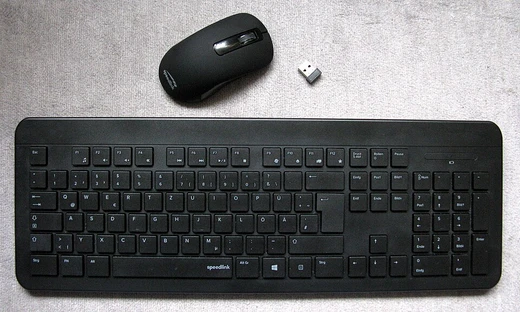
Device Bay
A late-1990s standard for hot-swappable PC peripherals.

Syced · CC0
In 1997, Compaq, Intel, and Microsoft jointly developed a standard called Device Bay. It was meant to offer a straightforward method for adding, removing, and sharing hardware peripherals. Although originally slated for release in the second half of 1998, the standard was never completed and has since been abandoned; its official website disappeared around mid-2001.
Device Bay leveraged then-emerging technologies like USB and FireWire to simplify adding and removing devices from a PC via plug-and-play. Users could connect peripherals such as hard drives, CD/DVD-ROM drives, audio devices, and modems without opening the computer case or turning it off. Devices could also be removed while the system was running, and this could be done through the operating system's software. Another benefit was that certain devices could be swapped between a desktop and a laptop computer.
HP later released a line of PCs that used the Device Bay concept to expand personal storage, marketing them as "HP Personal Media Drives." These drives and bays were primarily available on HP Media Center PCs.
- Developed by
- Compaq, Intel, Microsoft
- Year of development
- 1997
- Original intended introduction
- Second half of 1998
- Official website disappeared
- Mid-2001
- Supported interfaces
- USB, FireWire
Lore & Background
Device Bay was jointly developed by Compaq, Intel and Microsoft in 1997. It was originally intended to be introduced in the second half of 1998, but the standard was never finalized and has long since been abandoned. The official website disappeared in mid-2001.
Making use of new technologies at the time, such as USB and FireWire, Device Bay was intended to make adding and removing devices from the PC easier through plug-and-play. It allowed peripherals such as hard drives, CD/DVD-ROM drives, audio devices, and modems to be added without opening the case or turning the PC off. Devices could also be removed while the PC was still on, and this could be done through software in the operating system. Another advantage was that it allowed certain devices to be swapped between a desktop and laptop computer.
HP released a line of PCs that used the idea of Device Bay to expand personal storage, marketing them as "HP Personal Media Drives." These drives and bays were primarily available on HP Media Center PCs.
Reader's Guide
Device Bay represents a notable but ultimately unrealized effort in the late 1990s to simplify hardware expansion for personal computers. Jointly developed by Compaq, Intel, and Microsoft, it aimed to leverage emerging interfaces like USB and FireWire to allow users to add or remove peripherals—such as hard drives, optical drives, audio devices, and modems—without opening the computer case or powering it down. This plug-and-play capability was intended to make PC hardware as easy to manage as consumer electronics.
Although the standard was never finalized and was abandoned, its concept influenced later hot-swappable storage solutions. HP later adopted the idea in a limited form with its "HP Personal Media Drives" for Media Center PCs, allowing users to expand personal storage. Device Bay's legacy lies in demonstrating the market desire for simpler, user-accessible hardware expansion, a need later addressed by technologies like external USB drives and eSATA. Its failure also highlights the challenges of establishing an industry-wide standard before the underlying interfaces (USB and FireWire) had fully matured.
Did You Know?
- The official Device Bay website disappeared in mid-2001.
- HP later marketed similar bays as 'HP Personal Media Drives' on Media Center PCs.
The Evolution of Expansion Interfaces
The story of how components connect inside a computer reveals a fascinating arc of engineering trade-offs. At the heart of this story sits the bus — a shared communication pathway that lets multiple subsystems exchange signals without each needing its own dedicated wire. This approach proved especially economical in mini and micro computers, standing in contrast to the expensive dedicated paths found in mainframe systems. Intel played a defining role in shaping this landscape. In 1995, the company introduced the ATX form factor specification, improving upon earlier standards like the AT form factor by standardizing dimensions, power supply types, mounting hole locations, and rear panel ports. Around the same era, Intel also launched the Accelerated Graphics Port, a dedicated video bus designed to accelerate 3D graphics by giving the video card its own high-speed lane on the motherboard. At its introduction, AGP was considered fast and represented one of the final off-chip parallel communication standards. By the mid-2000s, PCI Express had largely supplanted it, while Conventional PCI remained as a more versatile but less specialized general-purpose bus for attaching a wide variety of hardware devices.
The Memory Hierarchy and Cache Architecture
Modern processors rely on a layered memory system to bridge the speed gap between the CPU and main memory. The cache sits at the center of this hierarchy: a small, fast buffer that stores frequently accessed instructions and operands, dramatically reducing the time the processor spends waiting for data. A cache hit means the needed value is already local, while a cache miss forces the system to fetch it from a more distant location and potentially evict other data to make room. The granularity of this system is the cache line, typically spanning 32 to 128 bytes, which defines the unit of allocation, refill, and eviction. In associative caches, the number of ways determines how many potential locations a given physical address can map to, and higher way counts reduce allocation collisions. Pathological situations like cache thrashing — where access patterns cause cyclical evictions of soon-needed data — can cripple performance. In multiprocessor environments, cache coherency becomes critical, ensuring that data replicated across multiple caches stays synchronized, especially when DMA operations modify underlying memory. The cache-only memory architecture (COMA) takes this further by dynamically shifting an address space between processor nodes based on demand. A data cache, or D-cache, specifically services load and store requests, mirroring main memory or VRAM for GPU workloads.
Processing Power: From Cores to AI Accelerators
The central processing unit remains the engine of every computer system, executing the instructions of a program. Within the CPU, the core is the portion responsible for carrying out arithmetic and logical operations. Since the late 2000s, nearly all processors have shipped with multiple cores — a quad-core processor, for instance, contains four such units working in parallel. Supporting these operations, the accumulator is a register that holds the result of a previous ALU operation and can also serve as an input to the adder, while the control store retains the microcode that governs the CPU's internal behavior. Yet raw general-purpose processing is no longer the only path to performance. An accelerator — whether a microprocessor, an ASIC, or an expansion card — offloads a specific task from the CPU using fixed-function hardware, with the graphics processing unit being the most common example. The newest frontier is the AI accelerator, purpose-built to run artificial neural networks and other machine learning or machine vision algorithms, whether in a training or deployment context. Products like the Movidius Myriad 2, TrueNorth, and the Tensor Processing Unit exemplify this trend, each targeting different aspects of the AI workload pipeline.
Storage Media and Data Retention
Retaining digital data is a core function of any computer, and the landscape of storage media tells a story of capacity wars and format battles. The Compact Disc family came in three flavors: the CD-ROM, a pre-pressed disc for data or music that cannot be written to; the CD-R, which allows a single write; and the CD-RW, supporting many rewrites. Each represented a step in making optical media more flexible for everyday users. The next generation arrived with the Blu-ray Disc, an optical format designed to supersede the DVD and capable of holding roughly five times as much data as a standard DVD. Blu-ray ultimately won a high-profile format war against HD DVD, and for a period, drives supporting both formats were sold. Most computers still do not ship with Blu-ray drives, though they can be added as a separate upgrade. Beyond optical media, a card reader serves as a data input device for card-shaped storage such as memory cards. At the hardware level, device memory refers to local memory attached to a specific component — a GPU or an OpenCL compute device, for example — distinct from the system's main memory. All of these technologies, housed within the computer case (also called the chassis, cabinet, tower, enclosure, housing, or system unit), work together to form the data retention layer of a machine.
Gallery

Frequently Asked Questions
What is Device Bay?
Device Bay was a late-1990s industry standard aimed at making PC peripheral management easier. It was jointly created by Compaq, Intel, and Microsoft in 1997 as a hot-swap framework for connecting and disconnecting hardware on the fly.
Who developed Device Bay?
The standard was a joint effort between Compaq, Intel, and Microsoft, all three of which worked on it starting in 1997.
What was Device Bay supposed to do?
It was designed to let users plug in, remove, and share peripherals such as hard drives, optical drives, and audio equipment through a unified plug-and-play experience. The concept leaned on then-new interfaces like USB and FireWire to handle the connections.
Why was Device Bay abandoned?
Despite an original target of a second-half 1998 launch, the specification was never finished and the project was quietly shelved. The official Device Bay website disappeared around mid-2001, confirming the standard had been fully dropped.
What interfaces did Device Bay support?
The standard was built around USB and FireWire, both of which were relatively new at the time. These were meant to provide the physical and logical layer for hot-swapping peripherals without needing to open the case or reboot.
More in Computer Peripherals 1-24
Spotted an error? Know more?
Reader corrections go straight into our review queue. Suggest an edit · How this site is sourced