Touch typing
Typing without sight, using muscle memory and home row.

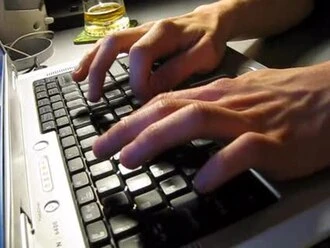
Touch typing (also called blind typing, or touch keyboarding) is a style of typing that relies on muscle memory to locate keys without using sight. It is notable for being popularized by Frank E. McGurrin in 1888 and for its association with the home row method, where eight fingers rest on a horizontal row of keys and reach for others.
- Inventor
- Frank E. McGurrin
- Year of invention
- 1888
- Home row keys qwerty
- ASDF for left hand, JKL; for right hand
- Average typing speed
- 30–40 WPM
- Professional speed
- over 100 WPM
- Contest prize
- $500 (equivalent to $18,000 in 2025)
Lore & Background
Touch typing was reportedly invented in 1888 by Frank E. McGurrin, a court stenographer from Salt Lake City, Utah who taught typing classes. On July 25, 1888, McGurrin, reportedly the only person using touch typing at the time, won a decisive victory over Louis Traub in a typing contest in Cincinnati, winning $500 and popularizing the method. Whether McGurrin was actually the first to touch type or simply the first to be popularly noticed is disputed; speeds of other typists at the time suggest they may have used similar systems.
On a standard QWERTY keyboard for English speakers, the home row keys are 'ASDF' for the left hand and 'JKL;' for the right hand. Most modern computer keyboards have a raised dot or bar on the home keys for the index fingers to help touch typists maintain correct finger positioning. The term 'touch typing' is often used to refer specifically to the home row method, while typists who do not look at the keyboard but do not use home row are called hybrid typists. Both two-handed and one-handed touch typing are possible.
Touch typing is contrasted to search and peck (hunt-and-peck), which is slower and requires greater finger travel. Various intermediate styles exist, such as using fewer than eight fingers (often omitting the little finger) or moving the entire hand to reach keys instead of returning to home row after each keystroke.
Reader's Guide
Touch typing's significance lies in its potential to improve typing speed and accuracy dramatically. Speeds average around 30–40 WPM, while 60–80 WPM is needed to keep up with one's thoughts; a Microsoft survey suggested many managers expect at least 50 WPM, and professional career typists can exceed 100 WPM. Routine practice is required to maintain high speed and accuracy. Touch typing reduces the need to switch attention between the keyboard and other areas, increasing productivity and reducing errors. It also helps improve posture and reduce neck pain by keeping eyes focused on the display.
However, the advantages are disputed. One study of 30 subjects found minimal difference in typing speed between touch typists and self-taught hybrid typists, concluding that the number of fingers does not determine speed and that fast typists keep their hands fixed and consistently use the same finger for each letter. The study has been criticized for only selecting subjects with average speeds up to 75 WPM, lacking generalizability for faster typists. Learning touch typing can be stressful initially, and for those with past typing experience, the initial lower performance level makes it seem not worthwhile. Typing speed generally improves with practice, and if a plateau is reached, taking a break may help, as speeds tend to increase over time even without serious practice.
Did You Know?
- Frank E. McGurrin reportedly invented home row touch typing in 1888.
- The home row keys on a QWERTY keyboard are ASDF for the left hand and JKL; for the right hand.
- A 1985 typing tutor software, Touch Typist Typing Tutor, was developed by Sector Software.
More in Computer Keyboards 1-24
Spotted an error? Know more?
Reader corrections go straight into our review queue. Suggest an edit · How this site is sourced