
ISO/IEC 9995
ISO/IEC standard series for keyboard layout principles.

Karl432 · CC0
ISO/IEC 9995 is an ISO/IEC standard series that defines layout principles for computer keyboards used in text and office systems. It provides the foundation for national and industry standards that specify keyboard layouts.
- Number of parts as of february 2026
- 12
Lore & Background
The project for this standard was adopted by ISO in 1985 under the proposition of Dr Yves Neuville. The ISO/IEC 9995 standard series dates back to 1994 and has undergone several updates over the years, with the last major revision published in December 2025 and January 2026. The series currently consists of 12 parts, covering topics from general principles to multilingual input and dead key functionality. The standard defines a physical division of keyboards into sections and zones, and a reference grid that identifies each key by a unique combination of a letter (row) and two digits (column). For example, the key marked "1" on many layouts is identified as "Key E01". The grid may be angled or squared, and the standard does not constrain the number of rows and columns in the alphanumeric section. Characters are organized into levels (up to four) and groups, allowing for multilingual and multiscript input. The standard specifies three ways of key labelling: columnar placement, group-1-priorized placement, and level-4-including placement. Prior editions only specified columnar placement, but legibility issues with three characters on a keytop led to the development of the other two methods.
Reader's Guide
The ISO/IEC 9995 standard series is significant as it establishes the fundamental principles for keyboard layouts used in text and office systems worldwide. It serves as the base for national and industry standards, ensuring consistency and interoperability across different keyboard designs. The standard's reference grid system provides a universal method for identifying keys, which is crucial for documentation, software development, and accessibility.
The series addresses the evolution of keyboard design from mechanical typewriters to modern digital systems, accommodating multiple scripts and languages through its levels and groups structure. The revision published in 2025/2026 updated several parts, including the general principles, alphanumeric section, Latin International layout, numeric section, groups for multilingual input, conventional symbols, and dead key functionality. Parts covering editing and function sections, allocation of letters to numeric keypads, and keyboard group selection were not affected by this revision.
The standard's allowance for up to four levels and multiple groups enables layouts like the Japanese kana second group and the German E1 layout to input more characters than their predecessors. The withdrawn part ISO/IEC 9995-6 was integrated into ISO/IEC 9995-5, reflecting the ongoing refinement of the standard series.
Did You Know?
- The standard allows a numeric section to be placed left of the alphanumeric section.
- Rows above the alphanumeric section are labeled from K on, and rows below the space key from Z downwards.
- The fourth level should only be used for obscure or rarely used characters, and its characters do not need to be shown on keytops.
- The German extended layout E1 uses the symbol as a variant of the extra selector symbol.
Origins and Standardization Timeline
The ISO/IEC 9995 series traces its conceptual roots to 1985, when ISO formally adopted the project under the proposal of Dr. Yves Neuville. Although the published standard series dates back to 1994, the groundwork laid nearly a decade earlier established the foundational framework for defining keyboard layout principles applicable to text and office systems. Over the subsequent decades, the standard underwent multiple revisions to keep pace with evolving computing needs and expanding character sets. The most recent major revision was published in December 2025 and January 2026, updating several parts while deliberately leaving others untouched. Crucially, this standard serves as the bedrock reference upon which national and industry-specific keyboard layout standards are constructed, making it a critical piece of infrastructure in the global computing landscape.
The Multi-Part Architecture
As of February 2026, the ISO/IEC 9995 series comprises twelve distinct parts, each addressing a specific aspect of keyboard design. Part 1 establishes general principles and terminology, Part 2 covers the alphanumeric section, and Part 3—whose content was completely overhauled in the 2026 revision—now addresses the Latin International keyboard layout rather than the complementary alphanumeric zone layouts it previously defined. Parts 4, 5, 7, 8, 9, 10, 11, and 12 handle everything from numeric sections and editing functions to multilingual input, dead keys, and group selection mechanisms. Notably, Part 6 (Function section) was withdrawn in October 2009 after its content was absorbed into Part 5. The 2025/2026 revision cycle left Parts 5, 8, and 12 unchanged, while Part 7 is already under revision again with a new version anticipated.
Physical Layout and the Reference Grid
Part 1 of the standard introduces a systematic way to describe and identify every key on a keyboard through a reference grid. Each key receives a unique identifier combining a letter for the row and two digits for the column—for instance, the key commonly labeled "1" becomes "Key E01." The keyboard is divided into sections: the alphanumeric section, an optional numeric section, and an editing and function section that encompasses everything else. Within these, zones are further delineated. The standard is deliberately flexible: it does not mandate a fixed number of rows or columns, permits the grid to be angled or squared, allows the numeric section to be omitted entirely or positioned to the left of the alphanumeric block, and even accommodates function keys arranged in multiple rows or outside the conventional top position. Columns for editing or function keys beyond a right numeric section are numbered from 60, while those to the left of the alphanumeric section use 80 and below.
Levels, Groups, and Multilingual Input
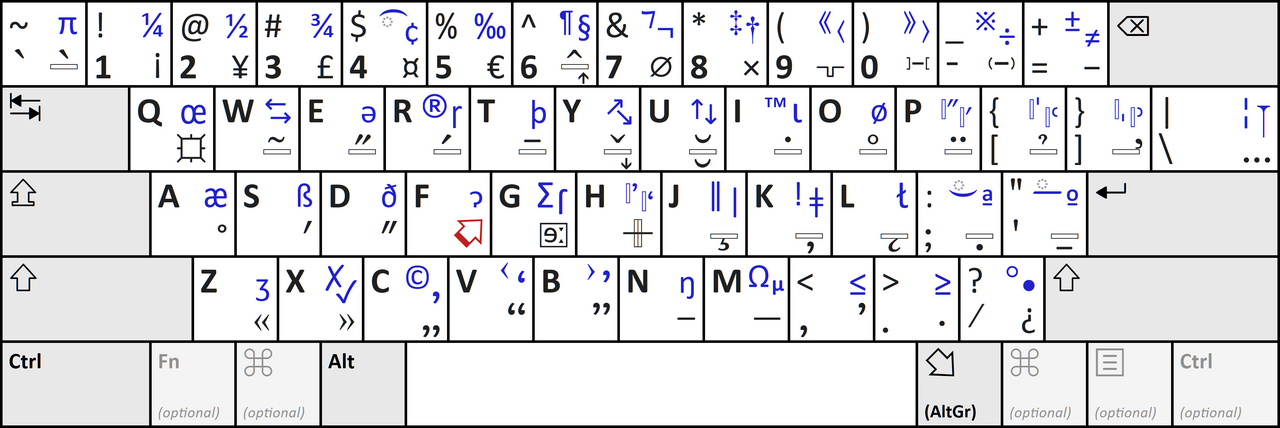
The standard organizes character input through a hierarchical system of levels and groups. Within the alphanumeric section, keys can carry up to four levels of characters: the basic unshifted level, the shifted level, a third level typically accessed via the AltGr key, and a fourth level requiring simultaneous AltGr and Shift. The standard explicitly cautions that the fourth level demands an awkward three-finger "guitar chord" grip unless a dedicated sticky-key mechanism exists, and therefore recommends reserving it for obscure or rarely used characters whose symbols need not appear on keytops. When four levels prove insufficient—such as when accommodating entirely different scripts—groups provide a higher tier of organization. Each group can itself contain up to four levels. Real-world examples include the Japanese layout, where kana forms the second group, and the Canadian Québec (1992) and German E1 (2018, updated 2023) layouts, which use groups to expand character coverage beyond earlier editions.
Gallery




Frequently Asked Questions
What is ISO/IEC 9995?
It is an ISO/IEC standard series that lays down the layout principles governing computer keyboards in text-entry and office-system contexts. Think of it as the rulebook that tells everyone else how to organize their keys.
What is ISO/IEC 9995's role in the keyboard ecosystem?
It acts as the upstream foundation on which national and industry keyboard-layout standards are built. Rather than dictating one specific arrangement, it provides the structural principles that downstream standards then instantiate.
How many parts does ISO/IEC 9995 contain?
As of February 2026, the series is made up of 12 parts, each addressing a different aspect of keyboard layout design.
Why is ISO/IEC 9995 important to keyboard fans and engineers?
Because virtually every national keyboard-layout standard traces its structural logic back to this series, making it the silent architect behind the key placements you use every day. Understanding it helps you see why layouts differ between countries while still sharing common design DNA.
Does ISO/IEC 9995 prescribe a single 'correct' keyboard layout?
No — it defines the principles and categories for organizing keys, not one fixed arrangement. The actual key positions are left to the national and industry standards that build on its framework.
More in Computer Keyboards 1-24
Spotted an error? Know more?
Reader corrections go straight into our review queue. Suggest an edit · How this site is sourced