
JCUKEN
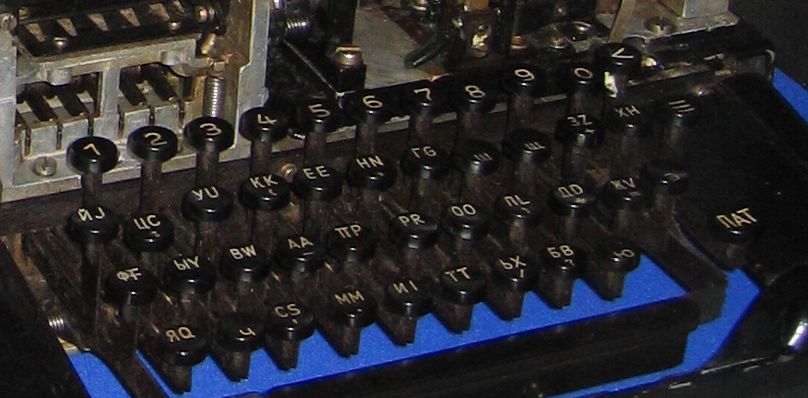
The standard Russian keyboard layout, adopted in 1953.

Austin Mills (austinmills) · CC BY-SA 2.0
JCUKEN (ЙЦУКЕН, also known as YCUKEN, YTsUKEN or JTSUKEN) is the standard keyboard layout used for typing Russian on computers and typewriters. It became the dominant layout in 1953, replacing an earlier system called JIUKEN (ЙІУКЕН). Alternative layouts exist, such as phonetic Russian keyboards, where Cyrillic letters are matched to Latin letters that sound similar, like those on a QWERTY board.
Before the 1917 Russian spelling reform, the JIUKEN layout was in use. It included the Cyrillic "decimal I" (І) and the letter Ѣ, both of which were removed by the reform, but it lacked the rare letters Ѳ and Ѵ. The numbers 1, 3, and 0 were absent, so typists substituted them with the letters decimal I, Ze (З), and O (О) respectively. The letters Ц and Э sat next to each other, and Ѣ was placed between Ч and С. The letter Ё was not part of this layout. After the reform, JIUKEN was modified: the decimal I became the number 1, and Ѣ was replaced by Ё.
The shift to JCUKEN began on July 1, 1953, with the introduction of the GOST 6431-52 standard. Soviet typewriters soon adopted this new layout, which made several changes: all numbers (1, 3, 0) were placed on the top row; the letter Ц moved to where the number 1 used to be; and the letters Ъ, Э, and Ё were moved to the end of the three letter rows. This version is still known today as the "Russian (typewriter)" layout and is standard in Unix-like systems under GOST 6431-90. In the late 1980s, as the Soviet Union began producing IBM PC/XT clones, a new standard (GOST 14289-88) was proposed by the Committee on Computer Science and Engineering. However, its punctuation and symbol placement matched neither American QWERTY nor the 6431-90 standard. Instead, Microsoft and keyboard manufacturers delivered a JCUKEN-QWERTY hybrid for MS-DOS, which closely resembled the version that would later ship with Windows in 1994.
JCUKEN is the foundation for many other Cyrillic keyboard layouts. Microsoft Windows currently supports layouts for Azerbaijani (Cyrillic), Bashkir, Belarusian, Kazakh, Kyrgyz, Mongolian, Tajik, Ukrainian, Uzbek (Cyrillic), and Yakut (Sakha). Belarusian, Ukrainian, and Mongolian have been available since Windows 95; Azeri, Kazakh, Kyrgyz, Tatar, and Uzbek since Windows XP; Bashkir and Tajik since Windows Vista; and Yakut since Windows 7.
- Replaced jiuken
- 1953
- Gost standard (typewriter/unix)
- GOST 6431-90
- Gost standard (1952)
- GOST 6431-52
- Proposed computer norm (ussr)
- GOST 14289-88
- Microsoft windows support began
- 1994 (with Windows)
Lore & Background
Earlier in Russia, the JIUKEN (ЙІУКЕН) layout was the main layout, but it was replaced by JCUKEN in 1953. The JIUKEN layout was used before the Russian spelling reform of 1917 and included the Cyrillic dotted or 'decimal' I as well as Ѣ, but lacked the numbers 1, 3, and 0, forcing typists to replace them with letters. After the reform, the decimal I was replaced by the number 1, and Ѣ was replaced by Ё. On July 1, 1953, the norm GOST 6431-52 on the arrangement of letters, numbers and symbols on the keyboard began to operate. Within a few years, Soviet typewriters switched to the new JCUKEN layout with all numbers 1, 3, 0 present in the first line; the letter Ц moved to the previous emplacement of number 1; and letters Ъ, Э, Ё moved to the end of the three lines of letters. This version is also known today in modern computers as Russian (typewriter). In OpenSolaris and other Unix-like operating systems this layout is standard (Keyboard GOST 6431-90). At the end of the 80s, when the Soviet Union began issuing analogues of IBM PC/XT personal computers, the Committee on Computer Science and Engineering proposed its own norm (GOST 14289-88), but this version did not follow the same locations of punctuations as either the American QWERTY version or the 6431-90 version. Instead, Microsoft and keyboard manufacturers delivered a Russian JCUKEN-QWERTY version for MS-DOS, almost analogous to the future version delivered in 1994 with Windows.
Reader's Guide
JCUKEN is notable as the primary keyboard layout for the Russian language, having replaced the JIUKEN layout in 1953 following the GOST 6431-52 standard. Its adoption standardized the placement of numbers and letters on Soviet typewriters and later influenced computer keyboards. The layout is the basis for many other Cyrillic layouts supported by Microsoft Windows, including Azerbaijani (Cyrillic), Bashkir, Belarusian, Kazakh, Kyrgyz, Mongolian, Tajik, Ukrainian, Uzbek (Cyrillic), and Yakut (Sakha). These layouts have been introduced across various Windows versions, from Windows 95 to Windows 7. Alternative layouts exist, such as Russian phonetic keyboard layouts, where Cyrillic letters correspond to similar-sounding Latin letters in QWERTY and other layouts. The JCUKEN layout also appears in Unix-like operating systems as the standard under GOST 6431-90, and a legacy typewriter version is available in Microsoft Windows. Its significance lies in its widespread use across multiple languages and operating systems, forming the foundation for Cyrillic typing in the digital age.
Did You Know?
- The JCUKEN layout replaced the JIUKEN layout in 1953.
- The JIUKEN layout lacked the numbers 1, 3, and 0, forcing typists to use letters instead.
- JCUKEN is the basis for many other Cyrillic layouts, including Belarusian, Ukrainian, and Kazakh.
- The Belarusian JCUKEN layout lacks a key for И, as the Belarusian language does not contain that letter.
From JIUKEN to JCUKEN: A Century of Keyboard Reform
The JCUKEN layout did not emerge in a vacuum. Its predecessor, JIUKEN, had been the standard Russian keyboard arrangement before the 1917 spelling reform. That reform eliminated several archaic Cyrillic characters, including the dotted "decimal" I and the yat (Ѣ), while also dropping the rarely used Ѳ and Ѵ. The old layout carried a peculiar quirk: the numbers 1, 3, and 0 were entirely absent from the top row, forcing typists to substitute the decimal I, the letter Ze, and the letter O in their place. The letters Ц and Э sat side by side, and the yat occupied the space between Ч and С. The letter Ё was simply not present. When the reform took effect, the decimal I was swapped for the numeral 1, and the yat was replaced by Ё. The new arrangement did not become official until July 1, 1953, when the GOST 6431-52 standard on keyboard placement took effect. Within a few years, Soviet typewriters transitioned to the updated JCUKEN arrangement, which added all three missing numerals to the top row, shifted Ц into the former position of the number 1, and relocated Ъ, Э, and Ё to the ends of the three letter rows.
JCUKEN as a Blueprint for the Cyrillic World
Beyond Russian, JCUKEN serves as the structural foundation for a remarkable family of keyboard layouts spanning numerous languages that use the Cyrillic script. Microsoft Windows alone supports layouts for Azerbaijani, Bashkir, Belarusian, Kazakh, Kyrgyz, Mongolian, Tajik, Ukrainian, Uzbek, and Yakut, each built upon the JCUKEN framework with language-specific substitutions. The Belarusian layout, for instance, places the short U (Ў) where Russian has Щ, and uniquely omits a dedicated key for И, replacing it with the decimal I (І), while the hard sign position is taken by the apostrophe. Ukrainian swaps yeru for the decimal I, replaces Э with Є, and introduces the letters Ї and Ґ. Tajik's variant, called YQUKEN, substitutes Қ for Ц, Ҷ for Ы, and Ӣ for the soft sign. Azerbaijani's JÜUKEN is the only JCUKEN derivative without the letter Й, replacing it with Je. Mongolian uses a modified version called FCUZHEN. Linux and other operating systems may offer additional custom layouts for the same or other languages beyond what Windows provides.
Platform Variations and the Typewriter-to-Computer Transition
The JCUKEN layout is not a single fixed arrangement but exists in several platform-specific variants. The typewriter and UNIX layout, standardized as Keyboard GOST 6431-90, remains the default on Unix-like operating systems and is available in Microsoft Windows as a legacy option. Microsoft and Apple each maintain their own JCUKEN implementations with subtle differences in key placement. The transition from typewriters to personal computers introduced further complexity. In the late 1980s, as the Soviet Union began producing IBM PC/XT-compatible machines, the Committee on Computer Science and Engineering proposed its own standard, GOST 14289-88. However, this version did not align its punctuation and symbol placements with either the American QWERTY convention or the GOST 6431-90 typewriter standard. In practice, Microsoft and keyboard manufacturers shipped a Russian JCUKEN-QWERTY hybrid for MS-DOS that closely resembled the layout eventually delivered with Windows in 1994. The pre-computer typewriter version, with its specific modifications to the original JIUKEN, is still accessible today in modern operating systems under the label "Russian (typewriter)."
Alternative Approaches: Phonetic and Non-JCUKEN Cyrillic Layouts
While JCUKEN dominates Russian and much of the Cyrillic keyboard landscape, alternative approaches exist. Russian phonetic keyboard layouts map Cyrillic letters to visually or phonetically similar Latin letters on QWERTY and other Western layouts, offering a different logic for key assignment. Outside the JCUKEN family entirely, the Serbian layout known as LjNjERTZ (ЉЊЕРТЗ) is built on the QWERTZ arrangement rather than JCUKEN. Because Serbian does not use the yers, yeru, Э, or Ё, those keys are absent, and a key for dze (Ѕ) is included instead. The Macedonian layout is a modification of the Serb-style keyboard, resembling QWERTY more closely than JCUKEN and swapping the positions of Ѕ and З. On Windows, Macedonian layouts allow AltGr to access additional letters and punctuation. These non-JCUKEN layouts illustrate that the Cyrillic keyboard world is not monolithic; the choice of layout depends on the specific language's alphabet, the operating system, and whether the user prefers a JCUKEN-based or QWERTY-based structural logic.
Gallery
Frequently Asked Questions
What is JCUKEN?
JCUKEN (ЙЦУКЕН) is the standard keyboard layout used for typing Russian on computers and typewriters. It is also referred to by transliterations such as YCUKEN, YTsUKEN, or JTSUKEN.
When did JCUKEN become the dominant Russian layout?
JCUKEN took over as the primary Russian layout in 1953, displacing the older JIUKEN (ЙІУКЕН) arrangement that had been in use since before the 1917 spelling reform.
How does JCUKEN differ from the older JIUKEN layout?
JIUKEN contained the Cyrillic decimal-I (І) and the letter Ѣ, both of which were dropped after the 1917 reform, while JCUKEN reflects the post-reform alphabet. JCUKEN also fills in a rare letter slot that JIUKEN had left empty.
Which GOST standards codify the JCUKEN layout?
The typewriter and UNIX-era specification is GOST 6431-90, while an earlier 1952 version is GOST 6431-52. For computer use in the late Soviet period, GOST 14289-88 was proposed as the relevant norm.
When did JCUKEN gain native support in Microsoft Windows?
Windows shipped built-in JCUKEN support starting in 1994, making the layout readily available to Russian-speaking users on that platform.
More in Computer Keyboards, Part 3 1-24
Spotted an error? Know more?
Reader corrections go straight into our review queue. Suggest an edit · How this site is sourced