
Greek keyboard
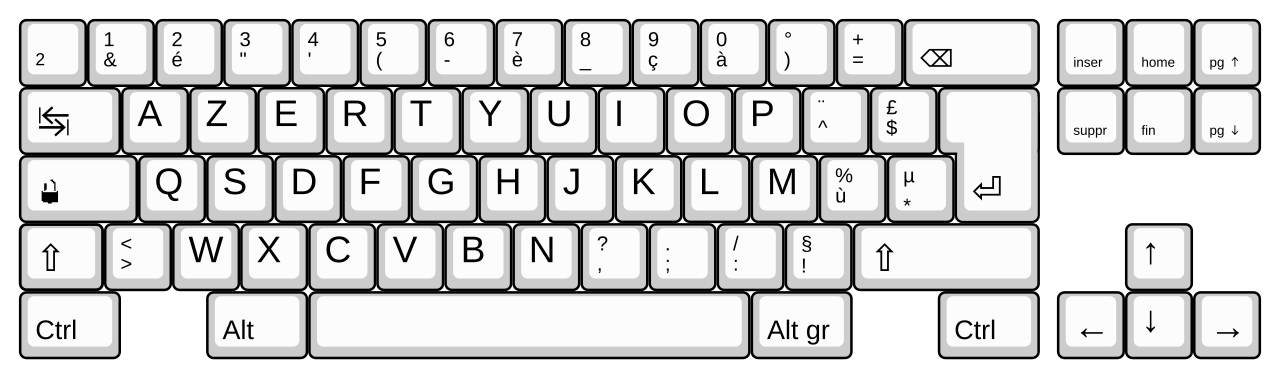
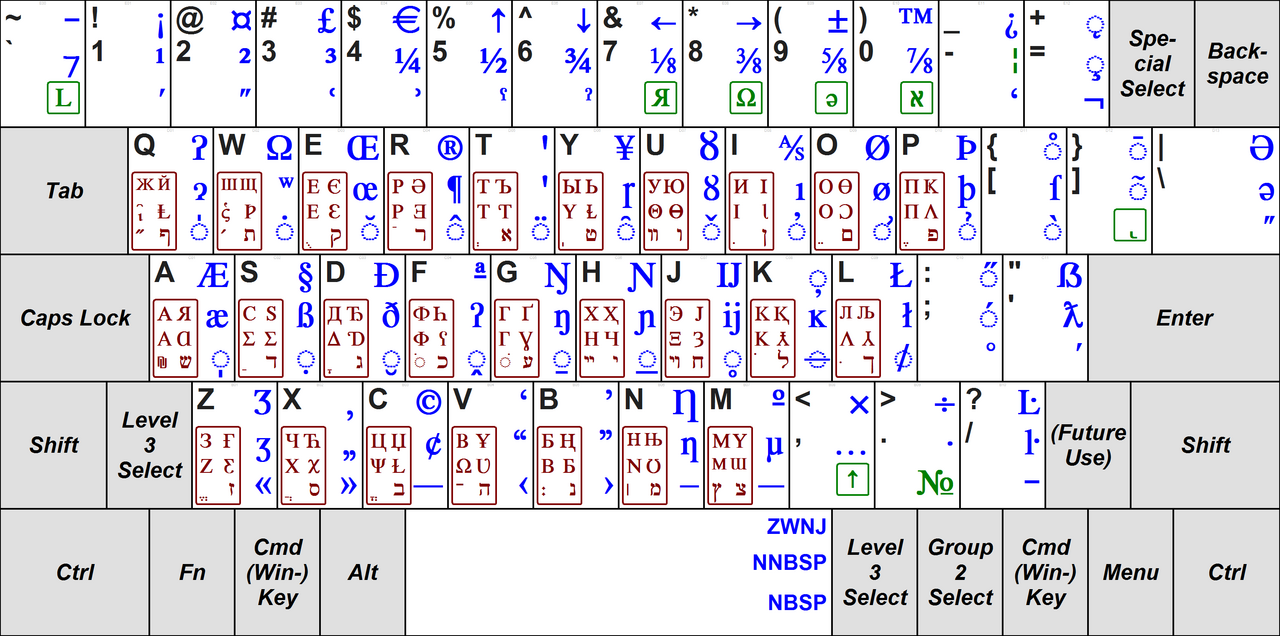
Greek keyboards use AltGr for extra symbols, like Cyrillic layouts.

Karl432 · Public domain
A Greek keyboard is a keyboard layout designed for typing the Greek alphabet. It is notable because, as the article describes, Cyrillic alphabet and Greek alphabet keyboards have similar arrangements to those for Latin alphabets, including a modified key labelled AltGr (alternative graphic) to the right of the space bar, which can be used to type an extra symbol in addition to the two otherwise available with an alphanumeric key, and using it simultaneously with the ⇧ Shift key usually gives access to a fourth symbol.
- Key types
- alphanumeric, modifier, navigation, function, system, numeric keypad
- Modifier keys
- ⇧ Shift, Ctrl, Alt, AltGr, Fn
- Additional symbols
- AltGr provides third-level symbols; AltGr+⇧ Shift provides fourth-level symbols
- Layout similarity
- similar arrangement to Cyrillic alphabet keyboards
Lore & Background
The article states that in most languages except English, additional letters (some with diacritics) are required, and some are present as standard on each national keyboard, as appropriate for its national language. These keyboards have another modified key, labelled AltGr (alternative graphic), to the right of the space bar. (US keyboards just have a second Alt key in this position.) It can be used to type an extra symbol in addition to the two otherwise available with an alphanumeric key, and using it simultaneously with the ⇧ Shift key usually gives access to a fourth symbol. These third-level and fourth-level symbols may be engraved on the right half of the key top, or they may be unmarked. The article notes that Cyrillic alphabet and Greek alphabet keyboards have similar arrangements.
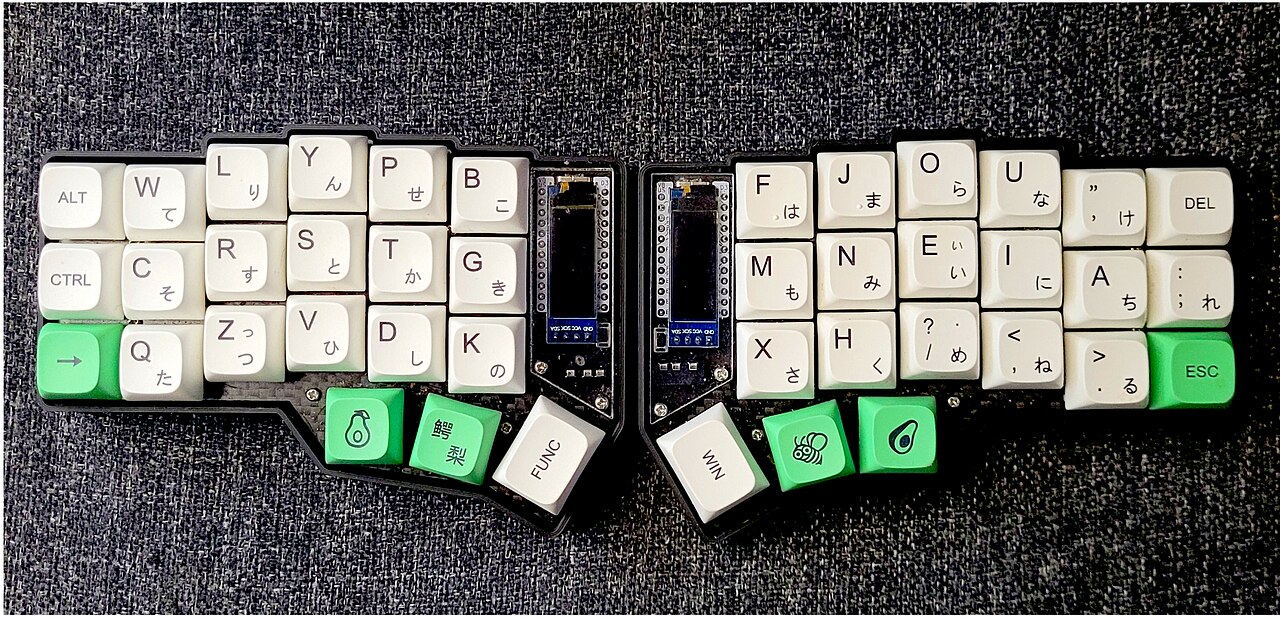
Different keyboard models vary in physical layout, such as in the number of keys and how they are positioned on the keyboard. However, most layouts localized for other languages differ in keycap legends rather than physical position. The core section of a keyboard consists of character keys, which can be used to type letters and other characters. Typically, there are three rows of keys for typing letters and punctuation, an upper row for typing digits and special symbols, and the Space bar on the bottom row. The positioning of the character keys is similar to the keyboard of a typewriter.
Reader's Guide
The Greek keyboard, as described in the article, is a localized layout that differs from English keyboards primarily in keycap legends rather than physical key positions. Its significance lies in its use of the AltGr modifier key to access additional Greek letters and symbols, following the same pattern as Cyrillic alphabet keyboards. The article explains that such national keyboards incorporate additional letters required for their language, and the AltGr key enables typing third-level and fourth-level symbols, which may be engraved on the key top or unmarked. This approach allows a standard physical keyboard to be dynamically mapped to any layout without switching hardware components—merely by changing the software that interprets the keystrokes. The legacy of the Greek keyboard is that it exemplifies how keyboard layouts adapt to different writing systems while maintaining the same underlying physical and functional principles. The article notes that modern keyboards send scancodes to the operating system, which converts them using a keyboard mapping table, so the symbol shown on the physical key-top need not be the same as appears on the screen. This flexibility means a Greek keyboard can be used with various software configurations, and its layout is part of the broader ecosystem of localized keyboards that serve specific language communities.
Did You Know?
- Greek alphabet keyboards have a similar arrangement to Cyrillic alphabet keyboards, including an AltGr key.
- Using AltGr simultaneously with the ⇧ Shift key on a Greek keyboard usually gives access to a fourth symbol.
Ancestral Roots in Telegraphy and Data Entry
The computer keyboard did not spring from a single breakthrough but from the slow convergence of two separate technological lineages. Teleprinters, capable of typing and transmitting text simultaneously across telegraph lines, were already in service by the 1870s, relaying stock-market data to ticker-tape displays. The more recognizable teleprinter form was refined between 1907 and 1910 by Charles Krum and his son Howard, with early contributions from Frank Pearne, building on independent earlier work by Royal Earl House and Frederick G. Creed. In parallel, Herman Hollerith's keypunch machines, which by the 1930s had grown typewriter-like text and number keys, handled data entry and storage. Together these two traditions—point-to-point communication and bulk data storage—imprinted the physical layouts still visible in today's keyboards. The earliest computers inherited this heritage directly: ENIAC relied on a keypunch for both input and paper-based output, while BINAC used an electromechanically driven typewriter to record data onto magnetic tape rather than paper.
Standards, Layouts, and the Geometry of Keys
Modern keyboards are governed by mechanical layout standards most often identified as ISO, ANSI, and JIS, corresponding roughly to worldwide, United States, and Japanese issuing bodies. The ANSI specification calls for keys spaced on three-quarter-inch centers with a minimum travel of 0.15 inches, while the ISO and JIS documents serve as the primary references for their respective regions. In practice the boundaries are porous: each standard also permits the other's approach. Key totals differ by convention—US-style boards typically carry 104 keys, whereas the 105-key arrangement is the norm elsewhere. Manufacturers routinely trim sections for compactness, the numeric keypad being the most frequently dropped cluster, yielding what is marketed as a tenkeyless design. Laptops and wireless peripherals often shed duplicate or seldom-used keys, though function and arrow keys are almost always retained. Ultimately, key size and spacing are bounded by the simple ergonomic requirement that a human finger must be able to press each key comfortably.
From Sole Interface to One Among Many
Since the 1970s, when keyboards supplanted punched cards and paper tape, the keyboard has been the principal way people talk to a computer. It held that position as the most tightly integrated peripheral well into the personal-computing era. The shift began in 1984, when the mouse entered the consumer market alongside a move from text-only, sparsely graphic screens toward icon-rich graphical interfaces. Touchscreens arrived in the 2000s, adding virtual keyboards to smartphones and tablets. Yet the physical keyboard has never been dethroned. It remains the core text-entry interface for word processors, web browsers, and social-media applications alike. Crucially, the keyboard itself carries no semantic meaning: the scan code it transmits merely reports which physical key was pressed or released. All interpretation—whether a stroke produces a letter, a symbol, or a system command—is delegated entirely to the software running on the machine.
Form Factors and the Engineering of the Keystroke
Keyboards are available in a spectrum of physical forms, each tuned to a particular use context. Full-size desktop boards present the widest repertoire: alphabetic characters, numerals, a dedicated numeric keypad, typographical symbols, punctuation, currency marks, diacritics, and a bank of function keys, with the engraved glyphs shaped by national language conventions. They also carry keys with no typewriter ancestor, such as the command or Windows keys. Laptop and notebook keyboards, by contrast, shorten both keystroke travel and over-travel distance, reduce the total key count, and frequently omit the numeric keypad altogether. Function keys may be relocated relative to their full-size positions. The internal switch mechanism also diverges: laptop boards more often employ scissor switches rather than rubber domes, a trend that runs opposite to the preference seen in full-size designs. Flexible keyboards sit between these two poles, blending attributes of conventional desktop and laptop construction.
Gallery
Frequently Asked Questions
What is a Greek keyboard?
A Greek keyboard is a key layout purpose-built for entering the Greek alphabet and its associated punctuation. It organizes its characters in a structure that closely mirrors the arrangements found in Latin and Cyrillic layouts.
What does the AltGr key do on a Greek keyboard?
AltGr, found to the right of the space bar, unlocks a third symbol on each alphanumeric key beyond the standard two. Holding it together with Shift reveals a fourth symbol, so a single key can produce up to four distinct characters.
How is a Greek keyboard similar to a Cyrillic keyboard?
Both layouts share a comparable arrangement of letters and modifier keys, and both place an AltGr key to the right of the space bar for accessing extra symbols. This common design philosophy makes the two layouts feel structurally familiar to one another.
Where is AltGr positioned on a Greek keyboard layout?
The AltGr key sits to the right of the space bar, the same spot it occupies on Cyrillic and many other non-Latin layouts. This placement keeps it within comfortable reach of the right hand during normal typing.
How many distinct symbols can one alphanumeric key produce on a Greek keyboard?
Each alphanumeric key can yield up to four different symbols: the base character, the Shift variant, the AltGr third-level symbol, and the AltGr-plus-Shift fourth-level symbol. This multi-level system lets a compact layout cover the full Greek character set without adding extra keys.
More in Computer Keyboards, Part 3 1-24
Spotted an error? Know more?
Reader corrections go straight into our review queue. Suggest an edit · How this site is sourced