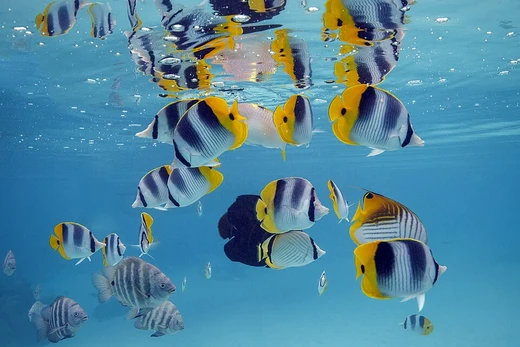
Chevron butterflyfish
A territorial butterflyfish with chevron markings, feeding on Acropora corals.

The chevron butterflyfish (Chaetodon trifascialis), also called the chevroned, triangulate, or V-lined butterflyfish, is a marine ray-finned fish in the family Chaetodontidae. It is found across a broad Indo-Pacific range. It is not the same as the melon butterflyfish, three-striped butterflyfish, or three-banded butterflyfish.
This fish has a relatively long, pale body marked with dark, V-shaped vertical lines. Its tail is black with a yellow rear edge, and a black band edged in pale runs through the eye. Juveniles have a black vertical band from the rear of the dorsal fin down the back to the rear of the anal fin, plus a yellow tail base and yellow pectoral fins. The dorsal fin has 13 to 15 spines and 14 to 16 soft rays; the anal fin has 3 to 5 spines and 13 to 15 soft rays. It can reach a total length of 18 centimeters (7.1 inches).
Its distribution spans the Indo-Pacific: from the western Indian Ocean along East Africa from Egypt to South Africa, across Indian Ocean islands, and into the Pacific to the Line Islands, Johnston Atoll, and Howland and Baker Islands. It ranges north to southern Japan and south to Lord Howe Island and Rapa Iti. In Australia, it appears from the Houtman Abrolhos to Beagle Reef, the Rowley Shoals and Scott Reef in Western Australia, the northern Great Barrier Reef off Queensland, some Coral Sea reefs, and as far south as Arrawarra Headland near Coffs Harbour in New South Wales. It also lives around the Cocos (Keeling) Islands and Christmas Island.
This territorial species inhabits semi-protected seaward and shallow lagoon reefs, closely tied to tabular and staghorn Acropora corals, whose polyps and mucus it eats. It is found at depths of 2 to 30 meters. Adults swim alone or, especially during breeding season, in pairs; juveniles stay hidden among coral branches. They are oviparous.
First formally described in 1825 by French naturalists Jean René Constant Quoy and Joseph Paul Gaimard, with the type locality given as Guam, the chevron butterflyfish has age-dependent color and an elongated shape. These traits have placed it in the monotypic subgenus Megaprotodon. Its closest living relatives appear to be species in the subgenera Discochaetodon (such as the eightband butterflyfish, C. octofasciatus) and Tetrachaetodon (such as the mirror butterflyfish, C. speculum).
- Maximum total length
- 18 centimetres (7.1 in)
- Dorsal fin spines
- 13-15
- Dorsal fin soft rays
- 14-16
- Anal fin spines
- 3-5
- Anal fin soft rays
- 13-15
- Depth range
- 2–30 m
- First described by
- Jean René Constant Quoy and Joseph Paul Gaimard in 1825
Lore & Background
The chevron butterflyfish has a relatively elongate pale body marked with dark vertical chevron markings. It has a black tail with yellow posterior margin, and a black band with pale edges running through the eye. Juveniles have a black vertical band from the rear of the dorsal fin over the rear of the body to the rear of the anal fins, with a yellow tail base and pectoral fins. This species attains a maximum total length of 18 centimetres.
It has a wide Indo-Pacific distribution, found from the western Indian Ocean along East Africa from Egypt to South Africa, across the Indian Ocean islands, and into the Pacific Ocean to the Line Islands, Johnston Atoll, and the Howland and Baker Islands. It extends north to southern Japan and south to Lord Howe Island and Rapa Iti. In Australia, it occurs from the Houtman Abrolhos to Beagle Reef, the Rowley Shoals and Scott Reef, the northern Great Barrier Reef, some Coral Sea reefs, and as far south as Arrawarra Headland near Coffs Harbour in New South Wales, as well as around Cocos (Keeling) Islands and Christmas Island.
The chevron butterflyfish is a territorial species occurring in semi-protected seaward and shallow lagoon reefs, closely associated with tabular and staghorn (Acropora) corals, the polyps and mucus of which they eat. Adults swim alone or in pairs during breeding season, while juveniles are secretive among coral branches. They are oviparous.
Reader's Guide
The chevron butterflyfish is notable for its age-dependent coloration and elongated outline, which has led to its placement in the monotypic subgenus Megaprotodon. Its closest living relatives appear to be species of the subgenera Discochaetodon (e.g., eightband butterflyfish) and Tetrachaetodon (e.g., mirror butterflyfish). These and perhaps other subgenera would use Megaprotodon as a genus name if Chaetodon is split up. The species was first formally described in 1825 by French naturalists Jean René Constant Quoy and Joseph Paul Gaimard, with the type locality given as Guam. Its ecological significance lies in its specialized diet of Acropora coral polyps and mucus, making it dependent on healthy coral reef habitats. The species is widely distributed across the Indo-Pacific, from East Africa to central Pacific islands, and is found at depths from 2 to 30 meters. Its territorial behavior and secretive juvenile stage contribute to its survival in semi-protected reef environments.
Did You Know?
- The chevron butterflyfish is also known as chevroned butterflyfish, triangulate butterflyfish, or V-lined butterflyfish.
- It has a black tail with a yellow posterior margin and a black band with pale edges through the eye.
More in Butterflyfish 1-24
Spotted an error? Know more?
Reader corrections go straight into our review queue. Suggest an edit · How this site is sourced