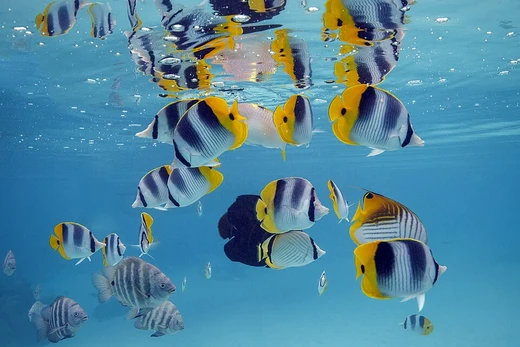
Chaetodontidae
Tropical marine fish of the family Chaetodontidae, including bannerfish and coralfish.

Butterflyfish, along with bannerfish and coralfish, belong to the family Chaetodontidae. This group includes roughly 129 species spread across 12 genera, primarily inhabiting coral reefs in the Atlantic, Indian, and Pacific Oceans. Within the large genus *Chaetodon*, several species pairs exist in the Indian and Pacific Oceans. Though they resemble smaller angelfish (Pomacanthidae), butterflyfish lack the preopercle spines on their gill covers. Some *Heniochus* species look similar to the Moorish idol (*Zanclus cornutus*), the sole member of the family Zanclidae. All three families are part of the order Acanthuriformes and share similar reef habitats.
Most butterflyfish measure between 12 and 22 cm (4.7 to 8.7 in) long, with the largest—the lined butterflyfish and the saddle butterflyfish (*C. ephippium*)—reaching up to 30 cm (12 in). Their name comes from the bright, patterned bodies of many species, which display black, white, blue, red, orange, and yellow; others are more drab. These fish are a diverse group of marine percoids found on nearly every coral reef system in tropical seas. Their vivid colors and patterns have drawn much study, yielding extensive knowledge about their behavior and ecology. Many species have eyespots on their sides and dark bands across their eyes, reminiscent of butterfly wings. Their deep, laterally compressed bodies stand out among the crowded reef life, and their bright coloration may help with communication between species. Butterflyfish have uninterrupted dorsal fins and tail fins that are rounded or truncated, never forked.
Active during the day, butterflyfish usually stay in waters less than 18 m (59 ft) deep, though some can descend to 180 m (590 ft). They stick to specific home ranges. Coral-eating species are especially territorial, forming pairs and claiming a particular coral head. In contrast, those that feed on zooplankton gather in large groups. At night, they hide in reef crevices and change color noticeably. Their striking appearance makes them popular in aquariums, but most species eat coral polyps and sea anemones. Balancing predator and prey populations is tricky, so hobbyists tend to keep only the few generalists or specialist zooplankton feeders. Butterflyfish are pelagic spawners, releasing many buoyant eggs into the water that drift with currents as plankton until hatching.
- Number of species
- approximately 129
- Number of genera
- 12
- Length range
- 12 to 22 cm (4.7 to 8.7 in)
- Largest species length
- 30 cm (12 in)
- Depth range
- less than 18 m (59 ft) (some species descend to 180 m (590 ft))
- Earliest confirmed fossil period
- Early Oligocene
Lore & Background
Butterflyfish mostly range from 12 to 22 cm (4.7 to 8.7 in) in length. The largest species, the lined butterflyfish and the saddle butterflyfish, C. ephippium, grow to 30 cm (12 in). The common name references the brightly coloured and strikingly patterned bodies of many species, bearing shades of black, white, blue, red, orange, and yellow. Other species are dull in colour. Butterflyfish are a boundless, different group of marine percoids with delegates on practically all coral reef frameworks and in every single tropical ocean. Their bright and color patterns have drawn in much consideration, creating an abundance of data about their conduct and environment. Many have eyespots on their flanks and dark bands across their eyes, not unlike the patterns seen on butterfly wings. Their deep, laterally narrow bodies are easily noticed through the profusion of reef life. The conspicuous coloration of butterflyfish may be intended for interspecies communication. Butterflyfish have uninterrupted dorsal fins with tail fins that may be rounded or truncated, but are never forked.
Generally diurnal and frequenting waters less than 18 m (59 ft) deep (though some species descend to 180 m (590 ft), butterflyfish stick to particular home ranges. These corallivores are especially territorial, forming pairs and staking claim to a specific coral head. Contrastingly, the zooplankton feeders form large conspecific groups. By night, butterflyfish hide in reef crevices and exhibit markedly different coloration. Their coloration also makes them popular aquarium fish. However, most species feed on coral polyps and sea anemones. Balancing the relative populations of prey and predator is complex, leading hobby aquarists to focus on the few generalists and specialist zooplankton feeders.
Butterflyfish are pelagic spawners; that is, they release many buoyant eggs into the water, which become part of the plankton, floating with the currents until hatching. The fry go through a tholichthys stage, wherein the body of the postlarval fish is covered in large, bony plates extending from the head. They lose their bony plates as they mature. Only one other family of fish, the scats (Scatophagidae) express such an armored stage.
Reader's Guide
The Chaetodontidae can be, but are not usually, divided into two lineages that arguably are subfamilies. The subfamily name Chaetodontinae is a little-used leftover from the period when the Pomacanthidae and Chaetodontidae were united under the latter name as a single family. Hence, Chaetodontinae is today considered a junior synonym of Chaetodontidae. In any case, one lineage of Chaetodontidae (in the modern sense) contains the 'typical' butterflyfish around Chaetodon, while the other unites the bannerfish and coralfish genera. As the Perciformes are highly paraphyletic, the precise relationships of the Chaetodontidae as a whole are badly resolved. Chaetodontidae is classified within the suborder Percoidei by the 5th edition of Fishes of the World, but they are placed in an unnamed clade which sits outside the superfamily Percoidea. This clade contains 7 families which appear to have some relationship to Acanthuroidei, Monodactylidae, and Priacanthidae. Other authorities have placed the family in the order Chaetodontiformes alongside the family Leiognathidae. Presently, based on the most recent phylogenetic analyses, Eschmeyer's Catalog of Fishes places it in the large, diverse order Acanthuriformes. Molecular analyses suggest that the Chaetodontidae shared a common ancestor with the Scatophagidae and Pomacanthidae that lived during the Early Eocene (54 Ma). Before DNA sequencing, the taxonomy was confused about whether to treat these as species or subspecies. Also, numerous subgenera have been proposed for splitting out of Chaetodon, and it is becoming clear how to subdivide the genus if that is desired. The fossil record of this group is disputed and marginal. Their restriction to coral reefs means their carcasses are liable to be dispersed by scavengers, overgrown by corals, and any that do fossilize will not long survive erosion. Many Eocene-aged fish such as Pygaeus have been variously referred to Chaetodontidae in the past; if used for calibration, it can be deduced that most living genera were probably distinct by the end of the Paleogene 23 Mya. However, these Eocene genera cannot be reliably referred to Chaetodontidae. The earliest confirmed fossil specimens of Chaetodontidae are an indeterminate larval specimen from Frauenweiler, Germany, two tholichthys specimens from the Menilite Formation of Poland, as well as the extinct species Chaetodon (Blumchaetodon) wattsi from Italy; all date to the Early Oligocene. The occurrence of the first confirmed butterflyfish in the Early Oligocene is supported by molecular phylogenies indicating that the family may have arose during the Late Eocene.
Did You Know?
- Butterflyfish lack preopercle spines at the gill covers, unlike angelfish.
- The fry go through a tholichthys stage with large, bony plates extending from the head.
- Only one other fish family, the scats (Scatophagidae), has such an armored stage.
- The earliest confirmed butterflyfish fossils date to the Early Oligocene.
Striking Appearance and Body Design
Butterflyfish are among the most visually arresting residents of tropical coral reefs, and their common name is well earned. Most species measure between twelve and twenty-two centimeters, though the lined butterflyfish and the saddle butterflyfish push the upper boundary to roughly thirty centimeters. Their bodies are deep and laterally compressed, making them immediately noticeable amid the dense chaos of reef life. Many display a dazzling palette of black, white, blue, red, orange, and yellow, while others remain comparatively drab. A recurring motif across the family is the eyespot on the flank paired with a dark band running through the eye, patterns that echo the wing markings of terrestrial butterflies. Their dorsal fin runs as a single unbroken arc, and the caudal fin is either rounded or squared off but never forked. At a glance, butterflyfish can be mistaken for smaller angelfish, yet they lack the preopercle spines that angelfish carry on their gill covers. A handful of Heniochus species even mimic the silhouette of the Moorish idol. Researchers suspect that much of this conspicuous coloration serves as a form of interspecies communication within the reef community.
Daily Rhythms, Territory, and Reproduction
Butterflyfish are broadly diurnal animals that patrol the shallower reaches of coral reefs, typically staying above eighteen meters, although a few species are known to descend as far as one hundred eighty meters. Each individual or pair maintains a well-defined home range. The corallivorous species are intensely territorial: they form breeding pairs and defend a specific coral head, feeding on polyps and sea anemones. In stark contrast, those that graze on zooplankton tend to aggregate in large groups of their own kind. When darkness falls, the scene shifts dramatically. Butterflyfish retreat into crevices in the reef structure and their coloration changes markedly, a nightly transformation that distinguishes them from their daytime appearance. Reproduction follows a pelagic strategy: adults release clouds of buoyant eggs directly into the open water, where the eggs drift as part of the plankton until they hatch. The resulting fry pass through a remarkable tholichthys stage, during which their bodies are encased in large bony plates extending from the head. They shed this armor as they mature. Only one other fish family, the scats, is known to exhibit a comparable armored larval phase.
Taxonomic Debates and a Shallow Fossil Record
The family Chaetodontidae, described by Rafinesque in 1815, encompasses roughly one hundred twenty-nine species spread across twelve genera, and its internal structure has long resisted clean classification. Two broad lineages are generally recognized: one centered on the enormous genus Chaetodon and its close relative Prognathodes, and another uniting the bannerfish and coralfish genera. The subfamily name Chaetodontinae is a vestige of an older arrangement that lumped angelfish and butterflyfish together, and it is now treated as a junior synonym of the family itself. Placement within the broader tree of fish has shifted repeatedly; authorities have variously assigned the family to Percoidei, to an unnamed clade outside Percoidea, to a separate order Chaetodontiformes, or, most recently, to the large order Acanthuriformes. Molecular phylogenies point to a common ancestor shared with the scats and angelfish that lived around fifty-four million years ago in the Early Eocene. The fossil record, however, is frustratingly thin. Coral-reef habitats make preservation unlikely, and the earliest confirmed specimens, a larval fish from Germany, two tholichthys from Poland, and the extinct Blumchaetodon wattsi from Italy, all date to the Early Oligocene.
Aquarium Appeal and the Challenge of Keeping Them
The vivid patterns and compact size of butterflyfish have made them perennial favorites in the marine aquarium hobby, and their bright coloration has attracted a wealth of observational data on their behavior and ecology. Yet keeping them successfully is far from straightforward. The majority of species are specialized corallivores, relying on coral polyps and sea anemones for sustenance, a dietary requirement that is extremely difficult to replicate in captivity. The interplay between predator and prey populations in a reef system is intricate, and this complexity translates directly into the aquarium context. As a result, experienced hobbyists tend to gravitate toward the small number of generalist feeders and the specialist zooplankton eaters, which are more adaptable to artificial feeding regimens. Butterflyfish are distributed across the coral reefs of the Atlantic, Indian, and Pacific Oceans, and within the vast genus Chaetodon, certain species pairs occupy the Indian and Pacific basins as geographic counterparts. Their popularity in the trade, combined with their restricted reef habitat, underscores the tension between human fascination and the ecological fragility of the ecosystems they call home.
Frequently Asked Questions
What is Chaetodontidae?
Chaetodontidae is the taxonomic family that unites butterflyfish, bannerfish, and coralfish under one group. It represents a collection of tropical marine fish tied to coral reef habitats in the Atlantic, Indian, and Pacific Oceans.
How many species and genera make up Chaetodontidae?
The family encompasses roughly 129 species distributed across 12 genera, with the genus Chaetodon accounting for the largest share. Within Chaetodon, several closely related species pairs occur in the Indian and Pacific Oceans.
How big do butterflyfish typically grow?
Most members of the family measure between 12 and 22 cm (about 4.7 to 8.7 inches) in standard length. The largest species in the group can reach approximately 30 cm (12 inches).
Where do butterflyfish live and how deep can they be found?
They are primarily coral-reef dwellers, with the majority staying above 18 meters (around 59 feet). A handful of species are recorded at much greater depths, descending to roughly 180 meters (590 feet).
How do butterflyfish differ from the angelfish they're often confused with?
Although the two families look superficially alike, butterflyfish do not have the preopercle spines on their gill covers that characterize angelfish (Pomacanthidae). Some Heniochus species can also be mistaken for the Moorish idol, which actually belongs to its own separate family, Zanclidae.
More in Butterflyfish 1-24
Spotted an error? Know more?
Reader corrections go straight into our review queue. Suggest an edit · How this site is sourced