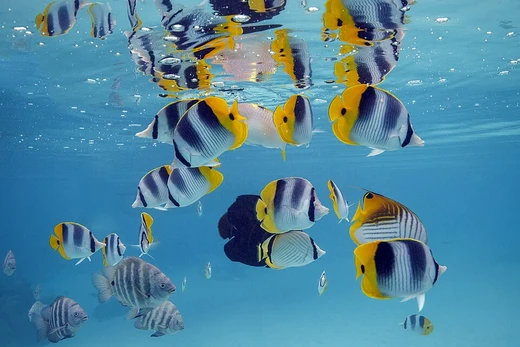
Chaetodon auripes
A yellow butterflyfish with a black eye band, found in East Asian waters.

The oriental butterflyfish (*Chaetodon auripes*) is a marine ray-finned fish in the family Chaetodontidae. It lives in the western Pacific Ocean, along the coasts of East Asia. Its body is a vivid yellow, with the dorsal, anal, and caudal fins also yellow. A wide vertical black band runs through the eye, with a thinner white band just behind it. Juveniles have a black spot (ocellus) on the upper part of the soft-rayed dorsal fin, which fades as they mature. The dorsal fin has 12 spines and 23–24 soft rays; the anal fin has 3 spines and 18–19 soft rays. The species reaches a total length of 20 cm (7.9 in).
First formally described in 1901 by David Starr Jordan and John Otterbein Snyder, the type locality is Nagasaki. Within its genus, it belongs to the large subgenus *Rabdophorus*, which some consider a separate genus. The species occurs from Japan (including the Ryukyu, Izu, and Ogasawara Islands) and southwestern South Korea to the southern coasts of China and Vietnam. It typically lives at depths of 1 to 30 m (3.3 to 98.4 ft), but has been recorded as deep as 150 m (490 ft). Adults are usually found on rocky reefs with coral and algae; juveniles inhabit tidal pools and sheltered shallow rocky areas. They gather in groups but are also seen alone. This butterflyfish tolerates cooler waters than others, surviving temperatures as low as 10 °C (50 °F) off Japan. It feeds on filamentous algae, worms, crustaceans, soft corals, stony corals, sea anemones, and other benthic invertebrates. The species appears in the aquarium trade but is rare.
- First formally described
- 1901
- Described by
- David Starr Jordan and John Otterbein Snyder
- Type locality
- Nagasaki
- Maximum total length
- 20 cm (7.9 in)
- Depth range
- 1 to 30 m (3.3 to 98.4 ft), known to occur as deep as 150 m (490 ft)
- Dorsal fin
- 12 spines and 23-24 soft rays
- Anal fin
- 3 spines and 18-19 soft rays
Lore & Background
Chaetodon auripes was first formally described in 1901 by the American ichthyologists David Starr Jordan and John Otterbein Snyder, with the type locality given as Nagasaki. Within its genus, this species belongs to the large subgenus Rabdophorus, which might warrant recognition as a full genus, separate from Chaetodon.
Chaetodon auripes has a vividly yellow body, and the dorsal, anal and caudal fins are also yellow. There is a wide vertical black band running through the eyes and a slightly thinner white band immediately behind that. Juveniles have a black ocellus on the upper part of the soft-rayed part of the dorsal fin, but this fades as the fish matures.
This species is found in the western Pacific Ocean, from Japan (including the Ryukyu Islands, the Izu Islands and the Ogasawara Islands) and the southwest of South Korea to the southern coasts of China and Vietnam. It typically occurs at depths of 1 to 30 m, and is known to occur as deep as 150 m. Adults are usually found on rocky reefs where coral and algae are present, while juveniles are usually found in tidal pools and sheltered rocky areas in shallow water. They gather in aggregations, although they are also often encountered as solitary individuals. This species lives in cooler waters than other butterflyfish, being able to tolerate temperatures down to 10 °C off Japan. It feeds on filamentous algae as well as worms, crustaceans, soft corals, stony corals, sea anemones, and other benthic invertebrates.
Reader's Guide
Chaetodon auripes holds significance as a representative of the butterflyfish family in the western Pacific, particularly in East Asian waters. Its description in 1901 by Jordan and Snyder adds to the historical record of ichthyology in the region. The species is notable for its tolerance of cooler waters, down to 10 °C, which distinguishes it from other butterflyfish. Its diet is broad, encompassing filamentous algae, worms, crustaceans, soft corals, stony corals, sea anemones, and other benthic invertebrates, indicating a generalist feeding strategy. The species is found in the aquarium trade but is rare, suggesting limited but existing interest among hobbyists. Its placement within the subgenus Rabdophorus, which might warrant recognition as a full genus, reflects ongoing taxonomic discussion within the family Chaetodontidae. The species' occurrence in habitats ranging from tidal pools to depths of 150 m, and its social behavior of gathering in aggregations or being solitary, illustrate its adaptability. Overall, Chaetodon auripes contributes to the biodiversity of rocky reefs and coral areas in East Asia, and its presence in cooler waters expands the ecological range of butterflyfish.
Did You Know?
- It can tolerate water temperatures as low as 10 °C off Japan, cooler than other butterflyfish.
- Juveniles have a black ocellus on the dorsal fin that fades as they mature.
Taxonomy & Classification
First formally named in 1901 by American ichthyologists David Starr Jordan and John Otterbein Snyder, Chaetodon auripes entered the scientific record with Nagasaki, Japan, designated as its type locality. The species sits within the butterflyfish family Chaetodontidae, a group of marine ray-finned fishes known for their striking coloration. Within the genus Chaetodon, this particular butterflyfish is assigned to the large subgenus Rabdophorus, a grouping so distinct that taxonomists have suggested it may ultimately deserve elevation to a full genus in its own right, separate from Chaetodon. This taxonomic ambiguity highlights the ongoing debate over how to delineate boundaries among the many butterflyfish species. Despite being described over two centuries ago, the oriental butterflyfish retains a certain taxonomic fluidity, reminding us that classification in marine ichthyology remains an evolving discipline. Its placement within Rabdophorus distinguishes it from the more numerous species in the core Chaetodon group and underscores the morphological and ecological diversity hidden within what was once considered a single, undifferentiated genus.
Physical Appearance & Development
The oriental butterflyfish is immediately recognizable by its brilliant yellow coloration, which covers the entire body as well as the dorsal, anal, and caudal fins. Cutting across this vivid yellow is a broad vertical black band that passes directly through the eye, creating a dramatic mask. Just behind this dark stripe runs a narrower white band, adding a crisp contrast to the fish's face. One of the most notable developmental features is a black ocellus, a false eye spot, located on the upper portion of the soft-rayed section of the dorsal fin in juvenile fish. As the individual matures, this ocellus gradually fades and eventually disappears entirely. In terms of fin architecture, the dorsal fin bears twelve spines followed by twenty-three or twenty-four soft rays, while the anal fin carries three spines and eighteen or nineteen soft rays. The species reaches a maximum total length of approximately twenty centimeters, making it a moderate-sized member of the butterflyfish family. The combination of its bold coloration, distinctive facial markings, and the transient juvenile eye spot gives Chaetodon auripes a visual identity unlike any other species in its range.
Range, Depth & Habitat
Chaetodon auripes occupies a relatively restricted stretch of the western Pacific Ocean, stretching from the waters around Japan, including the Ryukyu, Izu, and Ogasawara island chains, southward through the southwest coast of South Korea and along the southern shores of China and Vietnam. This distribution places it in noticeably cooler marine environments than those favored by most other butterflyfish species. Off the Japanese coast, the fish can tolerate water temperatures as low as ten degrees Celsius, a remarkable adaptation within the family. In terms of depth, adults are typically encountered between one and thirty meters, though records extend to an extraordinary one hundred and fifty meters, suggesting occasional forays into much deeper water. Habitat preferences shift with life stage: juveniles favor the protected shallows of tidal pools and sheltered rocky areas, while adults settle onto rocky reefs where coral and algae communities are established. The species is social in the sense that it forms aggregations, yet individuals are also frequently observed alone, reflecting a flexible social structure.
Diet & Human Interaction
As a benthic forager, Chaetodon auripes maintains a varied and opportunistic diet drawn from the rich invertebrate and algal communities of its rocky reef habitat. Its menu includes filamentous algae, a range of worms, and various crustaceans, but it also consumes soft corals, stony corals, and sea anemones, along with other benthic invertebrates. This dietary breadth positions the oriental butterflyfish as a generalist within its cooler-water niche, unlike many tropical butterflyfish relatives that are more specialized. The species' ability to thrive in waters as cold as ten degrees Celsius off Japan further distinguishes its ecological role from the predominantly warm-water butterflyfishes found across the Indo-Pacific. In terms of human interaction, the oriental butterflyfish does appear in the aquarium trade, though it remains a rare sight in home aquaria. Its preference for cooler temperatures and specific rocky-reef conditions likely contributes to the difficulty of keeping it outside its natural habitat, making encounters with this vivid yellow fish in a tank a notable event for marine enthusiasts.
Frequently Asked Questions
What is Chaetodon auripes?
Chaetodon auripes, commonly called the oriental butterflyfish, is a small marine ray-finned fish belonging to the family Chaetodontidae. It is native to the western Pacific Ocean, where it inhabits coastal waters along East Asian shores.
Where does Chaetodon auripes live and at what depth?
This species is found along the coasts of East Asia in the western Pacific, typically ranging from about 1 to 30 meters below the surface. It has, however, been recorded at depths as great as 150 meters, suggesting it can venture well into deeper zones.
What does Chaetodon auripes look like?
Its body and the dorsal, anal, and caudal fins are all a striking yellow, broken up by a broad vertical black stripe through the eye and a narrower white stripe immediately behind it. Young individuals also display a dark ocellus on the upper soft-rayed portion of the dorsal fin, a marking that gradually fades as the fish matures.
How big does Chaetodon auripes get?
The oriental butterflyfish reaches a maximum total length of roughly 20 centimeters, or about 8 inches, making it a modestly sized member of the butterflyfish family.
Who first described Chaetodon auripes and when?
The species was formally described in 1901 by ichthyologists David Starr Jordan and John Otterbein Snyder. Their type locality for the description was Nagasaki, Japan.
More in Butterflyfish 1-24
Spotted an error? Know more?
Reader corrections go straight into our review queue. Suggest an edit · How this site is sourced