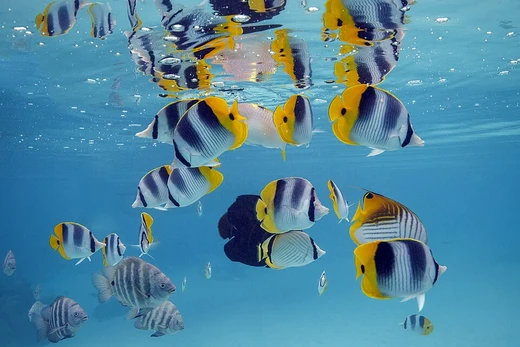
Chaetodon argentatus
A silver butterflyfish with a net-like pattern from the western Pacific.

Chaetodon argentatus, commonly known as the Asian butterflyfish, three band butterflyfish, or black pearlscaled butterflyfish, is a species of marine ray-finned fish in the family Chaetodontidae. It is native to the western Pacific Ocean and is notable for its distinctive silver body marked by a net-like pattern of diagonal black lines, along with two black saddle marks and a black vertical band at the rear.
- Maximum total length
- 20 centimetres (7.9 in)
- Dorsal fin spines
- 13-14
- Dorsal fin soft rays
- 21-22
- Anal fin spines
- 3
- Anal fin soft rays
- 15-16
- First described by
- Hugh McCormick Smith and Lewis Radcliffe
- Year described
- 1911
- Type locality
- Agojo Point, Catanduanes Islands, off southern Luzon Island, Philippines
Lore & Background
Chaetodon argentatus was first formally described in 1911 by American ichthyologists Hugh McCormick Smith and Lewis Radcliffe, with the type locality given as Agojo Point on the Catanduanes Islands off southern Luzon Island in the Philippines. The species has a silver body marked by a mesh of diagonal black lines creating a net-like pattern, along with two black saddle marks and a black vertical band at the rear running from the soft-rayed part of the dorsal fin to the equivalent part of the anal fin. It attains a maximum total length of 20 centimetres.
In the wild, Chaetodon argentatus has hybridised off southern Japan with the crosshatch butterflyfish (Chaetodon xanthurus). It is found over the outer slopes of coral or rocky reefs and drop-offs, with habitat varying by location: off southern Japan it lives over rocky areas, while in more southerly parts of its distribution it associates with coral reefs. Typically observed in pairs or small schools, it is an oviparous species that forms pairs to breed. Its diet is omnivorous, including filamentous algae, crustaceans, worms, sponges, bivalves, soft and stony corals, hydroids, and other invertebrates.
Reader's Guide
Chaetodon argentatus is uncommon in the aquarium trade outside Japan, though it is relatively easy to maintain in an aquarium. Its comparatively muted colouration means it is not as popular as its congeners. The species is distributed from the Ryukyu and Izu Islands of southern Japan south to the northern Philippines and east to Taiwan. Its presence on outer slopes of coral or rocky reefs and drop-offs, and its tendency to form pairs or small schools, contribute to its ecological role as an omnivore feeding on a wide variety of organisms including algae, crustaceans, worms, sponges, bivalves, corals, hydroids, and other invertebrates. The documented hybridization with Chaetodon xanthurus off southern Japan highlights its genetic interactions within the genus. Despite its limited popularity in the aquarium trade, its distinctive net-like pattern and silver coloration make it a recognizable species within its range.
Did You Know?
- Chaetodon argentatus was first described in 1911 by Hugh McCormick Smith and Lewis Radcliffe.
- It has hybridised in the wild off southern Japan with the crosshatch butterflyfish (Chaetodon xanthurus).
- This species attains a maximum total length of 20 centimetres (7.9 in).
Morphology & Appearance
The Asian butterflyfish presents a striking yet understated silhouette in the water. Its body is predominantly silver, overlaid with an intricate lattice of diagonal black lines that form a net-like mesh across the flanks. Two bold black saddle marks sit along the upper body, while a vertical black band stretches from the soft-rayed portion of the dorsal fin down to the matching section of the anal fin, anchoring the rear of the fish. The dorsal fin carries between thirteen and fourteen spines alongside twenty-one or twenty-two soft rays, and the anal fin holds three spines paired with fifteen or sixteen soft rays. At full maturity, an individual reaches a maximum total length of roughly twenty centimetres, or about eight inches. The overall effect is one of geometric precision rather than the vivid hues more commonly associated with tropical reef fish, giving the species its alternate common names of black pearlscaled butterflyfish and three band butterflyfish.
Range & Habitat
The Asian butterflyfish occupies a relatively compact stretch of the western Pacific Ocean. Its known range extends from the Ryukyu and Izu Islands off southern Japan southward to the northern Philippines, and eastward to the waters around Taiwan. Within this zone, the species favours the outer slopes of coral or rocky reefs as well as steep drop-offs, positioning itself in deeper, more exposed reef environments rather than shallow lagoon flats. An interesting regional distinction emerges across its distribution: off southern Japan the fish is typically encountered over rocky substrates, whereas in the more tropical, southerly portions of its range it shows a clear association with living coral reef structures. In terms of social behaviour, observers most often record the species in pairs or in small, loose schools rather than in large aggregations. These behavioural and habitat preferences together paint a picture of a reef-dwelling butterflyfish that thrives in the transitional zone where reef structure meets open water.
Taxonomy & Discovery
The formal scientific recognition of Chaetodon argentatus dates to 1911, when two American ichthyologists, Hugh McCormick Smith and Lewis Radcliffe, published the species description. Smith, who lived from 1865 to 1941, and Radcliffe, who lived from 1880 to 1950, designated the type locality as Agojo Point on the Catanduanes Islands, situated off the southern coast of Luzon in the Philippines. This makes the species a product of early twentieth-century Pacific ichthyological exploration, a period when many western Pacific reef fishes were being catalogued for the first time. Beyond its original description, the species has an intriguing taxonomic footnote: off southern Japan, it has been documented hybridising in the wild with the crosshatch butterflyfish, Chaetodon xanthurus. Such natural hybridisation between closely related butterflyfish species is a reminder that taxonomic boundaries in reef ecosystems can be more fluid than the formal classification suggests, and it adds a layer of biological complexity to what is otherwise a straightforward species account.
Diet, Breeding & Aquarium Presence
As an omnivore, the Asian butterflyfish maintains a notably broad menu. Its diet encompasses filamentous algae, a variety of crustaceans, marine worms, sponges, bivalve molluscs, both soft and stony corals, hydroids, and assorted other invertebrates, reflecting the diverse food web available on the outer reef slopes it inhabits. Reproductively, the species is oviparous and forms dedicated breeding pairs, a social structure that aligns with the paired or small-school behaviour observed in the wild. In the aquarium world, Chaetodon argentatus occupies a modest niche. Outside of Japan it is relatively uncommon in the trade, and even where available, its comparatively muted silver-and-black colouration means it does not attract the same enthusiasm as more flamboyant congeners. That said, those who do keep it note that the species is relatively straightforward to maintain in a home aquarium, making it a rewarding choice for hobbyists who appreciate subtlety and geometric patterning over bold, saturated hues.
Frequently Asked Questions
What is Chaetodon argentatus?
It is a species of marine butterflyfish in the family Chaetodontidae, native to the western Pacific. You'll also see it called the Asian butterflyfish, three band butterflyfish, or black pearlscaled butterflyfish.
What does Chaetodon argentatus look like?
The fish has a silver body overlaid with a net-like lattice of diagonal black lines, two black saddle marks along the back, and a black vertical band near the tail. This bold silver-and-black pattern is what earns it the 'black pearlscaled' nickname.
Where does Chaetodon argentatus live?
This species is native to the western Pacific Ocean, where it inhabits marine reef environments. It is a ray-finned fish confined to that tropical and subtropical region.
How big does Chaetodon argentatus grow?
Adults reach a maximum total length of about 20 centimetres (roughly 8 inches). Fin counts include 13–14 dorsal spines with 21–22 soft rays, and 3 anal spines paired with 15–16 soft rays.
Who first described Chaetodon argentatus?
The species was formally named and described by Hugh McCormick Smith and Lewis Radcliffe. It sits within the butterflyfish family Chaetodontidae alongside many other colorful reef species.
More in Butterflyfish 1-24
Spotted an error? Know more?
Reader corrections go straight into our review queue. Suggest an edit · How this site is sourced