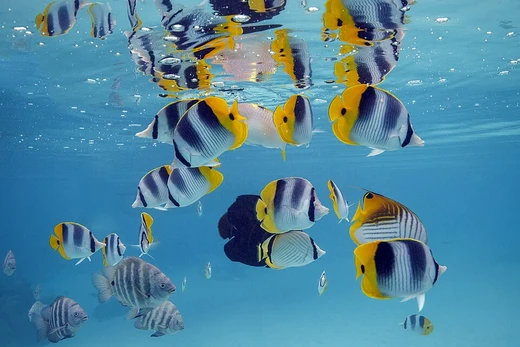
Banded butterflyfish
A tropical Atlantic butterflyfish with disruptive banding and a stable population.

The banded butterflyfish (Chaetodon striatus) is a species of marine ray-finned fish, a butterflyfish found in the tropical western Atlantic Ocean from Brazil to Bermuda. It is also known by common names such as the butterbun, the Portuguese butterfly, the school mistress, and the banded mariposa. Its name derives from the dark vertical bands on its body, which, combined with a vertical black bar through the eye, serve as an antipredator adaptation by disrupting the body's outlines.
- Maximum length
- about 16 cm (6.3 in)
- Dorsal fin spines
- 12
- Dorsal fin soft rays
- 19 to 21
- Anal fin spines
- 3
- Anal fin soft rays
- 16 to 17
- Depth range
- down to about 55 metres (180 ft), mostly less than 20 metres (66 ft)
- Conservation status
- least concern
Lore & Background
The banded butterflyfish grows to a maximum length of about 16 cm. Its dorsal fin has 12 spines and 19 to 21 soft rays, while the anal fin has 3 spines and 16 to 17 soft rays. The body is silvery with a slender black bar through the eye, two wide black bars in mid-body, and a third wide bar starting on the rear of the dorsal fin and continuing to the caudal peduncle. The pelvic fins and caudal fin are black.
This fish is native to the tropical and subtropical western Atlantic Ocean, ranging from Massachusetts in the United States to Santa Catarina in Brazil, including the Caribbean Sea, the Gulf of Mexico, Bermuda, and Saint Peter and Saint Paul Archipelago. It is a benthic fish found on coral reefs at depths mostly less than 20 metres.
The banded butterflyfish is usually seen singly or in pairs, but can occur in small shoals of about twenty individuals. Its diet mainly includes small invertebrates, crustaceans, coral polyps, polychaete worms, tube worms, sea anemones, and various eggs. It also feeds on plankton in the water column, in schools of up to 20 individuals. Sometimes it acts as a cleaning fish, removing external parasites from surgeon fishes, grunts, and parrot fishes.
Reader's Guide
The banded butterflyfish is a common species with a wide range across the tropical western Atlantic. Although it is sometimes harvested for the reef aquarium trade, this is not thought to significantly impact the population, which is believed to be stable. The International Union for Conservation of Nature has rated the fish's conservation status as being of least concern. Its distinctive banding pattern, which serves as an antipredator adaptation, makes it notable among butterflyfishes. The species is also recognized by multiple common names, reflecting its familiarity in different regions. Its role as a cleaner fish, removing parasites from other reef species, highlights its ecological interactions within coral reef communities. The banded butterflyfish's benthic habitat and diet of small invertebrates and coral polyps place it as an integral part of the reef ecosystem, though the article does not elaborate on broader ecological impacts.
Did You Know?
- The banded butterflyfish is also called the butterbun, Portuguese butterfly, school mistress, and banded mariposa.
- Its dark vertical bands and black bar through the eye are an antipredator adaptation that disrupts the body's outlines.
- The International Union for Conservation of Nature rates its conservation status as least concern.
Physical Appearance and Coloration
Butterflyfish are immediately recognizable for their vivid, patterned bodies, which display a palette of black, white, blue, red, orange, and yellow across many species, though some members present a far more muted appearance. The common name is well earned: numerous species carry eyespots on their flanks and dark vertical bands running across their eyes, evoking the markings found on butterfly wings. Their bodies are deep and laterally compressed, making them stand out clearly amid the dense visual clutter of a coral reef. Most individuals measure between 12 and 22 centimetres, with the lined butterflyfish and the saddle butterflyfish reaching up to 30 centimetres as the largest members of the family. They possess a single, uninterrupted dorsal fin and a caudal fin that is either rounded or truncated but never forked. At first glance they resemble smaller angelfish, yet they lack the preopercle spines that characterize those relatives. Some Heniochus species even echo the silhouette of the Moorish idol. Researchers believe the conspicuous coloration serves as a channel for interspecies communication, and by night the fish tuck into reef crevices where their coloration shifts dramatically from the daytime display.
Ecology and Behavioral Patterns
Butterflyfish are predominantly diurnal animals that patrol waters shallower than 18 metres, although certain species are known to descend as far as 180 metres. Rather than roaming freely, they anchor themselves to specific home ranges within the reef. Feeding strategy shapes social structure: corallivorous species are intensely territorial, typically forming bonded pairs that defend a particular coral head, while zooplankton-feeding species gather into large groups of their own kind. At nightfall, the fish retreat into crevices in the reef structure, where their coloration changes noticeably from the daytime display. Reproduction follows a pelagic pattern—pairs release clouds of buoyant eggs into the open water, where the eggs drift as part of the plankton until they hatch. The resulting fry pass through a remarkable tholichthys stage, during which their bodies are encased in large bony plates extending from the head; these plates are shed as the fish mature. Only one other fish family, the scats, exhibits this same armored larval phase. With roughly 129 species spread across 12 genera, the family occupies coral reef frameworks in every tropical ocean, from the Atlantic through the Indian to the Pacific.
Taxonomy and Evolutionary History
The family Chaetodontidae, named by Rafinesque in 1815, splits into two principal lineages. One contains the typical butterflyfish centred on the enormous genus Chaetodon, while the other unites the bannerfish and coralfish genera under the subfamily Heniochinae. The subfamily name Chaetodontinae is a vestige from an older classification that merged angelfish and butterflyfish into a single family, and it is now regarded as a junior synonym. Modern phylogenetic work places the family within the order Acanthuriformes, alongside the Pomacanthidae and Scatophagidae, with which it shares a common ancestor dating to the Early Eocene, roughly 54 million years ago. The fossil record, however, is sparse and contested; because butterflyfish live on coral reefs, their remains are easily scattered by scavengers or overgrown by living coral. The earliest confirmed fossils—a larval specimen from Frauenweiler in Germany, two tholichthys specimens from the Menilite Formation in Poland, and the extinct Chaetodon (Blumchaetodon) wattsi from Italy—all date to the Early Oligocene. Before the advent of DNA sequencing, taxonomists struggled to distinguish true species from subspecies, and numerous subgenera have since been proposed to subdivide Chaetodon.
Aquarium Trade and Conservation Challenges
The striking coloration that makes butterflyfish so visually arresting in the wild has made them popular choices for the marine aquarium trade. Yet keeping them in captivity presents genuine difficulties. The majority of species are corallivores, feeding on coral polyps and sea anemones, which makes replicating their natural diet in an artificial setting extremely challenging. Balancing the relative populations of prey and predator within a reef ecosystem is inherently complex, and this reality has led hobby aquarists to concentrate their efforts on the relatively few generalist species and the specialist zooplankton feeders that can be sustained more easily. The very conspicuousness of butterflyfish has also drawn extensive scientific attention, generating an abundance of data on their conduct and environment. Their presence across practically every coral reef framework in all tropical oceans underscores their ecological significance. For the aquarist, the practical lesson is that the most visually spectacular species are often the most demanding to maintain, and successful husbandry requires selecting the right individuals and providing conditions that mirror their narrow ecological niche.
Frequently Asked Questions
What is the banded butterflyfish?
The banded butterflyfish (Chaetodon striatus) is a tropical marine ray-finned fish belonging to the butterflyfish family. It inhabits the western Atlantic Ocean, ranging from Brazilian waters up to Bermuda.
What does the banded butterflyfish look like?
This species is distinguished by dark vertical bands across its body and a bold black bar running through the eye. Together these markings act as disruptive camouflage, breaking up the fish's outline to make it harder for predators to target.
Where can you find the banded butterflyfish?
You'll encounter this fish in tropical western Atlantic waters, stretching from Brazil northward to Bermuda. It most commonly occupies shallower depths under 20 metres, though it has been recorded as deep as roughly 55 metres.
How big does a banded butterflyfish grow?
Adults reach a maximum length of about 16 centimetres, or roughly 6.3 inches. The species carries 12 dorsal spines, 19 to 21 dorsal soft rays, 3 anal spines, and 16 to 17 anal soft rays.
What other names is the banded butterflyfish known by?
Beyond its scientific name, this fish goes by several colorful common names including butterbun, Portuguese butterfly, school mistress, and banded mariposa. Its primary common name comes directly from the distinctive dark vertical banding pattern on its flanks.
More in Butterflyfish 1-24
Spotted an error? Know more?
Reader corrections go straight into our review queue. Suggest an edit · How this site is sourced