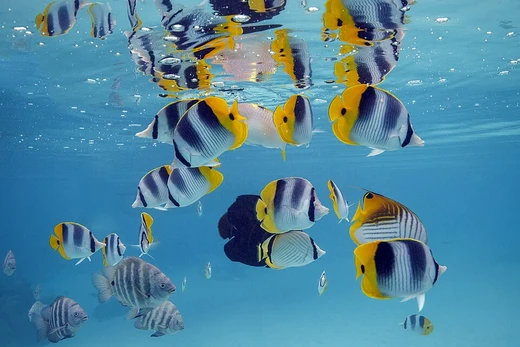
Black butterflyfish
A dark butterflyfish with yellow fins and a white mouth.

The black butterflyfish, also called the dusky butterflyfish, is a marine ray-finned fish in the family Chaetodontidae. Its scientific name is *Chaetodon flavirostris*, and it is native to the Pacific Ocean. It is also found in the Indian Ocean in the Cocos (Keeling) Islands. This fish has a dark bluish-grey body, a white mouth, and a narrow yellow band on its snout. A darker bump sits on its forehead. Its dorsal, anal, and caudal fins are yellow, with an orange band crossing the dorsal and anal fins and the caudal peduncle; these fins also have black edges, as does the tail. Young fish have paler grey bodies and yellow median fins. The dorsal fin contains 12 to 13 spines and 24 to 27 soft rays, while the anal fin has 3 spines and 20 to 21 soft rays. Adults can reach a total length of 20 centimeters (7.9 inches). In the southern Pacific Ocean, the black butterflyfish ranges from the Great Barrier Reef and New South Wales, Lord Howe Island, east to Easter Island (though records there likely refer to a vagrant). It also appears in American Samoa, the Cook Islands, Fiji, French Polynesia, New Caledonia, Niue, Norfolk Island, Pitcairn Island, Samoa, the Solomon Islands, Tonga, Vanuatu, and Wallis and Futuna. Additionally, it is found in the Indian Ocean at the Cocos (Keeling) Islands. This species lives at depths of 2 to 20 meters (6.6 to 65.6 feet) in rocky areas with good coral and algae cover, in lagoons, on seaward reefs, and occasionally in estuaries. It is omnivorous, eating algae, coral, and small benthic invertebrates. Black butterflyfish are oviparous and breed in pairs, also living as pairs; in some areas, they form aggregations. Juveniles stay in protected inner reefs. The black butterflyfish was first formally described in 1874 by German-born British ichthyologist Albert Günther, with the type locality given as Vavau, Tonga. It belongs to the large subgenus *Rabdophorus*, which might be recognized as a distinct genus. Its close relatives appear to be the diagonal butterflyfish (*Chaetodon fasciatus*), the raccoon butterflyfish (*C. lunula*), the Philippine butterflyfish (*C. adiergastos*), and possibly the red-tailed butterflyfish (*C. collare*). Though their coloration varies, these are all largish, oval-bodied butterflyfishes, most with ascending oblique stripes on the flanks.
- Maximum total length
- 20 centimetres (7.9 in)
- Dorsal fin spines
- 12-13
- Dorsal fin soft rays
- 24-27
- Anal fin spines
- 3
- Anal fin soft rays
- 20-21
- Depth range
- 2 to 20 metres (6.6 to 65.6 ft)
- First described by
- Albert Günther in 1874
Lore & Background
The black butterflyfish has a darkish bluish-grey body with a contrasting white mouth and a narrow yellow band on its snout. There is a dark bump on the forehead. The dorsal, anal, and caudal fins are yellow, with an orange band running across the dorsal and anal fins and across the caudal peduncle; these fins also have black margins, as does the tail. Juveniles have paler grey bodies and yellow median fins. The dorsal fin has 12-13 spines and 24-27 soft rays, while the anal fin has 3 spines and 20-21 soft rays. This species reaches a maximum total length of 20 centimetres. It is found in the southern Pacific Ocean from the Great Barrier Reef and New South Wales, Lord Howe Island east as far as Easter Island, including American Samoa, the Cook Islands, Fiji, French Polynesia, New Caledonia, Niue, Norfolk Island, Pitcairn Island, Samoa, the Solomon Islands, Tonga, Vanuatu, and Wallis and Futuna. The record from Easter Island is thought to refer to a vagrant. It is also found in the Indian Ocean in the Cocos (Keeling) Islands. It occurs at depths of 2 to 20 metres in rocky areas with good coverage of coral and algae in lagoons and on seaward reefs, and can occur in estuaries. The black butterflyfish was first formally described in 1874 by the German-born British ichthyologist Albert Günther with the type locality given as Vavau, Tonga. It belongs to the large subgenus Rabdophorus, which might warrant recognition as a distinct genus. Close relatives appear to be the diagonal butterflyfish, the raccoon butterflyfish, the Philippine butterflyfish, and perhaps the red-tailed butterflyfish.
Reader's Guide
The black butterflyfish is an omnivorous species, consuming algae, coral, and small benthic invertebrates. It is oviparous and breeds as pairs, and also lives as a pair. In some areas aggregations are known. Juveniles are found in protected inner reefs. The species is occasionally found in the aquarium trade, but it does not thrive in captivity and has a poor survival rate in transit. Its distribution spans much of the southern Pacific Ocean, with a notable vagrant record from Easter Island, and an additional presence in the Indian Ocean at the Cocos (Keeling) Islands. The species is part of the subgenus Rabdophorus, a group of largish butterflyfishes with an oval outline and often a pattern of ascending oblique stripes on the flanks; most have at least a vestigial form of the 'raccoon' mask, with a white space between the dark crown and eye areas. Despite its occasional appearance in the aquarium trade, its poor survival in captivity limits its significance as a captive species.
Did You Know?
- The black butterflyfish has a dark bump on its forehead.
- It is also known as the dusky butterflyfish.
- The type locality for this species is Vavau, Tonga.
- It is an omnivore that eats algae, coral, and small benthic invertebrates.
Physical Form and Striking Coloration
The butterflyfish family encompasses roughly 129 species spread across 12 genera, and their most immediately arresting feature is their vivid body patterning. Most individuals measure between 12 and 22 centimeters, though the lined butterflyfish and the saddle butterflyfish can reach a full 30 centimeters. Their common name is well earned: many species display bold combinations of black, white, blue, red, orange, and yellow, with eyespots dotting the flanks and dark bands sweeping across the eyes—patterns that evoke the wings of actual butterflies. A few species, however, settle for a more subdued palette. Structurally, butterflyfish possess deep, laterally compressed bodies that stand out clearly amid the dense clutter of reef life. Their dorsal fins run uninterrupted along the back, and their tail fins are either rounded or squared off, but never forked. This combination of shape and color makes them among the most visually distinctive members of any tropical reef community.
Daily Rhythms and Reproductive Strategy
Butterflyfish are predominantly active during daylight hours and typically inhabit waters shallower than 18 meters, although certain species venture down to 180 meters. They are notably site-faithful, each individual or pair maintaining a defined home range. Feeding ecology splits the family into two behavioral camps: corallivorous species are fiercely territorial, forming bonded pairs that defend a particular coral head, while zooplankton-feeding species tend to aggregate in large groups of their own kind. When darkness falls, these fish retreat into reef crevices and their coloration shifts dramatically, a nocturnal camouflage that contrasts sharply with their daytime display. Reproduction follows a pelagic strategy: adults release vast clouds of buoyant eggs into open water, where the embryos drift as plankton until hatching. The resulting larvae pass through a remarkable tholichthys stage, during which their bodies are encased in large bony plates extending from the head. As they mature these plates are shed. Only one other fish family, the scats, exhibits a comparable armored larval phase.
Taxonomic Structure and Deep Evolutionary Roots
The family Chaetodontidae, named by Rafinesque in 1815, is generally recognized as containing two major lineages. One centers on the large genus Chaetodon and its close relative Prognathodes, representing the typical butterflyfish. The other unites the bannerfish and coralfish genera under the subfamily Heniochinae. A handful of additional genera, including Parachaetodon and Roa, remain unassigned to either group. Molecular phylogenetic work indicates that Chaetodontidae shared a common ancestor with the scats and angelfish during the Early Eocene, roughly 54 million years ago. The fossil record, however, is thin and contested; coral-reef carcasses are easily scattered by scavengers or overgrown by living coral, making preservation rare. The earliest confirmed butterflyfish fossils are larval and tholichthys specimens from the Early Oligocene of Germany, Poland, and Italy. Molecular calibration suggests most living genera had already diverged by the close of the Paleogene, around 23 million years ago.
Reef Neighbors and the Aquarium Challenge
Butterflyfish are often mistaken for miniature angelfish, but they can be distinguished by the absence of preopercle spines on their gill covers. Certain members of the genus Heniochus even echo the silhouette of the Moorish idol, a solitary species in its own family. All three lineages—Chaetodontidae, Pomacanthidae, and Zanclidae—fall within the order Acanthuriformes and occupy overlapping reef habitats across the Atlantic, Indian, and Pacific Oceans. In the aquarium trade, butterflyfish are highly sought after for their brilliant patterns, yet keeping them presents significant challenges. The majority of species are specialized feeders on coral polyps and sea anemones, making it difficult to sustain them in captivity. Hobbyists therefore gravitate toward the relatively few generalist or zooplankton-feeding species, where the balance between available prey and the fish's dietary needs is easier to manage. This ecological specificity is what keeps most butterflyfish species out of home aquariums despite their undeniable visual appeal.
Frequently Asked Questions
What is the Black butterflyfish?
The Black butterflyfish (Chaetodon flavirostris), sometimes called the dusky butterflyfish, is a small marine ray-finned fish in the family Chaetodontidae. It is a native Pacific species with a limited but notable presence in the Indian Ocean.
What does the Black butterflyfish look like?
It has a dark bluish-grey body, a white mouth, and a narrow yellow band on the snout, with a small darker bump on the forehead. Its dorsal, anal, and caudal fins are yellow with black edges, and an orange band runs across the dorsal and anal fins as well as the caudal peduncle.
Where does the Black butterflyfish live?
This species is native to the Pacific Ocean and also occurs in the Indian Ocean at the Cocos (Keeling) Islands. It is a reef-associated fish found in shallow tropical waters.
How big does the Black butterflyfish get?
It reaches a maximum total length of about 20 centimetres (roughly 7.9 inches), making it a modestly sized member of the butterflyfish family.
At what depth can you find the Black butterflyfish?
It typically inhabits depths ranging from 2 to 20 metres (about 6.6 to 65.6 feet), placing it in the shallower reef zone where light and coral structure are abundant.
More in Butterflyfish 1-24
Spotted an error? Know more?
Reader corrections go straight into our review queue. Suggest an edit · How this site is sourced