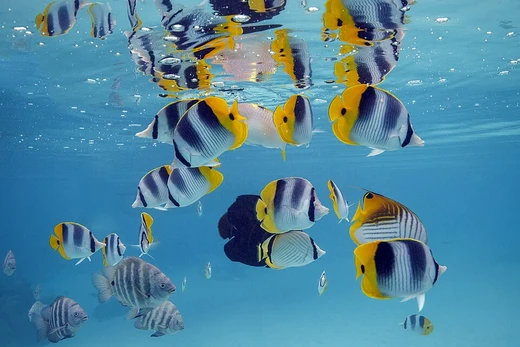
Prognathodes
Deep-reef butterflyfish genus once grouped with Chaetodon.

Prognathodes is a genus of butterflyfish belonging to the family Chaetodontidae. These fish inhabit rocky reefs in tropical seas worldwide, typically living at greater depths than those of the related genus *Chaetodon*—often beyond the range of standard scuba gear. Historically, they were frequently classified under *Chaetodon*. Their coloration includes white, yellow, black, and dark brown, and they grow to lengths of 10 to 16 centimeters.
The genus contains 13 recognized species:
- *Prognathodes aculeatus* (Longsnout butterflyfish) - *Prognathodes aya* (Bank butterflyfish) - *Prognathodes basabei* (Orangemargin butterflyfish) - *Prognathodes brasiliensis* (Brazilian butterflyfish) - *Prognathodes carlhubbsi* (Southern scythemarked butterflyfish) - *Prognathodes dichrous* (Bicolor butterflyfish) - *Prognathodes falcifer* (Northern scythemarked butterflyfish) - *Prognathodes geminus* (Twin butterflyfish) - *Prognathodes guezei* (Gueze's butterflyfish) - *Prognathodes guyanensis* (French butterflyfish) - *Prognathodes guyotensis* (Guyote butterflyfish) - *Prognathodes marcellae* (Macaronesian butterflyfish) - *Prognathodes obliquus* (Oblique butterflyfish)
- Family
- Chaetodontidae
- Colors
- whitish, yellow, black and dark brown
- Length range
- 10–16 centimetres (3.9–6.3 in)
- Number of species
- 13
Lore & Background
Prognathodes species are butterflyfish that inhabit rocky reefs in tropical oceans worldwide. They are notable for occurring deeper than species of the related genus Chaetodon, often at depths beyond the reach of normal scuba diving. Historically, these fish were commonly placed within Chaetodon, but they are now recognized as a distinct genus within the family Chaetodontidae. Their coloration includes whitish, yellow, black, and dark brown, and adults reach lengths of 10 to 16 centimeters.
Reader's Guide
The genus Prognathodes represents a group of butterflyfish that are ecologically distinct from their shallower relatives in Chaetodon due to their preference for deeper waters. The source article notes that they are mainly found deeper than Chaetodon, often at depths below those possible in normal scuba diving, which suggests a specialized niche on rocky reefs. Their past inclusion in Chaetodon reflects historical taxonomic uncertainty, but the current recognition of 13 species underscores their diversity. The article lists species such as Prognathodes aculeatus (Longsnout butterflyfish) and Prognathodes basabei (Orangemargin butterflyfish), among others, indicating a global distribution across tropical oceans. Their coloration—whitish, yellow, black, and dark brown—and size range of 10–16 centimeters are consistent with typical butterflyfish morphology. The genus's significance lies in its deep-reef habitat, which may offer insights into adaptation to lower light and pressure conditions, though the article does not elaborate on behavior or ecology beyond depth preference.
Did You Know?
- In the past, Prognathodes was commonly included in the genus Chaetodon.
- Adults reach 10–16 centimetres (3.9–6.3 in) in length.
Taxonomic Identity and the Road Away from Chaetodon
Prognathodes occupies a distinctive place within the butterflyfish family Chaetodontidae, yet its taxonomic journey reflects a broader and more common pattern in marine biology: the gradual recognition that what was once lumped together actually represents distinct evolutionary lineages. For much of the history of butterflyfish classification, the species now placed in this genus were simply slotted into the large and diverse genus Chaetodon, treated as minor variations within a much larger group. Over time, however, researchers came to recognize enough distinguishing characteristics to warrant separating them into their own genus. This reclassification was not a single dramatic event but rather a process of accumulated observation, morphological comparison, and analysis that ultimately gave Prognathodes its own recognized identity. The result is a genus that, while closely related to its Chaetodon neighbors, now stands apart with its own set of thirteen recognized members and its own place in the family tree. This separation also carries practical implications for how scientists organize their understanding of butterflyfish biodiversity across the world's tropical waters.
Habitat, Depth, and the Hidden Reef
One of the most defining features of Prognathodes is its preference for rocky reef habitats in tropical ocean waters around the globe. While butterflyfish in general are associated with coral and reef environments, Prognathodes species tend to occupy a particular niche within those ecosystems: rocky substrates rather than the more commonly studied coral formations. Perhaps even more notably, these fish are typically found at depths that exceed those favored by their Chaetodon relatives. In many cases, Prognathodes inhabit zones that fall below the practical limits of standard scuba diving, meaning that observing them in their natural environment often requires more specialized equipment such as mixed-gas diving or remotely operated vehicles. This depth preference has likely contributed to their relative obscurity compared to shallower butterflyfish species, as they have been less frequently encountered by casual divers and early marine biologists. Their global distribution across tropical oceans suggests a remarkable adaptability to rocky reef conditions in diverse geographic regions, from the Atlantic to the Pacific.
Coloration, Size, and the Aesthetics of the Deep
The visual palette of Prognathodes is striking yet restrained compared to some of its more flamboyant butterflyfish cousins. Species in this genus display combinations of whitish, yellow, black, and dark brown coloration across their bodies. Rather than the bold, high-contrast patterns that characterize many shallow-water Chaetodon species, Prognathodes tends toward a more subdued and earthy scheme. In terms of size, these fish are modest, reaching lengths between 10 and 16 centimeters, which translates to roughly 3.9 to 6.3 inches. This relatively small stature is consistent with their habitat in rocky reef crevices and deeper waters, where a compact body may offer advantages in maneuverability and energy conservation. The coloration likely serves multiple purposes in their deeper, often dimmer environment, potentially aiding in camouflage against rocky substrates or in species recognition among the thirteen distinct members of the genus. The interplay of these muted tones against the dark backdrop of deeper reef waters creates a visual identity that is both elegant and functional.
Thirteen Species and a 160-Year Story of Discovery
The genus Prognathodes currently encompasses thirteen recognized species, a roster that tells a story of both long-standing scientific curiosity and recent taxonomic progress. The earliest described member, Prognathodes aculeatus, was named by Poey back in 1860, while the most recent addition, Prognathodes geminus, was only formally described in 2019 by Copus, Pyle, Greene, and Randall. This nearly 160-year span of species descriptions underscores how much remains to be discovered and properly classified in the deeper waters where these fish reside. The species names themselves reflect a rich tapestry of origins: some honor individual scientists like Hubbs, Gueze, and Burgess, while others reference geographic locations such as Brazil, Guyana, and the Macaronesian region. The diversity of common names—Longsnout, Bicolor, Twin, Oblique, French, Brazilian—paints a picture of a genus that is both morphologically varied and geographically widespread. Each new species description represents not just a taxonomic update but a deeper understanding of the hidden biodiversity thriving in the world's tropical rocky reefs.
Frequently Asked Questions
What is Prognathodes?
Prognathodes is a genus of deep-reef butterflyfish in the family Chaetodontidae, found across tropical oceans worldwide. It comprises 13 recognized species that share a palette of white, yellow, black, and dark brown markings.
How does Prognathodes differ from Chaetodon?
For much of its taxonomic history, Prognathodes species were simply lumped into the larger Chaetodon genus before being carved out as a separate group. The most practical distinction is that Prognathodes tend to inhabit rocky reefs at depths beyond the comfortable range of recreational scuba gear.
Where can you find Prognathodes in the wild?
These fish are native to tropical seas around the globe, favoring rocky reef habitats. They typically occupy deeper water than their close Chaetodon relatives, often past the limits of standard scuba equipment.
How large do Prognathodes grow?
Adults in this genus reach a total length somewhere between 10 and 16 centimeters, roughly 4 to 6 inches. That places them in the mid-size range within the butterflyfish family.
How many Prognathodes species are there?
Thirteen species are currently recognized under the genus, including the Longsnout butterflyfish (P. aculeatus) and the Bank butterflyfish (P. aya). Each carries its own distinct pattern within the shared white, yellow, black, and dark-brown color scheme.
More in Butterflyfish 1-24
Spotted an error? Know more?
Reader corrections go straight into our review queue. Suggest an edit · How this site is sourced