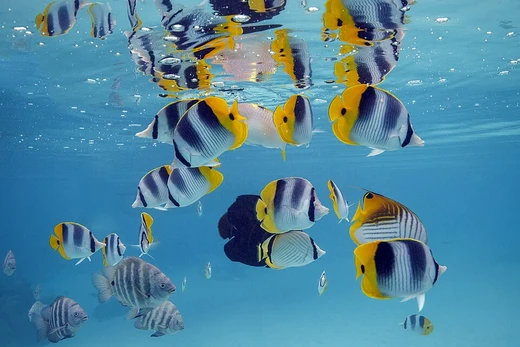
Blackback butterflyfish
A widespread Indo-Pacific butterflyfish that changes color at night.

The blackback butterflyfish (Chaetodon melannotus) is a ray-finned fish belonging to the butterflyfish family, Chaetodontidae. Its range spans the Indo-Pacific, from the Red Sea and East Africa to southern Japan, Micronesia, and Samoa.
Within its genus, it is part of the large subgenus Rabdophorus. Its closest relative appears to be the spot-tailed butterflyfish (C. ocellicaudus), with the yellow-dotted butterflyfish (C. selene) being a more distant relation. All share an oval body, silvery color, yellow fins and snout, ascending diagonal stripes, and black markings near the eyes, on the caudal peduncle, and sometimes on the back. The saddle butterflyfish (C. ephippium) and dotted butterflyfish (C. semeion) are also related, but their ancestors diverged early in the Rabdophorus lineage.
This species reaches up to 18 cm (7.1 in) in length and can live for up to 20 years. Its usual coloration matches the image on the right, but when frightened or at night, it can change color, turning the dorsal part of its body black except for two white patches.
Like most butterflyfish, it lives on reefs, especially in staghorn coral thickets, and is less common on exposed reef areas. It is typically found at depths of 4–20 m (13–66 ft), usually alone. During breeding season, pairs become more common, while juveniles are often found inshore, either in pairs or small groups. Its diet consists mainly of the polyps of soft and hard corals.
The blackback butterflyfish appears in the aquarium trade and is considered easy to maintain by the standards of its genus.
- Scientific name
- Chaetodon melannotus
- Family
- Chaetodontidae
- Max length
- 18 cm (7.1 in)
- Max lifespan
- 20 years
- Depth range
- 4–20 m (13–66 ft)
- Diet
- polyps of soft and hard corals
- Distribution
- Indo-Pacific: Red Sea and East Africa to southern Japan, Micronesia and Samoa
Lore & Background
The blackback butterflyfish belongs to the large subgenus Rabdophorus, which might warrant recognition as a distinct genus. Within this group, it appears to be a close relative of the spot-tailed butterflyfish (C. ocellicaudus), and somewhat less close to the yellow-dotted butterflyfish (C. selene). These species share an oval shape, silvery coloration with yellow fins and snout, ascending diagonal stripes, and black markings around the eyes, on the caudal peduncle, and sometimes on the back. The saddle butterflyfish (C. ephippium) and the dotted butterflyfish (C. semeion) are more distant relatives, with ancestors diverging soon after the Rabdophorus lineage began to diversify.
Normally, the coloration of this fish is as shown in typical images; however, when observed at night or frightened, it can change color. As a result, the dorsal portion of the body turns black, except for two white patches. It grows up to 18 cm in length and may live for up to 20 years.
Like most other species of butterflyfish, the blackback butterflyfish inhabits reefs. It is common on staghorn coral thickets and is less seen on exposed parts of reefs. It is generally found at a depth of 4–20 m, usually solitarily, though this changes during the breeding season when pairs are more common. Juveniles are more commonly found inshore, in pairs or traveling in small groups. This butterflyfish feeds primarily on the polyps of soft and hard corals.
Reader's Guide
The blackback butterflyfish is a species of ray-finned fish in the butterflyfish family Chaetodontidae, widespread through the Indo-Pacific from the Red Sea and East Africa to southern Japan, Micronesia and Samoa. Its significance lies in its distinctive behavior and ecological role. It is known to change color when frightened or at night, turning the dorsal portion of its body black except for two white patches, a trait that aids in camouflage or predator avoidance. Ecologically, it is common on staghorn coral thickets and feeds primarily on the polyps of soft and hard corals, making it a coral-dependent species. Its depth range of 4–20 m and solitary nature, except during breeding season when pairs form, highlight its typical reef habitat. Juveniles are found inshore in pairs or small groups. In human interactions, the blackback butterflyfish can be found in the aquarium trade and is considered easy to maintain by the standards of its genus. Its taxonomic placement within the subgenus Rabdophorus, with close relatives such as the spot-tailed butterflyfish and yellow-dotted butterflyfish, underscores its evolutionary relationships within the butterflyfish family. The species is also notable for its potential lifespan of up to 20 years, contributing to its resilience in reef ecosystems.
Taxonomy & Evolutionary Lineage
The saddle butterflyfish was formally named in 1831 by the French anatomist Georges Cuvier, with the type locality recorded as Bora Bora in the Society Islands of French Polynesia. Taxonomically, it sits within the large subgenus Rabdophorus, a grouping so substantial that some taxonomists have questioned whether it should be elevated to full genus status. Within this subgenus, the saddle butterflyfish occupies a remarkably isolated position. It appears to represent a distinct evolutionary lineage, with the dotted butterflyfish (Chaetodon semeion) being perhaps the only species that shares a somewhat closer relationship. The next tier of relatives—including the blackback butterflyfish, spot-tailed butterflyfish, and yellow-dotted butterflyfish—are already so genetically distant that their common ancestor with the saddle butterflyfish must have split off very early in the Rabdophorus diversification. This makes the saddle butterflyfish a living snapshot of an ancient branch of butterflyfish evolution.
Physical Form & Coloration
At up to 30 centimeters in length, the saddle butterflyfish ranks among the largest members of its genus, sharing that distinction with the lined butterflyfish. Its body shape is notably unusual for a butterflyfish, bearing a closer resemblance to certain angelfishes than to most of its Chaetodon relatives. The base coloration is a muted yellowish grey, but the fish is immediately recognizable by a large black saddle-shaped spot on its back, bordered below by a broad white band. Wavy blue lines decorate the lower flanks, while the throat and the trailing edges of the posterior fins glow in bright yellow. Adult individuals develop a distinctive filament extending backward from the upper portion of the soft dorsal fin, adding to their already striking silhouette. Together, these features make it one of the most visually distinctive large reef fish in the Indo-Pacific.
Geographic Range & Habitat
The saddle butterflyfish enjoys one of the broadest distributions of any butterflyfish, spanning both the Indian and Pacific Oceans. Its range stretches from Sri Lanka and the Cocos-Keeling Islands eastward to the Hawaiian, Marquesan, and Tuamotu island chains. To the north, it reaches as far as southern Japan, while to the south its distribution extends to Rowley Shoals and the waters off New South Wales, Australia. Within this vast expanse, the species is a resident of coral reef environments, typically encountered at depths ranging from the surface down to about 30 meters. This preference for shallow reef habitats means it is a familiar sight to divers and snorkelers across tropical island nations, from the Indian Ocean rim to the remote Polynesian atolls.
Diet & Feeding Ecology
As a coral reef dweller, the saddle butterflyfish is a generalist forager with a varied diet that reflects the rich biodiversity of its habitat. It grazes on filamentous algae, picking at the fine strands that grow over reef surfaces. Beyond plant matter, it consumes small invertebrates, coral polyps, and even the eggs of other fish. This mixed feeding strategy allows it to exploit multiple food sources within the reef ecosystem, reducing direct competition with more specialized butterflyfish species. Its large size relative to many reef fish, combined with this broad dietary range, suggests it occupies a somewhat unique ecological niche. The ability to feed on coral polyps in particular places it in a delicate relationship with the reef structure itself, as it both benefits from and potentially impacts the living coral that forms its home.
Frequently Asked Questions
What is the Blackback butterflyfish?
The Blackback butterflyfish (Chaetodon melannotus) is a ray-finned reef fish in the family Chaetodontidae, classified under the large subgenus Rabdophorus. Its closest living relative is the spot-tailed butterflyfish, and both share a similar oval, silvery body with yellow fins and ascending diagonal stripes.
Where can you find the Blackback butterflyfish in the wild?
It inhabits shallow coral reefs throughout the Indo-Pacific, stretching from the Red Sea and East African coast all the way to southern Japan, Micronesia, and Samoa. It typically stays between roughly 4 and 20 meters depth.
What does a Blackback butterflyfish eat?
Its diet consists almost entirely of polyps from both soft and hard corals, which it picks off the reef with its small, pointed mouth. This specialized feeding makes it an important part of the coral-reef food web.
How large and long-lived is the Blackback butterflyfish?
Adults top out at about 18 cm (7.1 in) in total length, and under favorable conditions they can live up to roughly 20 years. That makes it a mid-sized member of the butterflyfish family with a notably long lifespan for a reef fish.
What is the most interesting thing about the Blackback butterflyfish's coloration?
It shifts its coloration at night, darkening to reduce visibility while it rests in sheltered crevices. During the day it displays a silvery body, bright yellow fins and snout, and distinctive black markings around the eyes and near the caudal fin.
More in Butterflyfish 1-24
Spotted an error? Know more?
Reader corrections go straight into our review queue. Suggest an edit · How this site is sourced