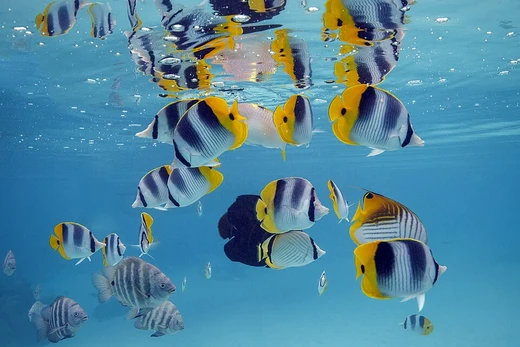
Chaetodon
Largest butterflyfish genus, with about 90 living species.

Chaetodon is a genus of tropical fish in the family Chaetodontidae, commonly called butterflyfish. It is the largest genus in the family, containing roughly 90 living species, although many of these may eventually be classified as separate genera.
Several subgenera have been proposed to split the genus. DNA studies largely support a 1988 analysis of skeletal features by S.D. Blum. A core group around the type species, *Chaetodon capistratus*, would remain in *Chaetodon*, while about four other groups might be split off. These could be named *Lepidochaetodon*, *Megaprotodon*, and *Rabdophorus*, plus an unnamed group containing the three-banded butterflyfish (*C. robustus*) and its relatives. However, the unity of the *Lepidochaetodon* group is not fully confirmed; it is unclear whether *Rhombochaetodon* is distinct from *Exornator*, and whether *Lepidochaetodon* is more closely related to these groups than to other *Chaetodon*, especially some lineages placed in *Megaprotodon*. The genera *Prognathodes* and *Roa*, once included in *Chaetodon*, are now considered valid separate genera. Historically, more distant fish were placed in *Chaetodon* because they resembled it in details—such as the common scat (*Scatophagus argus*), which shares a similar shape, size, and armored larvae—or simply because they are colorful, small, and unusual-looking, like the unrelated paradise fish (once called *C. chinensis*).
There are currently 87 recognized species in the genus, organized into several groups: *Chaetodon* sensu stricto, the *C. robustus* group, the *Lepidochaetodon* group (which may include *Burgessius*, *Heterochaetodon*, and possibly *Rhombochaetodon*; also *Tifia* and tentatively *C. daedalma*, *C. litus*, *C. nippon*, and *C. smithi*), the *Megaprotodon* group, and the *Rabdophorus* group (which may include *Aspilurochaetodon* and *Chaetodontops*). Several species are of uncertain placement, most likely belonging to *Chaetodon* sensu stricto or the *C. robustus* group.
Fossil species include *Chaetodon ficheuri* from the Late Miocene of Algeria (subgenus †*Arambourgchaetodon*) and *Chaetodon wattsi* from the Early Oligocene of Italy (subgenus †*Blumchaetodon*). Another fossil, *Chaetodon penniger* from the Late Oligocene of Azerbaijan, cannot be confidently assigned to the genus due to incomplete remains.
- Number of extant species
- 87 recognized species
- Approximate total living species
- about 90
- Type species
- Chaetodon capistratus
- Earliest confirmed fossil
- Early Oligocene of Italy (Chaetodon wattsi)
- Proposed subgenera
- Lepidochaetodon, Megaprotodon, Rabdophorus, and an unnamed group containing C. robustus
Lore & Background
The genus Chaetodon is the largest among the Chaetodontidae, with about 90 living species, though many might be split into distinct genera. Several subgenera have been proposed, including Lepidochaetodon, Megaprotodon, and Rabdophorus, as well as an unnamed group containing the three-banded butterflyfish (C. robustus) and its relatives. The monophyly of the Lepidochaetodon group is not fully established, and it is unclear whether Rhombochaetodon is distinct from Exornator, or whether Lepidochaetodon is closer to these than to other Chaetodon.
Historically, more distantly related fish were placed in Chaetodon for resembling them in details—for example, the common scat Scatophagus argus, which has a similar shape and size, as well as armored larvae like the Chaetodontidae—or simply because they are colorful, smallish, and unusual-looking, such as the quite unrelated paradise fish, as C. chinensis. The genera Prognathodes and Roa, once contained in Chaetodon, are now recognized as full genera.
The earliest confirmed specimens of Chaetodon are from Early Oligocene-aged coral reef deposits of Italy, belonging to the extinct species Chaetodon wattsi. Indeterminate Chaetodon fossil specimens referred to Chaetodon hoefleri are known from the Late Oligocene of Slovenia and the mid-late Miocene of Poland. The fossil record of this family is scant, and as even crude molecular clocks suggest that the ancestors of Chaetodon and the Chelmops lineage diverged in the Late Eocene, nothing more can be said without new fossils.
Reader's Guide
Chaetodon is notable as the largest genus in the butterflyfish family, containing about 90 living species, though many may eventually be recognized as distinct genera. The genus has a complex taxonomy, with several proposed subgenera such as Lepidochaetodon, Megaprotodon, and Rabdophorus, and an unnamed group around C. robustus. However, the monophyly of these groups is not fully established, and relationships among them remain uncertain. The genus has a fossil record extending back to the Early Oligocene, with the earliest confirmed specimen being Chaetodon wattsi from Italy. Indeterminate fossils referred to Chaetodon hoefleri are known from the Late Oligocene of Slovenia and the mid-late Miocene of Poland. Historically, unrelated fish such as the common scat and paradise fish were mistakenly placed in Chaetodon due to superficial similarities. The genera Prognathodes and Roa, once included in Chaetodon, are now considered full genera. The fossil record of the family is scant, and molecular clocks suggest the ancestors of Chaetodon and related lineages diverged in the Late Eocene, but further understanding awaits new fossil discoveries.
Did You Know?
- Chaetodon is the largest genus in the family Chaetodontidae, with about 90 living species.
- The earliest confirmed fossil of Chaetodon is from Early Oligocene coral reef deposits of Italy.
- Historically, the common scat (Scatophagus argus) was placed in Chaetodon due to similar shape and armored larvae.
- The genera Prognathodes and Roa were once contained in Chaetodon but are now recognized as full genera.
A Spectrum of Reef Life
The butterflyfish family, Chaetodontidae, encompasses roughly 129 species distributed across 12 genera, with the vast majority inhabiting coral reef systems in the Atlantic, Indian, and Pacific Oceans. The group is immediately recognizable for its vivid coloration—many species display bold combinations of black, white, blue, red, orange, and yellow—though a notable subset remains comparatively drab. The common name itself is drawn from the striking patterns on their flanks: eyespots and dark vertical bands running across the eyes evoke the markings of a butterfly's wings. Morphologically, these fish possess deep, laterally compressed bodies that stand out against the dense clutter of reef life. Their dorsal fins are continuous without interruption, and their caudal fins are either rounded or truncated, never forked. Size varies considerably; most species measure between 12 and 22 centimeters, but the lined butterflyfish and the saddle butterflyfish (C. ephippium) can reach 30 centimeters. Interestingly, certain species pairs appear in both the Indian and Pacific Oceans, members of the exceptionally large genus Chaetodon, hinting at a biogeographic pattern that spans two entire ocean basins.
Territorial Lives and the Mystery of the Tholichthys
Butterflyfish are predominantly diurnal creatures that patrol waters shallower than 18 meters, though select species have been observed descending to depths near 180 meters. They are strongly site-faithful, each individual or pair anchoring itself to a defined home range within the reef. Corallivorous species are especially territorial, forming bonded pairs and defending a particular coral head against intruders. In sharp contrast, those that feed on zooplankton tend to gather into large, loose aggregations of their own kind. When darkness falls, these conspicuous daytime swimmers retreat into the crevices of the reef, and their coloration shifts dramatically from the bright patterns seen in daylight. Reproduction follows a pelagic strategy: adults release clouds of buoyant eggs into the open water column, where they drift as plankton until hatching. The most remarkable postlarval stage is the tholichthys phase, during which the young fish's body is encased in large bony plates extending from the head. These plates are shed as the fish matures. Only one other family, the scats (Scatophagidae), shares this armored developmental stage, making it a rare and striking feature in the marine world.
A Fossil Puzzle and a Shifting Family Tree
The evolutionary history of Chaetodontidae remains one of the most contested in reef-fish systematics. Because these fish are restricted to coral reef environments, their carcasses are quickly dispersed by scavengers, overgrown by living coral, or eroded away, leaving an extremely thin fossil record. The earliest confirmed specimens are an indeterminate larval form from Frauenweiler, Germany, two tholichthys-stage individuals from the Menilite Formation in Poland, and the extinct species Chaetodon (Blumchaetodon) wattsi from Italy, all dating to the Early Oligocene. Molecular phylogenies support a family origin in the Late Eocene and suggest a common ancestor shared with the scats and angelfish roughly 54 million years ago. Taxonomically, the family splits into two major lineages: the typical butterflyfishes centered on the genus Chaetodon, and the bannerfish-and-coralfish group encompassing genera such as Heniochus, Chelmon, and Forcipiger. Before the advent of DNA sequencing, researchers struggled to determine whether many forms were distinct species or merely subspecies, and numerous subgenera have since been proposed to subdivide the enormous genus Chaetodon.
Neighbors, Lookalikes, and the Aquarium Challenge
Butterflyfish are often mistaken for smaller versions of the angelfish (Pomacanthidae), yet they lack the preopercular spines that characterize their reef-dwelling relatives. Members of the genus Heniochus, in particular, bear a superficial resemblance to the Moorish idol (Zanclus cornutus), the sole member of the family Zanclidae. All three families now fall within the order Acanthuriformes and occupy broadly similar reef habitats, yet the precise phylogenetic relationships among them remain poorly resolved because the traditional order Perciformes is highly paraphyletic. In the hobby aquarium trade, butterflyfish are prized for their dazzling coloration, but keeping them presents a significant challenge. The majority of species are specialized feeders on coral polyps and sea anemones, making it difficult for aquarists to replicate their natural diet. Balancing predator and prey populations in a captive setting is complex, so experienced keepers tend to select the few generalist species or those that specialize in zooplankton, which are far more manageable in a home tank.
Frequently Asked Questions
Who is Chaetodon?
Chaetodon is the dominant genus in the butterflyfish family Chaetodontidae, encompassing roughly 90 living species of tropical marine fish. It is the largest group in the entire family and forms the core of what most people recognize as butterflyfish.
What is Chaetodon's role in the butterflyfish family?
As the type genus of Chaetodontidae, Chaetodon anchors the family's taxonomic identity through its type species, Chaetodon capistratus. With nearly 90 recognized species, it dwarfs every other genus in the family and defines the group's overall diversity.
Why is Chaetodon important to the butterflyfish community?
It accounts for the overwhelming majority of recognized butterflyfish species, making it the backbone of the family's diversity. Its type species also serves as the classification reference point for all of Chaetodontidae.
What is Chaetodon's earliest known origin?
The oldest confirmed fossil linked to the genus is Chaetodon wattsi, found in Early Oligocene strata of Italy. This pushes the lineage's documented history back to the early Oligocene epoch, well before the modern radiation of tropical reef species.
More in Butterflyfish 1-24
Spotted an error? Know more?
Reader corrections go straight into our review queue. Suggest an edit · How this site is sourced