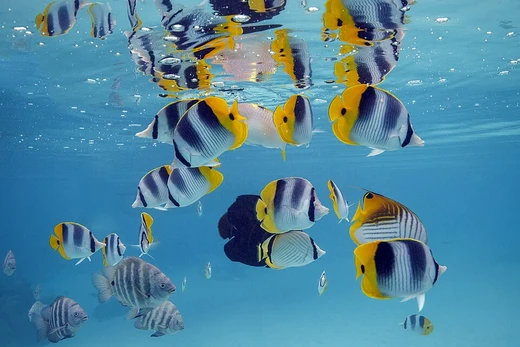
Chaetodon declivis
A silvery-white butterflyfish with a black wedge and yellow eye band.

The Marquesas butterflyfish (Chaetodon declivis) is a marine ray-finned fish belonging to the family Chaetodontidae, native to the central Pacific Ocean. Its body is silvery-white with black spots, and the upper rear portion has a blackish, wedge-shaped mark. A yellow vertical band crosses the eye, the dorsal fin is yellowish-orange, and the caudal fin is yellow. It reaches a total length of 12 centimeters (4.7 inches).
This species is found primarily in the central Pacific, including the Line Islands (United States Minor Outlying Islands), the Phoenix Islands (French Polynesia and Kiribati), and the Marquesas Islands (French Polynesia). It inhabits rocky and sandy seabeds at depths between 20 and 80 meters (66 to 262 feet). An oviparous fish, it forms pairs for breeding. In the wild, it is omnivorous, feeding on coral polyps, fanworms, crustaceans, tunicates, and algae.
The species was first formally described in 1975 by American ichthyologist John Ernest Randall, with the type locality recorded as Hanauu Bay on Fatu Hiva in the Marquesas Islands. The specific name *declivis* comes from Latin, meaning "sloping," referring to the diagonal dark patch on its upper body and fins. Populations of similar fish in the Marshall Islands are thought to be hybrids of *C. declivis* and *Chaetodon burgessi*. Historically, the Marquesas butterflyfish was collected for the aquarium trade, but commercial demand has declined since 2006.
- Scientific name
- Chaetodon declivis
- Family
- Chaetodontidae
- Maximum total length
- 12 cm (4.7 in)
- Depth range
- 20 to 80 m (66 to 262 ft)
- Type locality
- Hanauu Bay, Fatu Hiva, Marquesas Islands
- Described by
- John Ernest Randall
- Year described
- 1975
Lore & Background
The Marquesas butterflyfish has a silvery-white body marked with black spots, with the upper posterior section featuring a blackish, wedge-shaped area. A yellow vertical band runs through the eye. The dorsal fin is yellowish-orange while the caudal fin is yellow. It reaches a total length of 12 centimetres (4.7 in).
This species is endemic to the central Pacific Ocean and is primarily found in the Line Islands in the United States Minor Outlying Islands, Phoenix Islands in French Polynesia and Kiribati, and Marquesas in French Polynesia. It inhabits rocky and sandy seabeds at depths between 20 and 80 metres (66 and 262 ft).
The Marquesas butterflyfish is oviparous and forms pairs for breeding. In the wild, it is omnivorous, feeding on coral polyps, fanworms, crustaceans, tunicates, and algae. Populations of similar fishes in the Marshall Islands are believed to be hybrids of C. declivis and Chaetodon burgessi.
Reader's Guide
The Marquesas butterflyfish was first formally described in 1975 by American ichthyologist John Ernest Randall, with the type locality recorded as Hanauu Bay on Fatu Hiva in the Marquesas Islands. The specific name declivis is derived from Latin, meaning 'sloping', referring to the diagonally sloping dark patch on its upper body and fins. Historically, this species was collected for the aquarium trade, but its commercial demand has declined since 2006. The species is restricted to a few island groups in the central Pacific, including the Line Islands, Phoenix Islands, and Marquesas. Its biology includes oviparous reproduction and pair bonding for breeding, and it occupies a specialized ecological niche as an omnivore feeding on coral polyps, fanworms, crustaceans, tunicates, and algae. The existence of suspected hybrids with Chaetodon burgessi in the Marshall Islands adds to its taxonomic interest.
Did You Know?
- Its specific name declivis means 'sloping' in Latin, referring to the dark patch on its upper body.
- It is found at depths between 20 and 80 metres.
More in Butterflyfish 1-24
Spotted an error? Know more?
Reader corrections go straight into our review queue. Suggest an edit · How this site is sourced