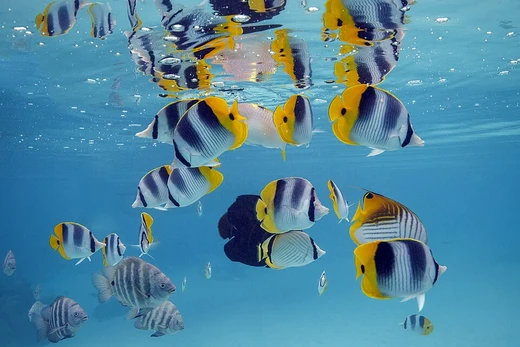
Burgess' butterflyfish
A deep-water butterflyfish with three black bars, found in the western Pacific.

Burgess' butterflyfish (Chaetodon burgessi) goes by the common names black & white butterflyfish or black-barred butterflyfish. It is a marine ray-finned fish in the family Chaetodontidae. Its range is the western Pacific Ocean.
The body is whitish to pale yellow, with three distinct black markings. One black bar crosses through the eye. A diagonal black bar runs from the top of the head to the rear base of the pectoral fin. A wide black wedge covers the rear part of the body. The dorsal fin has 13 spines and 18 to 19 soft rays; the anal fin has 3 spines and 15 to 16 soft rays. Maximum total length is 14 centimeters (5.5 inches).
This species occurs in the western Pacific. Records include Green Island off southern Taiwan; the Indonesian islands of Flores, Sulawesi, and Raja Ampat; Sabah in Malaysia; Palau; the Philippines; Papua New Guinea; the Solomon Islands; Pohnpei in the Federated States of Micronesia; and Tonga. In Australia it has been recorded at Rowley Shoals in Western Australia and Holmes Reef in the Coral Sea, Queensland.
Burgess' butterflyfish lives along drop-offs where gorgonians and black corals are abundant, typically deeper than 40 meters (130 feet), though in some places it appears in shallower water. Individuals are solitary or in pairs. The species is oviparous, and pairs form for breeding. Its diet includes gorgonians, black corals, worms, crustaceans, sponges, and other invertebrates.
The species was first formally described in 1973 by American ichthyologists Gerald R. Allen and Walter A. Starck II. The type locality is off Bairakaseru Island in the Ngemelis Islands, part of the Palau Islands in the Philippine Sea. The specific name honors American ichthyologist Warren E. Burgess, who wrote a 1978 revision of the Chaetodontidae and alerted Allen and Starck to this species and its relationship with the Indian butterflyfish (C. mitratus). Populations of similar fish in the Marshall Islands are thought to be hybrids between this species and the Marquesas butterflyfish (C. declivis).
Burgess' butterflyfish is collected for the aquarium trade, with most exported from the Philippines. Though demanding to maintain, it can help control Aiptasia sea anemones, a common aquarium pest.
- Scientific name
- Chaetodon burgessi
- Maximum total length
- 14 cm (5.5 in)
- Dorsal fin spines
- 13
- Dorsal fin soft rays
- 18-19
- Anal fin spines
- 3
- Anal fin soft rays
- 15-16
- Type locality
- off Bairakaseru Island, Ngemelis Islands, Palau Islands, Philippine Sea
Lore & Background
Burgess' butterflyfish is whitish to pale yellowish and is marked by three areas of contrasting black. The first is a black bar which runs through the eye, the second is a diagonal bar which starts at the top of the head and runs to the rear of the base of the pectoral fin, while the third is a wide black wedge covering the posterior of the body. The dorsal fin contains 13 spines and 18-19 soft rays, while the anal fin has 3 spines and 15-16 soft rays. This species attains a maximum total length of 14 centimetres (5.5 in).
It is found in the western Pacific Ocean, recorded from Green Island off southern Taiwan, the Indonesian islands of Flores, Sulawesi and Raja Ampat, Sabah in Malaysia, Palau, the Philippines, Papua New Guinea, the Solomon Islands, Pohnpei in the Federated States of Micronesia, and Tonga. It has also been recorded in Australia at Rowley Shoals in Western Australia and Holmes Reef in the Coral Sea, Queensland. Burgess' butterflyfish are found along drop-offs where there is an abundance of gorgonians and black corals, typically at depths greater than 40 metres (130 ft), although in places they will occur in shallower water. They are encountered as either solitary fish or in pairs. This is an oviparous species and they form pairs for breeding. They feed on gorgonians, black corals, worms, crustaceans, sponges and other invertebrates.
Reader's Guide
Burgess' butterflyfish was first formally described in 1973 by the American ichthyologists Gerald R. Allen and Walter A. Starck II, with the type locality given as off Bairakaseru Island in the Ngemelis Islands part of the Palau Islands in the Philippine Sea. The specific name honours the American ichthyologist Warren E. Burgess, who wrote a 1978 revision of the Chaetodontidae during which he brought Allen and Starck's attention to this species and its affinity with the Indian butterflyfish (C. mitratus). Populations of similar fishes to C. burgessi in the Marshall Islands are thought to be hybrids between this species and the Marquesas butterflyfish (C. declivis).
Burgess' butterflyfish is collected for the aquarium trade, with most fish in that trade being exported from the Philippines. Although it can be a demanding species to maintain, they can be useful in controlling Aiptasia sea anemones which can be a problem in aquariums. Its deep-water habitat and specialized diet make it a less common but valued species among advanced aquarists.
Did You Know?
- Burgess' butterflyfish is also known as the black & white butterflyfish or black-barred butterflyfish.
- It was first formally described in 1973 by Gerald R. Allen and Walter A. Starck II.
- The specific name honours American ichthyologist Warren E. Burgess.
- Populations in the Marshall Islands are thought to be hybrids with the Marquesas butterflyfish (C. declivis).
More in Butterflyfish 1-24
Spotted an error? Know more?
Reader corrections go straight into our review queue. Suggest an edit · How this site is sourced