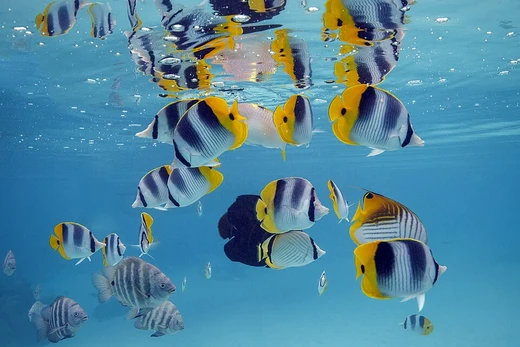
Bluestripe butterflyfish
Endemic to Hawaii, this omnivorous butterflyfish lives in harems.

The bluestripe butterflyfish (Chaetodon fremblii) is a Hawaiian endemic, commonly seen on shallow reefs. Its body is laterally compressed, reaching about 15 cm in length, with a pointed snout and rectangular shape. The dorsal fin contains 12 to 14 spines and 20 to 21 soft rays; the anal fin has 3 spines and 16 to 18 soft rays. Eight distinct diagonal blue stripes radiate from the eye across a yellow background. A black spot sits atop the head, and a larger black patch marks the tail base—this may trick predators into attacking the tail instead of the head.
This fish is abundant on coral and rocky reefs down to roughly 28 meters deep. Unlike many butterflyfish that rely almost entirely on coral, the bluestripe is an omnivore. Because it lives in a resource-rich environment where food is easier to find, males do not form pair bonds. Instead, they defend a territory that includes up to four smaller female territories, operating a harem system.
The species was first formally described in 1828 by English naturalist Edward Turner Bennett. Its specific name honors Lieutenant John Frembly, a Royal Navy marine surveyor and geologist who donated a collection of Sandwich Islands fish to the Zoological Society of London.
In aquariums, the bluestripe butterflyfish is easier to keep than coral-eating species due to its generalist diet. Wild specimens are harvested, but they can be difficult to feed in captivity. Juveniles that have settled within two to three months are more willing to accept prepared foods. Captive breeding has been attempted, but the two-month open-ocean larval stage is hard to replicate.
- Scientific name
- Chaetodon fremblii
- Family
- Chaetodontidae
- Maximum length
- 15 cm (6 in)
- Dorsal fin spines
- 12 to 14
- Dorsal fin soft rays
- 20 to 21
- Anal fin spines
- 3
- Anal fin soft rays
- 16 to 18
- Depth range
- down to about 28 m (90 ft)
Lore & Background
The bluestripe butterflyfish was first formally described in 1828 by the English naturalist Edward Turner Bennett. The specific name honours Lieutenant John Frembly R.N., a marine surveyor and geologist who presented a collection of fish specimens from the Sandwich Islands to the Zoological Society of London. The fish is laterally flattened with a pointed snout and rectangular body, reaching up to 15 cm in length. It has eight distinctive diagonal blue stripes radiating from the eye region on a yellow background, with a black spot at the top of the head and a larger black spot at the base of the tail. This tail spot may serve to distract predators by encouraging them to attack the tail rather than the head.
Reader's Guide
The bluestripe butterflyfish is notable for its omnivorous diet, unlike some butterflyfishes that feed almost exclusively on corals. Because it lives in a more resource-rich environment where food is easier to find, males operate a harem system, defending a territory that includes up to four smaller female territories. This contrasts with the pair-bond mating systems of corallivorous specialists. In captivity, the bluestripe butterflyfish is sometimes kept in reef aquaria and is easier to maintain than corallivorous types due to its generalized diet. However, specimens harvested from the wild can be difficult to get to eat; juveniles within two or three months of settling are more willing to accept prepared and novel foods. Attempts have been made to breed the fish in captivity, but the lengthy larval period of about two months in the open ocean is difficult to replicate.
Did You Know?
- The bluestripe butterflyfish is endemic to the Hawaiian Islands.
- The species was first described in 1828 by Edward Turner Bennett, named after Lieutenant John Frembly.
More in Butterflyfish 1-24
Spotted an error? Know more?
Reader corrections go straight into our review queue. Suggest an edit · How this site is sourced