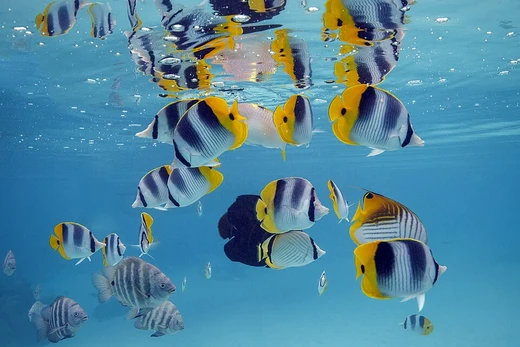
Bluelashed butterflyfish
A yellow butterflyfish with blue lines and a black eye stripe.

The bluelashed butterflyfish (Chaetodon bennetti) is a marine ray-finned fish in the family Chaetodontidae, also called the eclipse butterflyfish, archer butterflyfish, or Bennett's butterflyfish. Its body is yellow, with a black patch ringed in blue below the dorsal fin and two curved blue lines above the belly. A vertical black stripe across the eye is bordered by two blue lines. The dorsal fin has 13–14 spines and 15–17 soft rays; the anal fin has 3 spines and 14–16 soft rays. It reaches a maximum total length of 20 centimeters (7.9 inches).
This species has a wide Indo-Pacific range. In the eastern Indian Ocean, it occurs from Somalia to South Africa, across the Indian Ocean north to India and Sri Lanka, and into the Pacific as far north as Kashiwa-jima in southern Japan, south to Lord Howe Island, and east to Mangarava in French Polynesia. In Australia, it is found at the Cocos (Keeling) Islands, Christmas Island, the Rowley Shoals, Scott Reef, Ashmore Reef in the Timor Sea, and on the northern Great Barrier Reef south to Moreton Bay.
The bluelashed butterflyfish inhabits seaward and lagoon reefs with rich coral growth. Juveniles may live in shallow thickets of Acropora coral. Adults are usually in pairs. Its diet consists largely of coral polyps.
The species was first formally described in 1831 by French anatomist Georges Cuvier. The specific name honors English naturalist Edward Turner Bennett, who had the type specimen shown to Cuvier. Like other butterflyfishes with angular yellow bodies, black eyestripes, and a single differently colored patch, it belongs to the subgenus Tetrachaetodon, and is considered the most basal living species in that group. If the genus Chaetodon is split, this subgenus would be placed in Megaprotodon.
- Maximum total length
- 20 centimetres (7.9 in)
- Dorsal fin spines
- 13–14
- Dorsal fin soft rays
- 15–17
- Anal fin spines
- 3
- Anal fin soft rays
- 14–16
- First formally described by
- Georges Cuvier
- Year of description
- 1831
Lore & Background
The bluelashed butterflyfish has a yellow body with a black patch surrounded by a blue circle below the dorsal fin and two curved blue lines above the belly. Its vertical black eyestripe is flanked by two blue lines. The species attains a maximum total length of 20 centimetres.
It is found in seaward and lagoon reefs in areas with rich coral growth. Juveniles may be found in shallow Acropora thickets, while adults occur in pairs. This species feeds largely on coral polyps.
The bluelashed butterflyfish was first formally described in 1831 by the French anatomist Georges Cuvier. The specific name honours the English naturalist Edward Turner Bennett, who had the type specimen shown to Cuvier. It is regarded as the most basal living species in the subgenus Tetrachaetodon.
Reader's Guide
The bluelashed butterflyfish holds significance as a widely distributed Indo-Pacific species, recorded from the eastern coast of Africa to French Polynesia, and from southern Japan to Lord Howe Island. In Australia, it occurs on the Cocos (Keeling) Islands, Christmas Island, the Rowley Shoals, Scott Reef, Ashmore Reef, and the Great Barrier Reef south to Moreton Bay. Its presence in both seaward and lagoon reefs with rich coral growth underscores its dependence on coral ecosystems. The species feeds largely on coral polyps, linking its survival to the health of coral reefs. Within the subgenus Tetrachaetodon, it is considered the most basal living species, providing insight into the evolutionary history of butterflyfishes with angular yellow bodies and black eyestripes. Its description by Georges Cuvier in 1831, with the specific name honoring Edward Turner Bennett, adds historical context to its taxonomy. The bluelashed butterflyfish is also known by common names including eclipse butterflyfish, archer butterflyfish, and Bennett's butterflyfish.
More in Butterflyfish 1-24
Spotted an error? Know more?
Reader corrections go straight into our review queue. Suggest an edit · How this site is sourced