Patatnik
A traditional Bulgarian potato dish from the Rhodope Mountains.

K kapustin · CC BY-SA 3.0
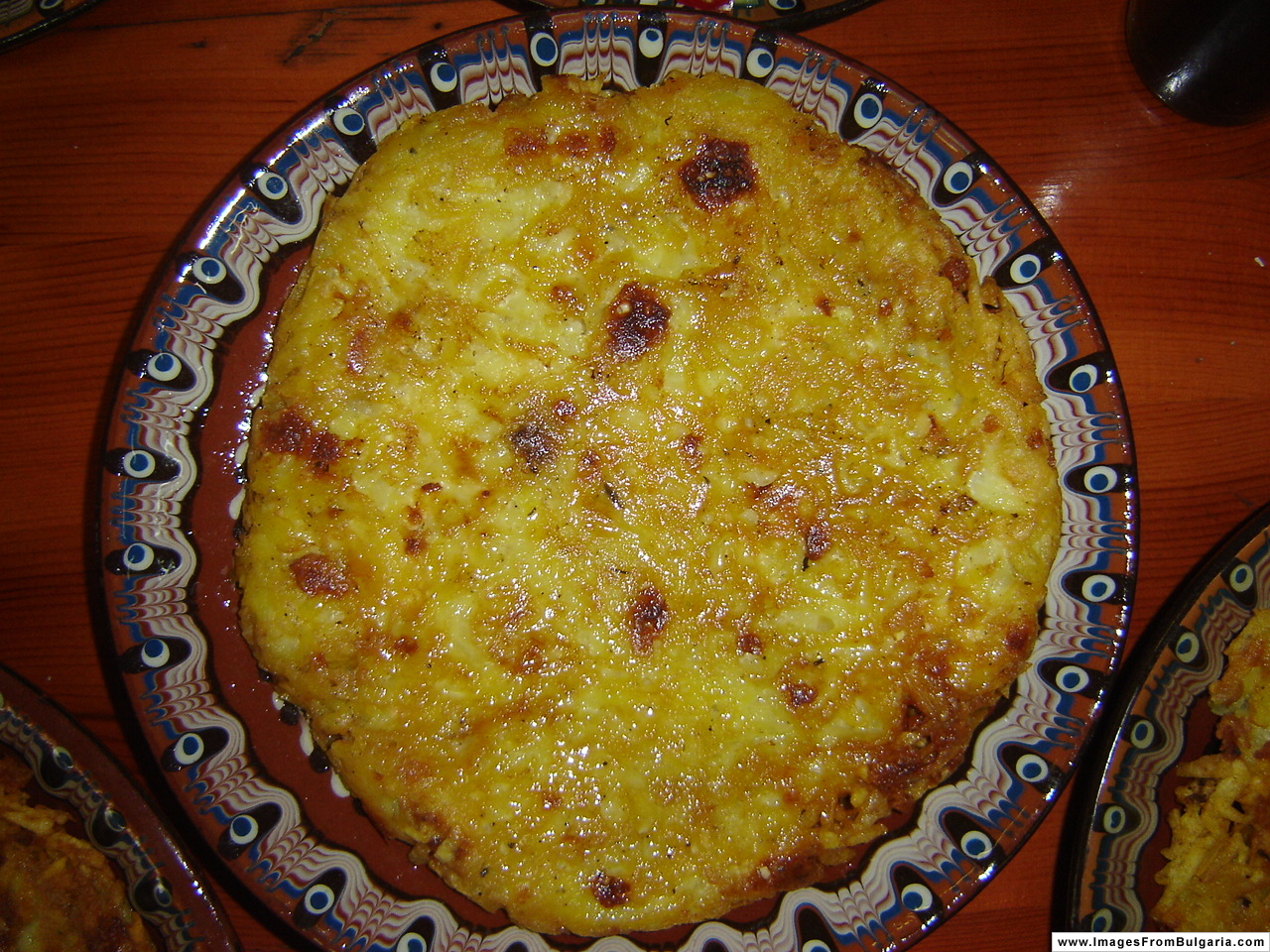
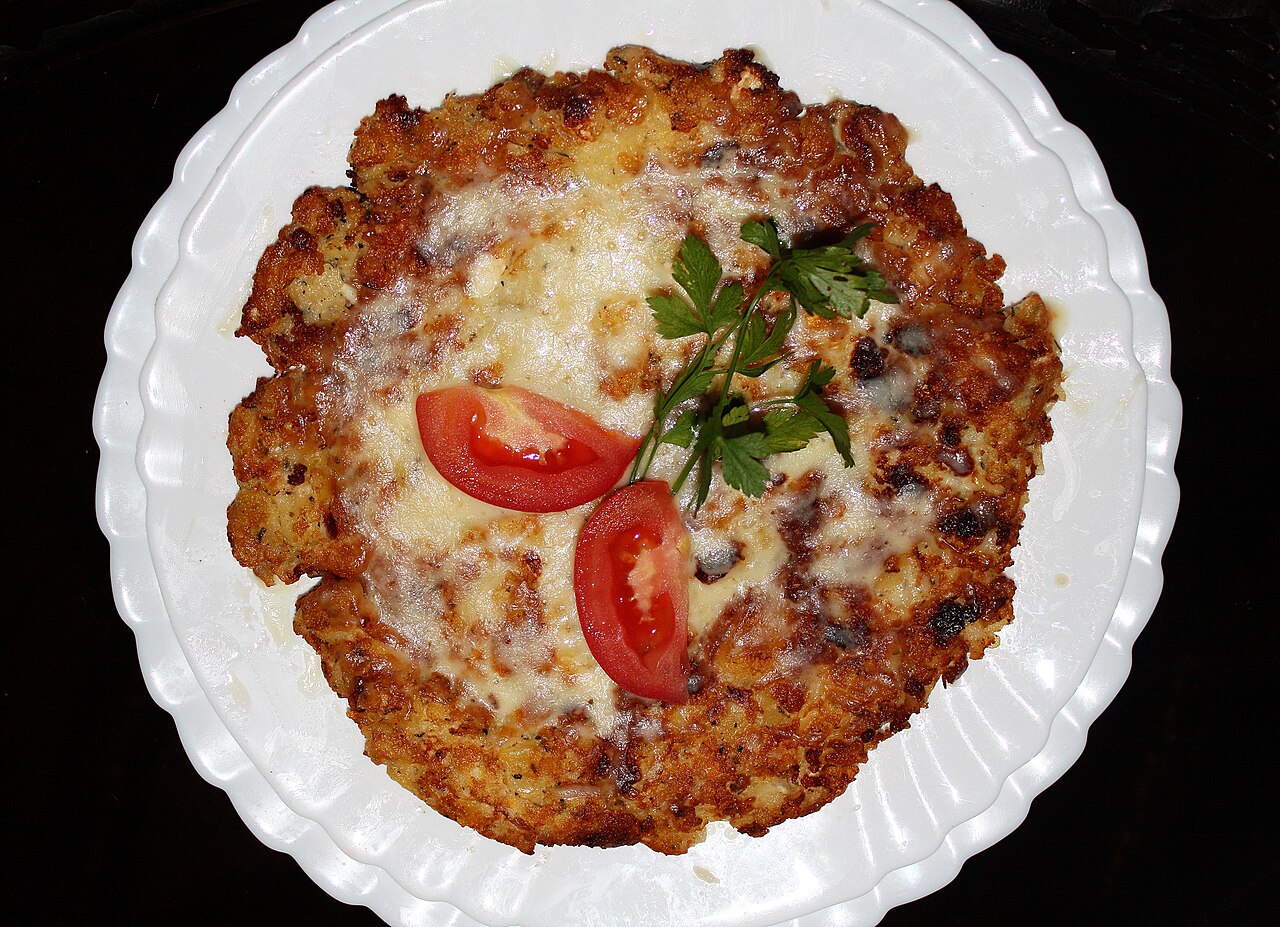
Patatnik (also spelled patetnik) is a potato dish from Bulgaria, specifically tied to the Rhodope Mountains in the country’s central south. The main ingredients are grated potatoes, onions, salt, and a very mild mint known locally as gyosum, all combined and cooked over a low heat. While some restaurants add white cheese or eggs, these are not part of the traditional recipe; savory and peppers are also used by some cooks.
To prepare it, the grated potatoes are squeezed dry and mixed with the onions. Part of this doughy mixture is rolled into two sheets—one placed at the bottom of the dish, larger than the dish so its edges extend outward. The remaining mixture, seasoned with savory, is poured over the bottom sheet, then covered with the second sheet; the edges of both sheets overlap, making it similar to a potato banitsa. In one method, the patatnik is flipped once the bottom is well cooked, then slid back into the dish with the cooked side up. In another method, no sheets are formed—the ingredients are mixed into a homogeneous mass, cooked in a deep dish over low heat, turned over after 20 minutes, covered, and cooked further.
The dish is traditional across the entire Rhodopes and neighboring areas, stretching from Bansko in Pirin through Smolyan and Zlatograd eastward to Chernichevo. Its name comes from the local word *patato* or *pateto* (meaning “potato”) combined with the Bulgarian masculine suffix *-nik*. This word is typical of the Rup dialects spoken in the Rhodopes and differs from standard Bulgarian *kartof* and western Bulgarian *kompir*. In Nedelino, the dish is called *kashnitsa*.
Quick Facts
- Country
- Bulgaria
- Region
- Rhodope Mountains
- Main Ingredient
- Potatoes, onions, eggs, salt, spearmint
Facts from the source article.
Lore & Background
Patatnik is prepared by squeezing out grated potatoes and mixing them with onions. Some of the doughy mixture is rolled into two sheets; one sheet is placed on the bottom of the dish, larger in diameter so it extends beyond the rim. The remaining mixture is spiced with savory, poured on top of the first sheet, and covered with the other sheet, with edges overlapping—resembling a potato banitsa. According to one method, the patatnik is turned over when the bottom is well cooked and slipped back into the dish with the heated side. Other recipes skip the sheets and instead mix all ingredients until homogeneous, then cook in a deep dish on a slow fire; after 20 minutes the mixture is turned over, covered, and cooked further.
Reader's Guide
Patatnik holds cultural significance as a traditional dish of the Rhodope Mountains and surrounding regions, reflecting local agricultural staples and culinary practices. Its name derives from the local word patato or pateto ('potato') with the Bulgarian masculine suffix –nik, typical of the Rup dialects spoken in the Rhodopes. This distinguishes it from standard Bulgarian kartof and western Bulgarian kompir. The dish is sometimes prepared with non-traditional additions like sirene (white cheese) or eggs in restaurants, but these are not considered authentic. In Nedelino, it is known as kashnitsa. Patatnik exemplifies how regional dialects and cooking methods preserve unique food heritage within Bulgaria, and its preparation methods—whether layered like a banitsa or mixed homogeneously—showcase local variation. The dish remains a staple of Rhodopean cuisine, connecting communities from Bansko to Chernichevo.
Did You Know?
- Patatnik is made with a very mild mint called gyosum in Bulgarian.
- Some restaurants add sirene (white cheese) or eggs, but this is not traditional.
- In Nedelino, the dish is known as kashnitsa.
Core Ingredients & the Art of Slow Cooking
Patatnik begins with a deceptively simple pantry: grated potatoes, onions, salt, and a very mild variety of mint known locally as gyosum. The potatoes are grated and then squeezed to remove excess moisture before being combined with the onions, creating a thick, doughy mass. This base is seasoned and cooked over a slow, patient fire—a method that distinguishes the dish from quick stovetop preparations. In the more elaborate traditional approach, the mixture is divided and rolled into two flat sheets. The larger sheet lines the bottom of the cooking vessel, extending well beyond its edges. The remaining portion, spiced with savory, is layered on top and sealed with the second sheet, the overlapping edges creating a structure that closely mirrors a potato banitsa. A second, simpler technique skips the sheet-forming entirely, instead blending all ingredients into a uniform mass and cooking it in a deep dish. After roughly twenty minutes, the patty is flipped, covered, and allowed to finish cooking. The result is a dense, savory potato cake that rewards the cook's patience.
A Dish of the Rhodope Highlands
Patatnik is deeply rooted in the geography of central-southern Bulgaria, specifically the Rhodope Mountains and the surrounding highland communities. Its traditional range stretches impressively: from Bansko nestled in the Pirin range, through the towns of Smolyan and Zlatograd, and extending eastward all the way to Chernichevo. This wide geographic footprint underscores that the dish is not the province of a single village but a shared culinary heritage of an entire mountain region. In the small community of Nedelino, the same preparation goes by a different name entirely—kashnitsa—illustrating how even within the Rhodope sphere, local identity shapes how food is labeled. The dish's association with these highland areas gives it a distinct regional character that sets it apart from lowland or urban Bulgarian cooking, anchoring it firmly in the pastoral, mountainous culture of the country's interior south.
Language, Dialect, and the Name Patatnik
The very name of the dish is a window into the linguistic landscape of the Rhodopes. Patatnik derives from the local word patato or pateto, meaning "potato," combined with the standard Bulgarian masculine suffix -nik. This particular term for potato is characteristic of the Rup dialects spoken throughout the Rhodope region, making the dish's name a small marker of regional identity. It is notably distinct from both the standard Bulgarian word kartof and the western Bulgarian term kompir, meaning that someone from a different part of the country might not immediately recognize the reference. The existence of yet another local name—kashnitsa, used in Nedelino for the same preparation—further demonstrates how dialectal variation permeates even the most basic aspects of food culture. In this way, patatnik is as much a linguistic artifact as a culinary one, carrying within its syllables the specific speech patterns of the mountain communities that created it.
Traditional Purity vs. Modern Adaptations
At its most authentic, patatnik relies on a tight, restrained set of ingredients: potatoes, onions, salt, gyosum mint, and savory. This lean combination is what defines the dish in the eyes of traditional cooks across the Rhodope region. However, the dish has not remained entirely static. In restaurant settings, chefs sometimes incorporate sirene—a Bulgarian white cheese—or crack eggs into the mixture, additions that, while popular, are explicitly not part of the traditional recipe. Some home cooks also introduce peppers alongside the savory, broadening the flavor profile slightly. The structural preparation also varies: while the layered, sheet-based method that produces a banitsa-like form is well established, an equally valid traditional approach simply blends all components into a homogeneous mass and cooks it in a deep dish. These variations show a dish flexible enough to adapt to individual taste and setting while still maintaining its core identity as a slow-cooked, potato-forward preparation of the Rhodope highlands.
Gallery
More in Bulgarian cuisine 1-24
Spotted an error? Know more?
Reader corrections go straight into our review queue. Suggest an edit · How this site is sourced