
Panagyurishte-style eggs
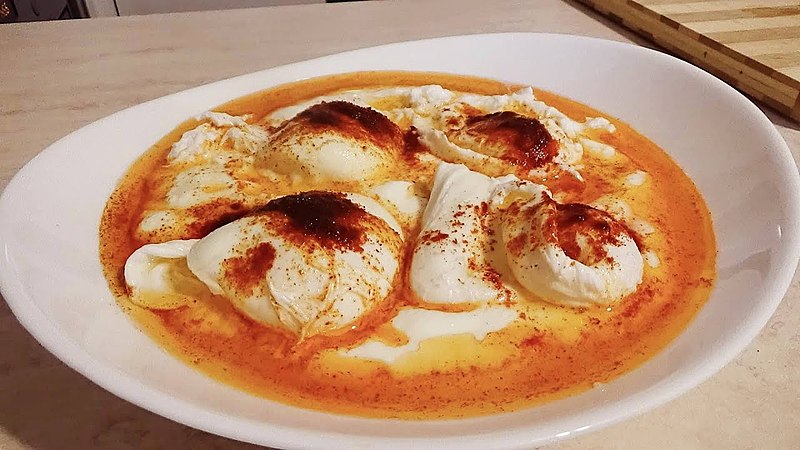
Bulgarian poached egg dish with yogurt, sirene, and paprika butter.

ShadowBee · CC BY-SA 4.0
Panagyurishte-style eggs (in Bulgarian: Яйца по панагюрски) is a popular Bulgarian dish made with poached eggs, Bulgarian yoghurt and sirene, and eaten warm, often for lunch. The original recipes for this dish are from the town of Panagyurishte, but the actual recipe was invented in the system of the Balkantourist restaurants during socialist era Bulgaria, based on traditional Bulgarian ingredients.
- Type
- Dish
- Origin
- Bulgaria (town of Panagyurishte)
- Era
- Socialist era Bulgaria (Balkantourist restaurant system)
- Main ingredients
- Eggs, Bulgarian yogurt, sirene, butter, paprika, garlic, white wine vinegar
- Serving temperature
- Warm
- Typical meal
- Lunch or breakfast
Lore & Background
The dish known today as Panagyurishte-style eggs was created in the system of the Balkantourist restaurants during socialist era Bulgaria. Although its name references the town of Panagyurishte, the original local recipes were quite different from the modern version. The dish was given that particular name to highlight its folk origin, using traditional Bulgarian ingredients like sirene and yogurt. Over time, it made its way to the average Bulgarian family's table and became a beloved breakfast or lunch for generations.
Reader's Guide
In old Balkantourist-era cookbooks, two variations existed: one where poached eggs were placed on a bed of crumbled sirene, and another where eggs were placed on a bed of yogurt seasoned with garlic paste. Over time, these two recipes merged, and today people mix the crumbled sirene with yogurt. The preparation involves poaching eggs in water with salt and white wine vinegar, then rinsing them with cold water. A bed is made from the sirene/yogurt mix, the warm poached eggs are placed on top, and the dish is doused with melted butter mixed with paprika. Garlic paste is added to taste. The dish is similar to the Ottoman dish Çılbır.
Did You Know?
- Original recipes from Panagyurishte were quite different from the modern version.
- In old Balkantourist-era cookbooks, there were two variations: one with eggs on crumbled sirene, another with eggs on yogurt seasoned with garlic paste.
- Despite some similarities, the dish is distinct from the Ottoman dish Çılbır, which uses garlic yogurt and chili-butter but no sirene cheese.
From a Town's Traditions to a National Staple
The dish now known across Bulgaria as Panagyurishte-style eggs carries the name of the town of Panagyurishte, yet the modern recipe bears little resemblance to what was actually prepared there in earlier times. The version most Bulgarians recognize today was not born in a village kitchen but within the restaurant network of Balkantourist, the state-run hospitality system of socialist-era Bulgaria. Chefs working in that system took two deeply traditional ingredients—sirene and Bulgarian yoghurt—and arranged them around poached eggs, then attached the Panagyurishte label to signal a folk pedigree. That branding proved effective. As the dish slipped out of restaurant walls and onto the tables of ordinary households, its simplicity and satisfying flavour turned it into a go-to midday meal. Generations of families came to rely on it for breakfast or lunch, and its easy preparation meant it required no special equipment or rare ingredients, only eggs, a pot of water, and the pantry staples every Bulgarian kitchen already held.
Two Recipes, One Living Standard
In the cookbooks published during the Balkantourist era, the dish appeared in two distinct forms. In one preparation, the poached eggs rested directly atop a generous layer of crumbled sirene. In the other, the eggs sat on a bed of yoghurt that had been seasoned with garlic paste. These were not minor tweaks but genuinely different presentations, each highlighting a different dairy as the star. Over the decades, however, the boundary between the two blurred. Home cooks, seeking the creaminess of the yoghurt alongside the tang and body of the sirene, simply combined the two into a single mixture. The result—crumbled sirene folded into Bulgarian yoghurt, seasoned with garlic—became the standard base that most people now associate with the dish. This organic merger means that the "authentic" Panagyurishte-style egg is, in a sense, a living recipe: it carries the DNA of both original Balkantourist variations while belonging fully to no single cookbook edition.
The Craft of the Poach and the Sauce
The heart of the dish lies in how the eggs are cooked and how the finishing sauce is built. A pot of water is seasoned with a pinch of salt and a tablespoon of white wine vinegar—specifically white, because coloured vinegar would taint the eggs' appearance. The water is brought to a rolling boil, then removed from the heat and allowed to cool to roughly eighty degrees Celsius before the eggs are gently introduced. Cooks employ various techniques: some swirl the water to create a vortex and lower the egg into the centre, while others use a spoon to cradle and "bathe" the yolk as it sets. Once poached, the eggs are plunged into cold water to halt the cooking and wash away any residual vinegar tang. A simpler alternative is to soft-boil the eggs in boiling water, provided the yolk remains liquid. For the sauce, butter is melted and paprika is stirred in for just a moment before the pan is pulled from the flame, since overcooked paprika turns bitter. The eggs are then set on their sirene-yoghurt bed and doused with this warm, paprika-kissed butter.
A Place at the Table and Beyond
Panagyurishte-style eggs occupy a warm, unpretentious niche in Bulgarian culinary life. Served warm and most often as a lunch, the dish has become a dependable fixture of the family table, passed down through generations as a meal that requires minimal effort yet delivers a satisfying balance of creamy, tangy, and richly buttery notes. Its ingredient list—eggs, Bulgarian yoghurt, sirene, butter, paprika, garlic, and a splash of white wine vinegar—demands nothing exotic, which is precisely why it has endured. The dish also sits in an interesting cross-cultural context: the Ottoman Turkish preparation known as Çılbır is described as almost identical, suggesting a shared regional tradition of poached eggs over a yoghurt base. Whether garnished with a scattering of fresh parsley or dill, or finished with a dusting of paprika for colour, the plate remains deceptively simple. It is a dish that belongs to no restaurant and no occasion, yet it is found in virtually every Bulgarian home, a quiet testament to how a few humble ingredients, handled with care, can become a national comfort food.
Gallery
More in Bulgarian cuisine 1-24
Spotted an error? Know more?
Reader corrections go straight into our review queue. Suggest an edit · How this site is sourced