Sergipe
Smallest Brazilian state, with a history of colonial resistance and piracy.

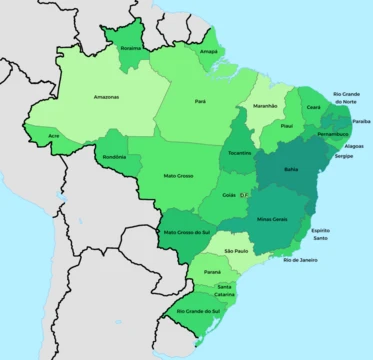
Sergipe is the smallest state in Brazil by geographical area, larger only than the Federal District. It lies in the Northeast Region along the Atlantic coast, bordered by Bahia to the south and west and Alagoas to the north. Its capital and largest city is Aracaju, and the state is divided into 75 municipalities. Sergipe holds 1.1% of the Brazilian population and produces 0.6% of the national GDP. Inland, the state is mostly covered by savanna, while the coastline features mangroves, swamps, and sandy beaches, with a narrow strip of tropical rainforest along the coast. The São Francisco River forms the northern boundary, and smaller rivers like the Irapiranga, Real, and Cotinguiba drain the southern half, though sandbars at their mouths prevent good ports. The capital, Aracaju, sits on the estuary of the Cotinguiba River near the coast, on a sandy plain with dunes within the city limits. Other principal towns include Estância, a center for cotton textiles and soap; Laranjeiras, in a sugar-growing district; and São Cristóvão, the old colonial capital. The name Sergipe comes from an Old Tupi word meaning "river of crabs," or alternatively from a local Indigenous chief named Serigy. The region was home to Kanindé, Aratus, and Tupi peoples. Portuguese rule was established after two decades of warfare against the Tupinambá, with the first settlement at São Cristóvão in 1591. The area was invaded by the Dutch and raided by French buccaneers, attracted by its king-wood. From 1641 to 1645 it was part of Dutch Brazil. The Portuguese regained control in 1645, and by the 18th century Sergipe produced a third of Bahia's sugar. Sugarcane grew in several river valleys, while livestock supplied draft animals to neighboring states. Sergipe was separated from Bahia by royal decree on July 8, 1820, and retained its separation after Brazilian independence in 1822, first as a captaincy and then as a province. Economic development remained low during the 19th century, aside from a brief cotton boom.
- Capital
- Aracaju
- Largest City
- Aracaju
- Official Language
- Portuguese
- GDP Share of Brazil
- 0.6%
Lore & Background
Present-day Sergipe was home to numerous indigenous peoples, including the Kanindé, Aratus, and Tupi. The area was one of the last coastal regions of Brazil whose indigenous population, consisting of Tupinambá tribes, resisted subjugation to Portuguese colonial rule. The region was fully brought under Portuguese rule after approximately two decades of warfare during which thousands of natives were murdered and thousands more enslaved to work on sugar plantations. Sergipe was invaded numerous times by the Dutch and frequently raided by French buccaneers. During the 17th century, the state was known throughout the Americas for its king-wood, a prized commodity that was the primary attraction during the buccaneer raids. By the 18th century, the Portuguese military had driven off the pirates permanently. Sergipe retained its separation from Bahia after the Independence of Brazil in 1822. Coastal Sergipe was attacked by Nazi Germany in 1942, prompting Brazil to declare war on Germany and Italy.
Reader's Guide
Sergipe's significance lies in its role as a microcosm of Brazilian colonial and post-colonial history. As the smallest state, it encapsulates key themes: indigenous resistance, Portuguese colonization, sugar plantation economy, Dutch and French incursions, and the transition from captaincy to province to state. The state's economy, historically based on sugar and livestock, now has an industrial sector that is the largest component of its GDP. Demographically, Sergipe is predominantly multiracial, with a strong Catholic majority. The state's educational institutions, including the Universidade Federal de Sergipe, contribute to regional development. The legacy of outlaws like Lampião underscores the state's turbulent early 20th century. Overall, Sergipe offers a compact but rich case study of Brazilian regional history, from colonial exploitation to modern statehood.
Did You Know?
- Sergipe is the smallest state in Brazil by geographical area, larger only than the Federal District.
- The name Sergipe originates from an Old Tupi word meaning 'in the river of the siri' (a species of crab).
More in Brazilian States 1-24
Spotted an error? Know more?
This is a living reference — every entry is fact-audited, and reader corrections feed straight into our audit queue. Suggest an edit · See this site's audit record