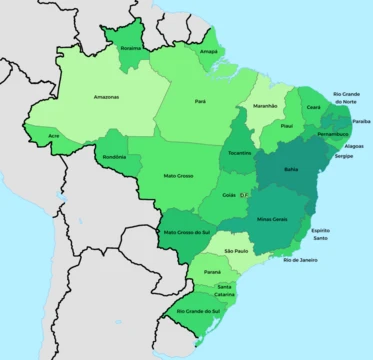
Roraima
Northernmost Brazilian state, isolated, with a history of colonial conflict.

Roraima is one of the 26 states of Brazil, situated in the country’s North Region. It holds the distinction of being the northernmost and most geographically and logistically isolated state in the nation. Its borders meet the state of Pará to the southeast, Amazonas to the south and west, Venezuela to the north and northwest, and Guyana to the east. The state covers an area slightly larger than Belarus, making it the fourteenth largest Brazilian state by area. Its capital, Boa Vista, is the only state capital in Brazil located entirely in the Northern Hemisphere. Since 2019, the governor has been Antônio Denarium of the conservative Progressistas party.
Roraima is the least populous state in Brazil, with an estimated 631,181 inhabitants as of 2020, and it also has the lowest population density in the country at 2.01 inhabitants per square kilometre. The economy is primarily based on the tertiary sector and registers high growth, yet its Gross Domestic Product is the lowest in Brazil, reaching R$ 16.024 billion, which represents only 0.20% of the national economy.
The history of Roraima is deeply tied to the Branco River, which facilitated the arrival of the first Portuguese settlers. The Branco River Valley’s strategic location attracted English and Dutch explorers, who entered via the Guiana Shield seeking indigenous people for enslavement. Spanish forces also invaded from Venezuela. The Portuguese eventually expelled all invaders, securing sovereignty over the region. From 1725, Carmelite missionaries worked to convert indigenous peoples, and Portuguese occupation intensified after the 1730s through rescue troops, war parties, and the establishment of villages. The São Joaquim Fort, built in 1755 at the confluence of the Uraricoiera and Takutu rivers, was crucial in securing Portuguese control. Settlements such as Nossa Senhora da Conceição, Santo Antônio, São Felipe, Nossa Senhora do Carmo, and Santa Bárbara were founded. Since the 2010s, Roraima has become the primary entry point for Venezuelan refugees, with an estimated 100,000 displaced Venezuelans residing in the state, roughly one-sixth of its population.
- Capital
- Boa Vista
- Population density
- 2.01 inhabitants per square kilometre
- Governor (since 2019)
- Antônio Denarium (Progressistas)
- Etymology
- From Pemon language: 'Green Peak', 'Mother of the Winds', or 'Cashew Mountain'
Lore & Background
Roraima is one of the 26 states of Brazil, located in the country’s North Region. It is the northernmost and most geographically and logistically isolated state in Brazil. The state is bordered by Pará to the southeast, Amazonas to the south and west, Venezuela to the north and northwest, and Guyana to the east. Its capital and largest city is Boa Vista, which is the only Brazilian state capital situated entirely in the Northern Hemisphere. Roraima covers an area slightly larger than Belarus, making it the fourteenth largest Brazilian state by area. It is the least populous state in Brazil, with an estimated 631,181 inhabitants as of 2020, and also has the lowest population density at 2.01 inhabitants per square kilometre. The state’s economy is based mainly on the tertiary sector and registers high growth, though its Gross Domestic Product is the lowest in the country, representing only 0.20% of the Brazilian economy. The name “Roraima” comes from the Pemon language, with possible meanings including “Green Peak,” “Mother of the Winds,” and “Cashew Mountain.” The first Portuguese settlers arrived via the Branco River. Before them, English and Dutch explorers entered the Branco River Valley through the Guyanas seeking indigenous slaves, and Spaniards invaded from Venezuela. Portuguese settlers defeated and expelled all invaders, establishing Portugal’s sovereignty. The São Joaquim Fort, built in 1755 at the confluence of the Uraricoera and Takutu rivers, was decisive in this conquest, though it no longer exists today. As a result of the crisis in Venezuela since the 2010s, Roraima has become the leading entry point for Venezuelan refugees in Brazil, with an estimated 100,000 displaced Venezuelans in the state.
Reader's Guide
Roraima's significance lies in its unique position as Brazil's northernmost and most isolated state, with a history shaped by colonial rivalries among Portuguese, English, Dutch, and Spanish powers. The Branco River Valley was a strategic frontier, and the Portuguese ultimately secured sovereignty through military forts and settlement. Roraima remains the least populous Brazilian state, with the lowest population density and the smallest GDP, though its economy grows rapidly. Its capital, Boa Vista, is the only Brazilian capital entirely in the Northern Hemisphere. The state's name, from the Pemon language, reflects its landscape and indigenous heritage. The legacy of colonial conflict and recent humanitarian crisis underscores Roraima's role as a borderland of cultural and geopolitical intersection.
Did You Know?
- Roraima is the only Brazilian state whose capital, Boa Vista, lies entirely in the Northern Hemisphere.
- The word 'Roraima' may mean 'Green Peak', 'Mother of the Winds', or 'Cashew Mountain' in the Pemon language.
More in Brazilian States 1-24
Spotted an error? Know more?
This is a living reference — every entry is fact-audited, and reader corrections feed straight into our audit queue. Suggest an edit · See this site's audit record