Amazonas (Brazilian state)
Largest Brazilian state, named after the Amazon River.
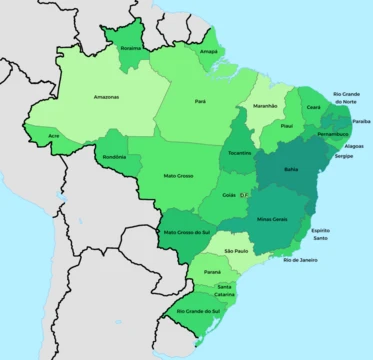
Amazonas is a state of Brazil, situated in the North Region at the country’s northwestern edge. It is the largest Brazilian state by area and the ninth-largest country subdivision globally, covering over 1.57 million square kilometers. This makes it the largest such subdivision in South America, exceeding the combined territories of Chile, Paraguay, and Uruguay. The state shares borders with Roraima, Pará, Mato Grosso, Rondônia, and Acre, as well as the nations of Peru, Colombia, and Venezuela. Its name derives from the Amazon River, which Francisco de Orellana named in 1541 after encountering indigenous women he likened to the Amazons of Greek myth. Originally part of the Spanish Empire’s Viceroyalty of Peru, the region was settled by Portuguese moving northwest from Brazil in the early 18th century and formally incorporated into the Portuguese Empire following the Treaty of Madrid in 1750. It became a state under the First Brazilian Republic in 1889. The territory is almost entirely tropical jungle, with settlements clustered along navigable waterways and accessible only by boat or plane. The capital, Manaus, is a modern city of 2.1 million inhabitants situated on the Amazon River, 1,500 kilometers upstream from the Atlantic. Nearly half the state’s population lives in Manaus; other major cities—Parintins, Manacapuru, Itacoatiara, Tefé, and Coari—are also along the Amazon in the eastern half. The Amazon rainforest itself formed about ten million years ago when the river changed course to flow eastward after the rise of the Andes. During Ice Ages, sea level drops drained a vast inland lake, and the forest retreated into isolated patches, allowing species to diverge and later rejoin, contributing to the region’s immense biodiversity. Pre-Columbian inhabitants were seminomadic peoples who combined agriculture with fishing and hunting. Thousands of tribes once lived here, but disease and assimilation reduced their numbers to around three hundred thousand by the late 20th century, with some uncontacted groups remaining.
- capital
- Manaus
- population
- 2.1 million in Manaus; nearly half the state's population lives there
- country
- Brazil
- region
- North Region
- largest_city
- Manaus
- established
- 1889 (state under First Brazilian Republic)
Quick Facts
- Settlement Type
- State
- Flag Link
- Flag of Amazonas (Brazilian state)
- Flag Size
- 125px
- Motto
- la · Iustitia et Aequalitas / "Justice and Equality"
- Anthem
- Hino do estado do Amazonas · pt · vertical-align=sup
- Subdivision Type
- Country
- Subdivision Name
- Brazil
- Subdivision Type2
- Region
- Subdivision Name2
- North
- Seat Type
- Capital and largest city
- Seat
- Manaus
- Government Type
- Unitary state
Facts from the source article.
Lore & Background
Amazonas, the largest Brazilian state, occupies the northwestern corner of the country and is named for the Amazon River. Its appearance is overwhelmingly defined by dense tropical jungle, with nearly all settlements clustered along navigable waterways. The capital, Manaus, is a modern city of over two million people situated on the Amazon River, roughly 1,500 kilometers inland from the Atlantic. The state’s vast area—greater than the combined territories of Chile, Paraguay, and Uruguay—is accessible primarily by boat or plane. Its defining characteristics include a history shaped by colonial expansion: originally part of the Spanish Viceroyalty of Peru, the region was settled by Portuguese moving northwest in the early 1700s and formally incorporated into the Portuguese Empire by the 1750 Treaty of Madrid. The state’s geography was forged over millions of years; the Amazon River once flowed westward, but the rise of the Andes and the linking of the Brazilian and Guyana shields created a vast inland sea that eventually drained eastward, giving birth to the rainforest. During Ice Ages, the forest retreated into isolated patches, allowing species to diverge, which contributed to the region’s immense biodiversity. Pre-Columbian inhabitants were seminomadic peoples, and today uncontacted tribes still exist. The state’s population is concentrated in Manaus and a few other riverine cities such as Parintins, Manacapuru, Itacoatiara, Tefé, and Coari, all located in the eastern half of the territory.
Reader's Guide
Amazonas is significant as the largest Brazilian state and the largest country subdivision in South America, greater than the areas of Chile, Paraguay, and Uruguay combined. Its history reflects colonial conflicts between Spain and Portugal, with the territory initially part of the Spanish Empire's Viceroyalty of Peru before being settled by the Portuguese. The state's name derives from the Amazon River, named by Francisco de Orellana after a reported conflict with indigenous women. The region's pre-Columbian inhabitants were seminomadic peoples, and approximately two thousand tribes lived there in the sixteenth century, though disease and assimilation reduced their numbers to about three hundred thousand by the end of the twentieth century. The Amazon rainforest itself formed about ten million years ago when the river began flowing eastward after the rise of the Andes. The state's legacy includes its vast biodiversity, with species such as over 20 species of stingray adapted to freshwater, and its role in the geopolitical history of South America, with borders defined by treaties including the Treaty of Madrid and the Treaty Vásquez Cobo–Martins.
Did You Know?
- Amazonas is the largest country subdivision in South America, greater than the areas of Chile, Paraguay, and Uruguay combined.
- The Amazon River once flowed westward, possibly as part of a proto-Congo river system when the continents were joined as part of western Gondwana.
Frequently Asked Questions
What is Amazonas (Brazilian state)?
Amazonas is a state in Brazil's North Region, occupying the country's north-western corner. It holds the distinction of being Brazil's largest state by area and the ninth-largest country subdivision worldwide.
What is the capital of Amazonas (Brazilian state)?
Manaus serves as both the capital and the largest city of Amazonas. With roughly 2.1 million residents, it is home to nearly half of the state's total population.
Why is Amazonas (Brazilian state) important to Brazil?
As the country's largest state by area and a cornerstone of the North Region, Amazonas carries major geographical and ecological weight for Brazil. Its urban center, Manaus, anchors the state's population, concentrating nearly half of all residents in a single city.
More in Brazilian States 1-24
Spotted an error? Know more?
This is a living reference — every entry is fact-audited, and reader corrections feed straight into our audit queue. Suggest an edit · See this site's audit record