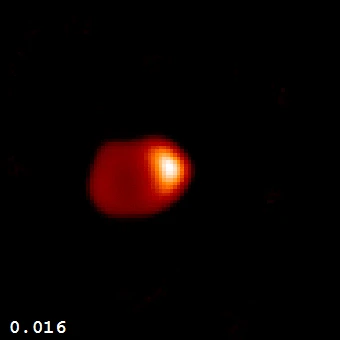
ZTF J1239+8347
First mass-transferring binary brown dwarf system discovered.

ZTF J1239+8347 is a binary system of two L-type brown dwarfs that orbit each other once every 57.41 minutes. The system lies roughly 339 parsecs away in the constellation Cepheus. As of April 2026, it is the first known example of a mass-transferring binary brown dwarf.
The two brown dwarfs each have masses between 60 and 80 times that of Jupiter, radii similar to Jupiter’s, and surface temperatures just above 1000 K. They are so close together that the more massive component—called the accretor—pulls material directly from its less massive companion, the donor. This material forms a narrow stream that slams into the accretor’s atmosphere, heating it and creating a hotspot that glows in blue and ultraviolet light. As the pair orbits, the hotspot rotates in and out of Earth’s view, causing the system’s observed brightness to change periodically. Astronomers expect the two brown dwarfs will eventually merge into a new star, though the timescale for that event is unknown.
The system was first cataloged by the Gaia satellite in its second data release (Gaia DR2) in 2018. A late 2018 study by Nicola Pietro Gentile Fusillo and colleagues suggested it might be a white dwarf candidate, based on Gaia’s measurements of a very dim absolute magnitude and blue color. The same team revisited the system in 2021 using Gaia Early DR3 data and found similar properties, so it remained classified as a white dwarf candidate. At that time, it was known only by its Gaia designation, 1726297924930902400.
In 2023, Liangliang Ren and colleagues analyzed Zwicky Transient Facility (ZTF) data and first reported the system’s variable brightness, flagging it as an ellipsoidal variable-type binary white dwarf candidate. A 2024 study of Gaia DR3 data by Maya Steen and colleagues similarly flagged it as a binary white dwarf candidate, classifying it as a cataclysmic variable. Both studies began referring to the system by its J2000 equatorial coordinates, J1239+8347.
In March 2026, a team led by Samuel Whitebook announced that ZTF J1239+8347 was actually a binary system of mass-transferring brown dwarfs, not white dwarfs. Their discovery relied on visible and near-infrared spectroscopy taken during 2024–2025, along with photometric light curves from other telescopes. This finding makes ZTF J1239+8347 the first known mass-transferring binary brown dwarf.
- Constellation
- Cepheus
- Distance
- 339 pc
- Orbital period
- 57.41 minutes
- Component masses
- 60–80 Jupiter masses each
- Component radii
- Similar to Jupiter
- Effective temperatures
- Just over 1000 K
- First recognized as binary brown dwarf
- 2026
Lore & Background
The system was first catalogued by the Gaia satellite in its second data release (Gaia DR2) from 2018. A late 2018 study by Nicola Pietro Gentile Fusillo and colleagues suggested it could be a white dwarf candidate due to its dim absolute magnitude and blue color. A 2021 study of Gaia Early DR3 data found similar properties, so it remained classified as a white dwarf candidate. The variable brightness was first reported in a 2023 analysis of Zwicky Transient Facility data by Liangliang Ren and colleagues, who flagged it as an ellipsoidal variable-type binary white dwarf candidate. A 2024 study of Gaia DR3 data by Maya Steen and colleagues similarly flagged it as a binary white dwarf candidate, classifying it as a cataclysmic variable.
In March 2026, a team led by Samuel Whitebook announced that ZTF J1239+8347 is actually a binary system of mass-transferring brown dwarfs, based on visible and near-infrared spectroscopy taken during 2024–2025 and photometric light curve measurements. The two brown dwarfs orbit so closely that the more massive component (the accretor) pulls material directly from the less massive component (the donor). The accreted material forms a narrow stream that directly impacts the accretor's atmosphere, creating a hotspot that glows in blue and ultraviolet light. As the brown dwarfs orbit, the hotspot rotates in and out of view, causing periodic brightness changes.
The origin of the system is unclear; Whitebook and colleagues suggested a third star might have gravitationally pushed the brown dwarfs closer together. The brown dwarfs' orbits are expected to decay over time due to gravitational radiation and magnetic braking, and they will eventually merge to form a new star, though the timescale is uncertain.
Reader's Guide
ZTF J1239+8347 holds significance as the first mass-transferring binary brown dwarf system discovered. Its initial misclassification as a binary white dwarf suggests that there may be more misclassified binary brown dwarfs hidden in binary white dwarf catalogues. The system exhibits a high luminosity in visible and ultraviolet light, explained by the heating from mass transfer. The hotspot on the accretor spans a radius of about 0.1 Jupiter radii and is extended longitudinally, possibly due to strong winds. At maximum brightness, the visible spectrum shows prominent hydrogen absorption features, indicating the hotspot glow originates from inside the accretor's hydrogen-rich atmosphere. At minimum brightness, visible hydrogen emission lines appear, possibly from reprocessing in the accretor's atmosphere or the donor reflecting light from the hotspot. The system's peak-to-trough brightness amplitude is very large (>2 magnitudes) in ultraviolet but decreases at longer wavelengths. The brown dwarfs are expected to merge eventually, with their combined mass sufficient to initiate nuclear fusion, though the timescale remains uncertain.
Did You Know?
- ZTF J1239+8347 has an orbital period of only 57.41 minutes.
- The system is located about 339 parsecs away in the constellation Cepheus.
- It was first recognized as a mass-transferring binary brown dwarf system in March 2026.
- The brown dwarfs are expected to eventually merge to form a new star.
More in Binary and Multiple Stars, Part 5 1-24
Spotted an error? Know more?
Reader corrections go straight into our review queue. Suggest an edit · How this site is sourced