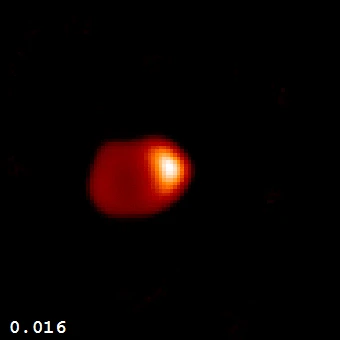
Upsilon1 Cassiopeiae
A naked-eye astrometric binary in Cassiopeia, 330 light years away.

Upsilon1 Cassiopeiae is a binary star system classified as an astrometric binary, located in the northern constellation Cassiopeia. Its Bayer designation, Latinized from υ1 Cassiopeiae, is also written as Upsilon1 Cas or υ1 Cas. The system has an apparent visual magnitude of 4.82, making it visible without a telescope. From Earth, annual parallax measurements place it roughly 330 light-years away, and it is moving toward the Sun at a radial velocity of −24 km/s.
The primary star visible to us is an evolved giant of spectral type K2 III, meaning it is a K-type star that has left the main sequence. Estimated at 4.75 billion years old, it is a red clump star, currently fusing helium in its core. After correcting for limb darkening, its measured angular diameter, combined with its distance, indicates a physical radius about 21 times that of the Sun. It has 1.39 times the Sun's mass and shines with 174 times the Sun's luminosity from its expanded photosphere, which has an effective temperature of 4,422 K.
Two fainter stars appear nearby in the sky but are not physically linked to the system. As of 2003, a magnitude 12.50 companion lies 17.80 arcseconds away at a position angle of 61°, and a magnitude 12.89 companion is 93.30 arcseconds away at a position angle of 125°.
- Apparent visual magnitude
- 4.82
- Distance
- ~330 light years
- Radial velocity
- −24 km/s
- Stellar classification (visible componen
- K2 III
- Age
- 4.75 billion years
- Mass
- 1.39 M☉
- Radius
- ~21 R☉
- Luminosity
- 174 L☉
- Effective temperature
- 4,422 K
Lore & Background
The visible component of Upsilon1 Cassiopeiae is an evolved K-type giant star with a stellar classification of K2 III. With an estimated age of 4.75 billion years, it is a red clump star that generates energy through the fusion of helium at its core. Its measured angular diameter, after correction for limb darkening, yields a physical size of about 21 times the radius of the Sun. It has 1.39 times the mass of the Sun and radiates 174 times the Sun's luminosity from its expanded photosphere at an effective temperature of 4,422 K.
The system has two visual companions: a magnitude 12.50 star at an angular separation of 17.80 arc seconds along a position angle of 61°, as of 2003, and a more distant magnitude 12.89 companion at a separation of 93.30 arc seconds along a position angle of 125°, as measured in 2003. Neither star appears to be physically associated with υ1 Cas.
Reader's Guide
Upsilon1 Cassiopeiae is notable as an astrometric binary, meaning its binary nature is inferred from the gravitational perturbation of the visible star's motion rather than direct imaging. Its status as a red clump giant—a helium-fusing star—places it in an important evolutionary phase for understanding stellar interiors and galactic populations. The system's proximity of about 330 light years and naked-eye visibility make it accessible for both amateur observation and professional study. The two optical companions, while not physically bound, provide context for the star's field environment. The star's radial velocity of −24 km/s indicates it is moving toward the Sun, a kinematic detail that contributes to studies of stellar motions in the Milky Way. Its measured angular diameter and derived radius of 21 solar radii offer a concrete example of the expanded state of evolved giants. The system's age of 4.75 billion years is comparable to that of the Sun, allowing comparisons of stellar evolution at similar ages but different masses.
Did You Know?
- Upsilon1 Cassiopeiae is an astrometric binary star system.
- The visible component is a red clump giant fusing helium at its core.
- It has two visual companions, neither of which is physically associated with the system.
- The star is drifting closer to the Sun at a radial velocity of −24 km/s.
Frequently Asked Questions
What is Upsilon1 Cassiopeiae?
It is a naked-eye binary star system located in the northern constellation Cassiopeia, formally catalogued as an astrometric binary. The visible primary is an evolved K2 giant that has already left the main sequence.
Can I see Upsilon1 Cassiopeiae without a telescope?
Yes — its apparent visual magnitude of 4.82 places it within the range of unaided human vision under reasonably dark skies. At roughly 330 light-years from Earth, it is close enough to be a straightforward target for casual stargazing.
What kind of star is the primary component?
The visible star is classified K2 III, a cool K-type giant in a post-main-sequence evolutionary phase. It carries about 1.39 solar masses and is estimated to be around 4.75 billion years old.
Is Upsilon1 Cassiopeiae moving toward or away from the Sun?
Its radial velocity of −24 km/s tells us the system is slowly drifting in our direction. That approach speed is modest but clearly detectable through Doppler shifts in the star's spectral lines.
Why is it called an 'astrometric' binary rather than a visual one?
The companion star is too faint to be resolved directly; its existence is revealed only by the tiny periodic wobble it induces in the primary's apparent position. This makes Upsilon1 Cassiopeiae a textbook case of a binary detected through gravitational perturbation rather than direct imaging.
More in Binary and Multiple Stars, Part 5 1-24
Spotted an error? Know more?
Reader corrections go straight into our review queue. Suggest an edit · How this site is sourced