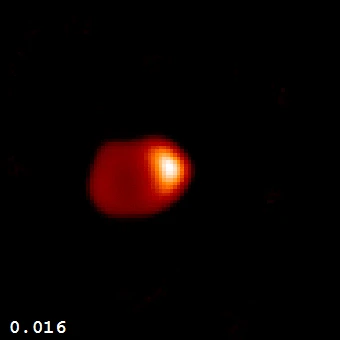
Theta Apodis
A high-proper-motion red giant with a variable brightness and a binary companion.

Theta Apodis is a variable star in the southern circumpolar constellation of Apus, identified by the Bayer designation θ Apodis. It is notable as a semiregular pulsating red giant on the asymptotic giant branch, with a high proper motion and an astrometric binary companion.
- Bayer designation
- θ Apodis
- Apparent visual magnitude range
- 4.65 to 6.20
- Distance
- approximately 390 ly
- Stellar classification
- M7 III
- Luminosity
- approximately 3879 times that of the Sun
- Variability type
- semiregular pulsating
- Period
- 119 days (with a longer period of around 1,000 days)
Lore & Background
Benjamin Apthorp Gould announced that Theta Apodis is a variable star in 1879. It is a semiregular pulsating variable whose brightness changes over a range of 0.56 magnitudes with a period of 119 days, and a longer period of around 1,000 days has also been detected. The star is an evolved red giant currently on the asymptotic giant branch, with a stellar classification of M7 III. It shines with a luminosity approximately 3879 times that of the Sun and has a surface temperature that is not specified in the available data. Theta Apodis is losing mass at a rate of times the mass of the Sun per year through its stellar wind. Dusty material ejected from this star interacts with the surrounding interstellar medium, forming a bow shock as the star moves through the galaxy; the stand-off distance for this front is located at about 0.134 ly from Theta Apodis. The star has been identified as an astrometric binary, indicating that it has an orbiting companion that causes gravitational perturbation of the primary star.
Reader's Guide
Theta Apodis holds significance as a variable star in a southern circumpolar constellation, first identified as variable by Benjamin Apthorp Gould in 1879. Its semiregular pulsations, with a primary period of 119 days and a longer secondary period of around 1,000 days, contribute to understanding the behavior of evolved red giants on the asymptotic giant branch. The star's high proper motion, greater than 50 milliarcseconds per year, is unusual for a red star and suggests a relatively fast trajectory through the galaxy. The interaction of its stellar wind with the interstellar medium, producing a bow shock at a stand-off distance of 0.134 ly, provides a case study for mass-loss processes and circumstellar environments. Additionally, its identification as an astrometric binary reveals the presence of an unseen companion, adding a dynamical dimension to its study. The star's brightness range of 4.65 to 6.20 makes it faintly visible to the naked eye under dark suburban skies, linking observational astronomy with stellar evolution.
Did You Know?
- It is a semiregular pulsating variable with a brightness range of 0.56 magnitudes.
- The star's bow shock from its stellar wind is located about 0.134 ly from the star.
- Theta Apodis is an astrometric binary, implying an unseen companion perturbs its motion.
Frequently Asked Questions
What is Theta Apodis?
Theta Apodis is a semiregular pulsating red giant in the southern circumpolar constellation Apus, identified by the Bayer designation θ Apodis. It is an M7 III star sitting on the asymptotic giant branch, roughly 390 light-years from Earth.
How does Theta Apodis's brightness vary?
The star's apparent visual magnitude oscillates between 4.65 at its brightest and 6.20 at its faintest due to semiregular pulsations. That span of about 1.5 magnitudes makes it noticeably dimmer in the low state than in the high state.
Is Theta Apodis a binary star?
Yes, it hosts an astrometric companion detected through the system's high proper motion rather than direct visual resolution. The companion's gravitational influence is inferred from the star's path across the sky.
How luminous is Theta Apodis compared to the Sun?
As a cool red giant, it radiates approximately 3,879 times the total luminosity of the Sun. Its M7 III classification reflects the expanded, low-temperature envelope typical of stars in the asymptotic giant branch phase.
Why do astronomers find Theta Apodis interesting?
It bundles several study-worthy traits into one system: semiregular pulsation, a high proper motion, and a confirmed astrometric binary companion. Together these features make it a useful case for examining late-stage stellar evolution alongside binary dynamics.
More in Binary and Multiple Stars, Part 5 1-24
Spotted an error? Know more?
Reader corrections go straight into our review queue. Suggest an edit · How this site is sourced