Sigma Ceti
A hierarchical triple star system in Cetus.

Sigma Ceti, also designated σ Ceti, is a triple star system located in the equatorial constellation Cetus. It has an apparent visual magnitude of 4.78, making it visible without a telescope on a clear, dark night. Parallax measurements place it about 87.1 light-years from the Sun, and it is moving closer at a line-of-sight velocity of −29 km/s.
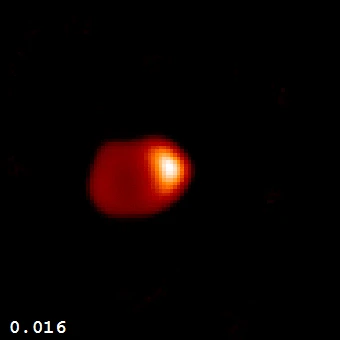
The system is a hierarchical triple. The inner pair consists of the primary, component Aa, and the secondary, component Ab, which form a spectroscopic and astrometric binary. They have been resolved using the SOAR telescope. This inner binary has an orbital period of 21 years and follows an eccentric orbit; the most recent periastron occurred in 2015.
Component Aa is an F-type main-sequence star with a stellar classification of F5 V, though one 1975 study classified it as F4 IV, suggesting it may be a slightly more evolved subgiant. It has about 145% of the Sun's mass and roughly 211% of its radius. At an estimated age of 2.1 billion years, it radiates seven times the Sun's luminosity from its outer atmosphere, with an effective temperature of 6,527 K.
Component Ab is 3.89 magnitudes fainter than the primary in the I-band, and little is known about it. Its mass is estimated at 70% of the Sun's mass.
The outer component is the proper-motion companion HD 15767, also called Sigma Ceti B. It is separated by 345 arcseconds, equivalent to about 9,300 AU at the system's distance, with an orbital period estimated at 500,000 years. This star is a K-dwarf with an apparent magnitude of 8.74. It has 77% of the Sun's mass and 70% of its radius, radiating 0.26 solar luminosities from its photosphere at an effective temperature of roughly 5,000 K.
Historically, Sigma Ceti was one of four stars—along with Pi Ceti, Epsilon Ceti, and Rho Ceti—that the astronomer Al Sufi called Al Sadr al Ḳaiṭos, meaning "the Whale's Breast." In the catalog from Technical Memorandum 33-507, these four stars were listed as Al Sadr al Ḳaiṭos I (Rho Ceti), II (Sigma Ceti), III (Epsilon Ceti), and IV (Pi Ceti).
- Apparent magnitude
- 4.78
- Distance
- 87.1 light years
- Radial velocity
- −29 km/s
- Spectral type (primary)
- F5 V (or F4 IV per Malaroda 1975)
- Mass (primary)
- 145% solar
- Radius (primary)
- 211% solar
- Luminosity (primary)
- 7 solar
- Effective temperature (primary)
- 6,527 K
- Mass (ab)
- 70% solar
- Mass (b)
- 77% solar
Lore & Background
Sigma Ceti is a hierarchical triple system. The inner pair consists of the primary component Aa and the secondary Ab, forming a spectroscopic and astrometric binary that has been resolved with the SOAR telescope. This inner system has an orbital period of 21 years and an eccentric orbit; the most recent periastron occurred in 2015. The primary, component Aa, appears to be a normal F-type main sequence star with a stellar classification of F5 V, though Malaroda (1975) assigned it F4 IV, suggesting it may be a more evolved subgiant. It is estimated to have 145% of the Sun's mass and about 211% of the Sun's radius. With an age of about 2.1 billion years, it radiates seven times the solar luminosity at an effective temperature of 6,527 K. The secondary, Sigma Ceti Ab, is 3.89 magnitudes fainter in the I-band; little is known about it, but its mass is estimated at 70% of the Sun's mass. The outer component is the proper motion companion HD 15767, also called Sigma Ceti B, with a wide separation of 345 arcseconds (9,300 AU) and an estimated orbital period of 500 thousand years. It is a K-dwarf star with an apparent magnitude of 8.74, having 77% of the Sun's mass and 70% of its radius, radiating 0.26 solar luminosities at an effective temperature of about 5,000 K.
Reader's Guide
Sigma Ceti is notable as a hierarchical triple system that offers a clear example of stellar dynamics across vastly different scales. The inner binary, with a 21-year orbit and resolved by modern telescopes, provides a laboratory for studying the properties of an F-type primary and its less massive companion. The outer K-dwarf companion, separated by thousands of astronomical units and with an orbital period of half a million years, illustrates the long-term gravitational binding in wide systems. The system's Bayer designation and its inclusion in Al Sufi's Al Sadr al Ḳaiṭos (the Whale's Breast) group it with three other stars in Cetus, reflecting its historical recognition. The primary's uncertain classification—either a main-sequence F5 V star or a slightly evolved F4 IV subgiant—highlights the ongoing refinement of stellar taxonomy. At a distance of 87.1 light years and approaching the Sun, Sigma Ceti remains accessible for both amateur observation and professional study, contributing to understanding of stellar evolution and multiple-star formation.
Did You Know?
- Sigma Ceti is also designated as HD 15767 and BD-15 0449.
- The inner binary's most recent periastron was in 2015.
- The outer companion, Sigma Ceti B, has an orbital period estimated at 500,000 years.
- This star, along with π, ε, and ρ Ceti, was part of Al Sufi's Al Sadr al Ḳaiṭos.
Frequently Asked Questions
What is Sigma Ceti?
Sigma Ceti (σ Ceti) is a hierarchical triple star system located in the constellation Cetus. It is made up of an inner binary pair—components Aa and Ab—plus a third star orbiting the pair at a wider separation.
How far is Sigma Ceti from Earth?
Parallax measurements place the system at roughly 87.1 light-years from the Sun. It is currently drifting closer to us at a radial velocity of about −29 km/s.
Can I see Sigma Ceti with the naked eye?
Yes; its apparent visual magnitude of 4.78 puts it just within the range of unaided visibility on a dark, clear night. Because Cetus is a large but faint constellation, locating the star can still be a bit tricky for casual observers.
What makes Sigma Ceti's structure interesting to astronomers?
It is a true hierarchical triple, with the inner Aa–Ab pair acting as both a spectroscopic and an astrometric binary that has been resolved using the SOAR telescope. The outer component then circles this inner pair, creating a three-body architecture that is a useful case study for orbital dynamics.
What are the key physical properties of Sigma Ceti's primary star?
Component Aa is an F-type star classified as F5 V (or F4 IV per Malaroda 1975), with a mass of about 145 % solar and a radius roughly 211 % solar. These figures place it as a moderately evolved, slightly oversized F star compared with the Sun.
More in Binary and Multiple Stars, Part 5 1-24
Spotted an error? Know more?
Reader corrections go straight into our review queue. Suggest an edit · How this site is sourced