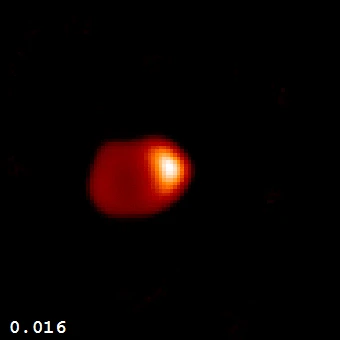
Xi Tauri
A hierarchical quadruple system with eclipsing and spectroscopic components.

Johann Wolfgang von Goethe · Public domain
Xi Tauri (ξ Tau, ξ Tauri) is a hierarchical quadruple star system located in the constellation Taurus, about 210 light-years from Earth. The system contains three blue-white B-type main sequence stars and one F-type main sequence star. Two of the B-type stars form an eclipsing binary, orbiting each other every 7.15 days. These two stars together orbit a third star once every 145 days. The fourth star, an F-type star, orbits the inner trio in roughly fifty years and has been resolved optically. The best-fit orbital model suggests this fourth star may itself be a binary, though its semi-major axis is not specified. The brightest and most massive individual star is the third star, but the eclipsing pair has a greater combined mass and is therefore usually considered the primary.
The system’s typical combined apparent magnitude is +3.73, but it varies between +3.73 and +3.81 due to eclipses between the two inner stars, classifying it as a variable star. Naming conventions for the four components vary: some sources label the faint resolved companion as component C, others as B. Similarly, the inner three stars are referred to either as Aa, Ab, and B, or as Aa, Ab, and Ac.
- Constellation
- Taurus
- Apparent magnitude (combined)
- +3.73
- Variability range
- +3.73 to +3.81
- Distance
- 210 light years
- Spectral types
- Three B-type main sequence, one F-type main sequence
- Orbital period (inner eclipsing pair)
- 7.15 days
- Orbital period (inner pair around third
- 145 days
Lore & Background
Xi Tauri consists of three blue-white B-type main sequence stars and one F-type main sequence star. Two of the B stars form an eclipsing binary that revolves around each other every 7.15 days. This inner pair in turn orbits the third star once every 145 days. The fourth star, an F-type star, orbits the other three in a roughly fifty-year period and has been resolved optically. The best-fit orbital fit would require it to be a binary system itself, with a semi-major axis of . The brightest and most massive of the four stars is the third star, although the eclipsing pair have a greater combined mass and are generally considered the primary. The typical combined apparent magnitude is +3.73, but because the two inner stars eclipse one another, the system's brightness varies from +3.73 to +3.81. Nomenclature for the four stars varies: some sources refer to the faint resolved companion as component C, others as B; the inner three stars are respectively Aa, Ab, and B, or Aa, Ab, and Ac.
Reader's Guide
Xi Tauri is significant as a hierarchical quadruple system that demonstrates multiple levels of orbital motion, from a 7.15-day eclipsing binary to a roughly fifty-year orbit of the outermost component. Its classification as a variable star due to eclipses provides a clear example of how multiplicity can produce observable brightness changes. The system's composition—three B-type main sequence stars and one F-type main sequence star—offers a case study in stellar evolution within a gravitationally bound group. The unresolved binary nature suggested by the best-fit orbital fit for the fourth star adds further complexity, hinting that the system may actually contain five stars. The varying nomenclature across sources reflects the challenge of designating components in such a compact, hierarchical arrangement. At a distance of about 210 light years, Xi Tauri remains a valuable target for understanding the dynamics and formation of multiple star systems.
Did You Know?
- Xi Tauri is a hierarchical quadruple system consisting of three B-type and one F-type main sequence star.
- The two innermost stars eclipse each other every 7.15 days, causing the system's brightness to vary from magnitude +3.73 to +3.81.
- The fourth star orbits the inner triple in a roughly fifty-year period and has been resolved optically.
- The best-fit orbital fit for the fourth star suggests it may itself be a binary system.
Gallery

Frequently Asked Questions
What is Xi Tauri?
Xi Tauri is a hierarchical quadruple star system in the constellation Taurus, roughly 210 light-years from Earth. It is made up of three blue-white B-type main-sequence stars and one cooler F-type main-sequence star, all bound together in nested orbits.
How is Xi Tauri's quadruple structure arranged?
Two B-type stars orbit each other in a tight 7.15-day eclipsing pair, and that pair circles a third B-type star every 145 days. An F-type star then sweeps around the inner trio on a much wider path of about fifty years, and best-fit orbital models suggest it may itself be a binary.
Is Xi Tauri a variable star?
Yes—the innermost B-type pair periodically eclipse one another, causing the combined brightness to dip slightly between magnitudes +3.73 and +3.81. The variability is modest, so the system is classified as a mildly eclipsing binary at the core of the quadruple.
Can I see Xi Tauri with the naked eye?
At a combined apparent magnitude of about +3.73, Xi Tauri is easily visible to the unaided eye under reasonably dark skies in the constellation Taurus. It sits among the brighter winter stars, making it a handy reference point for locating the Hyades region.
Why do astronomers find Xi Tauri interesting?
Its clean hierarchical architecture—eclipsing inner pair, spectroscopic middle orbit, and an optically resolved outer companion—gives researchers a rare chance to study how multiple-star systems assemble and remain stable. The hint that the outermost F-type star might be a binary adds another layer of complexity to an already rich system.
More in Binary and Multiple Stars, Part 5 1-24
Spotted an error? Know more?
Reader corrections go straight into our review queue. Suggest an edit · How this site is sourced