Rho Pegasi
A probable astrometric binary with a white A-type primary.

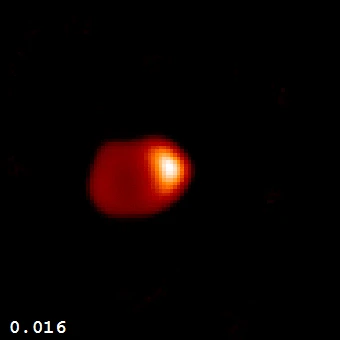
Rho Pegasi, also named Leidian, is a probable astrometric binary system in the northern constellation of Pegasus, near the boundary with Pisces. The visible component is a white-hued A-type main-sequence star faintly visible to the naked eye at an apparent visual magnitude of 4.90.
- Apparent visual magnitude
- 4.90
- Distance
- approximately 274 light years
- Radial velocity
- −10.6 km/s
- Stellar classification
- A1V
- Mass
- 2.8 solar masses
- Radius
- 3.1 solar radii
- Luminosity
- 110 solar luminosities
- Effective temperature
- 9,484 K
- Projected rotational velocity
- 107 km/s
- Age
- 331 million years
Lore & Background
Rho Pegasi was identified as a probable astrometric binary through changes in the proper motion of its visible component. The system is drifting closer to the Sun, with a radial velocity of −10.6 km/s. The visible star is an A1V main-sequence star, 331 million years old, spinning at a projected rotational velocity of 107 km/s. It has 2.8 times the Sun's mass, 3.1 times its radius, and radiates 110 times the Sun's luminosity from a photosphere at 9,484 K. In Chinese astronomy, the star belongs to the constellation Léi Diàn (Thunder and Lightning). The IAU Working Group on Star Names adopted the name Leidian for this star on 13 August 2026, after this Chinese constellation.
Reader's Guide
Rho Pegasi's significance lies in its status as a probable astrometric binary, a system inferred from subtle shifts in proper motion rather than direct visual or spectroscopic detection. This makes it a valuable object for studying binary dynamics and stellar masses through astrometric methods. Its white A-type primary is a relatively young, rapidly rotating star, typical of its class, and its distance of about 274 light years places it within the realm of stars accessible to detailed photometric and kinematic study. The star's Chinese heritage, reflected in its name Leidian, connects it to the cultural astronomy of the Thunder and Lightning asterism. As a faint naked-eye object, it serves as a bridge between amateur observation and professional astrophysical investigation, particularly in the context of binary star research and stellar evolution.
Did You Know?
- Rho Pegasi is a probable astrometric binary, detected through changes in proper motion.
- Its effective temperature is 9,484 K.
- The name Leidian was adopted by the IAU Working Group on Star Names on 13 August 2026.
Frequently Asked Questions
What is Rho Pegasi (Leidian)?
Rho Pegasi, also called Leidian, is a white-hued A-type main-sequence star sitting in the northern constellation Pegasus close to the border with Pisces. At an apparent visual magnitude of 4.90, it is a faint but just-barely-reachable target for the unaided eye on a dark night.
Is Rho Pegasi a binary star?
Yes—Rho Pegasi is classified as a probable astrometric binary, meaning the companion is inferred from tiny positional wobbles of the primary rather than seen directly. The visible A1V-type star is the primary, while the secondary remains an unseen object detected only through its gravitational tug.
What are Rho Pegasi's key physical stats?
The primary packs about 2.8 solar masses and a radius of roughly 3.1 solar radii, placing it solidly on the main sequence. It sits approximately 274 light-years away and carries a radial velocity of −10.6 km/s, indicating a gentle approach toward the Solar System.
Where do I find Rho Pegasi in the night sky?
Aim your gaze at the constellation Pegasus in the northern sky, specifically near the region where Pegasus meets Pisces. Because of its 4.90 magnitude, you'll need dark, clear conditions to pick it out without optical aid.
Why do binary-star fans care about Rho Pegasi?
Its probable astrometric companion makes it a neat case study for tracking unseen masses and orbital mechanics. Paired with its relatively high mass and radius compared to the Sun, the white A-type primary offers a nice contrast to the cooler stars that dominate the surrounding sky.
More in Binary and Multiple Stars, Part 5 1-24
Spotted an error? Know more?
Reader corrections go straight into our review queue. Suggest an edit · How this site is sourced