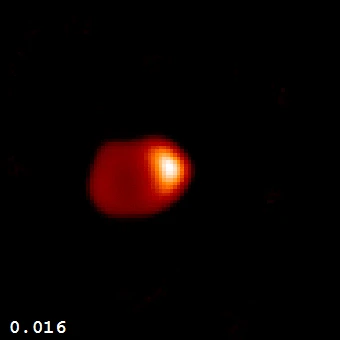
Theta Circini
A binary Be star system in Circinus with Gamma Cassiopeiae variability.

Theta Circini (θ Cir) is a binary star system in the southern constellation Circinus, northwest of Alpha Circini. Faintly visible to the naked eye at an apparent visual magnitude of about five, it is an astrometric binary with an orbital period of 38.2 years and an eccentricity of 0.2775. The system lies approximately 276 light years from the Sun.
- Apparent visual magnitude
- ~5
- Distance
- ~276 light years
- Orbital period
- 38.2 years
- Eccentricity
- 0.2775
- Angular semimajor axis
- 0.08808"
- Combined stellar classification
- B3 Ve
- Variable type
- Gamma Cassiopeiae variable
Lore & Background
Theta Circini is an astrometric binary star system whose two components appear to have similar visual magnitude, mass, and classification. The combined stellar classification is B3 Ve, indicating a B-type main sequence star with emission lines characteristic of a Be star. Alternate classifications include B4 Vnp and B4npe, where 'n' denotes broad absorption lines due to rapid rotation and 'p' signifies a chemically peculiar star. The system behaves as a Gamma Cassiopeiae variable, exhibiting occasional outbursts of up to 0.27 in magnitude. The orbital parameters include a period of about 38.2 years, an eccentricity of 0.2775, and an angular semimajor axis of 0.08808 arcseconds.
Reader's Guide
Theta Circini is notable as an astrometric binary system in which both components share similar visual magnitude, mass, and spectral type, making it a valuable object for studying binary star dynamics and the properties of Be stars. Its classification as a Gamma Cassiopeiae variable, with outbursts of up to 0.27 magnitude, places it among a class of eruptive Be stars that exhibit episodic mass loss. The system's combined spectral type B3 Ve, along with alternative designations B4 Vnp and B4npe, highlights its rapid rotation and chemical peculiarity. The orbital solution—period 38.2 years, eccentricity 0.2775, and semimajor axis 0.08808 arcseconds—provides a well-constrained astrometric orbit. Theta Circini contributes to the understanding of binary interactions in Be stars and the variability mechanisms of Gamma Cassiopeiae variables.
Frequently Asked Questions
Who is Theta Circini?
Theta Circini (θ Cir) is a binary star system located in the small southern constellation Circinus, sitting just northwest of the brighter Alpha Circini. At an apparent visual magnitude of roughly five, it is barely detectable by the unaided eye under good dark-sky conditions.
What makes Theta Circini special?
The pair is a binary Be star system exhibiting Gamma Cassiopeiae-type variability, meaning the components shed material into circumstellar disks. Its combined spectral classification of B3 Ve flags it as a hot, rapidly rotating stellar duo with active mass-loss processes.
How does Theta Circini's orbit work?
The two stars trace an elliptical path around their common barycenter with a period of approximately 38.2 years. The orbit's eccentricity of about 0.2775 means the separation between the pair changes noticeably from periastron to apastron over each cycle.
Why is Theta Circini important to astronomers?
As an astrometric binary with a measured angular semimajor axis of 0.08808 arcseconds at a distance of roughly 276 light years, it serves as a useful benchmark for testing orbital mechanics and stellar mass estimates. Its Be-star variability also makes it a valuable target for studying disk formation and mass loss in early-type stars.
Where can I find Theta Circini in the night sky?
Look in the faint southern constellation Circinus (the Compass), just to the northwest of the more prominent Alpha Circini. Because it hovers around magnitude five, you will need relatively dark skies and a clear view of the southern horizon to pick it out without binoculars or a telescope.
More in Binary and Multiple Stars, Part 5 1-24
Spotted an error? Know more?
Reader corrections go straight into our review queue. Suggest an edit · How this site is sourced