Tau Coronae Borealis
A possible binary star in Corona Borealis.

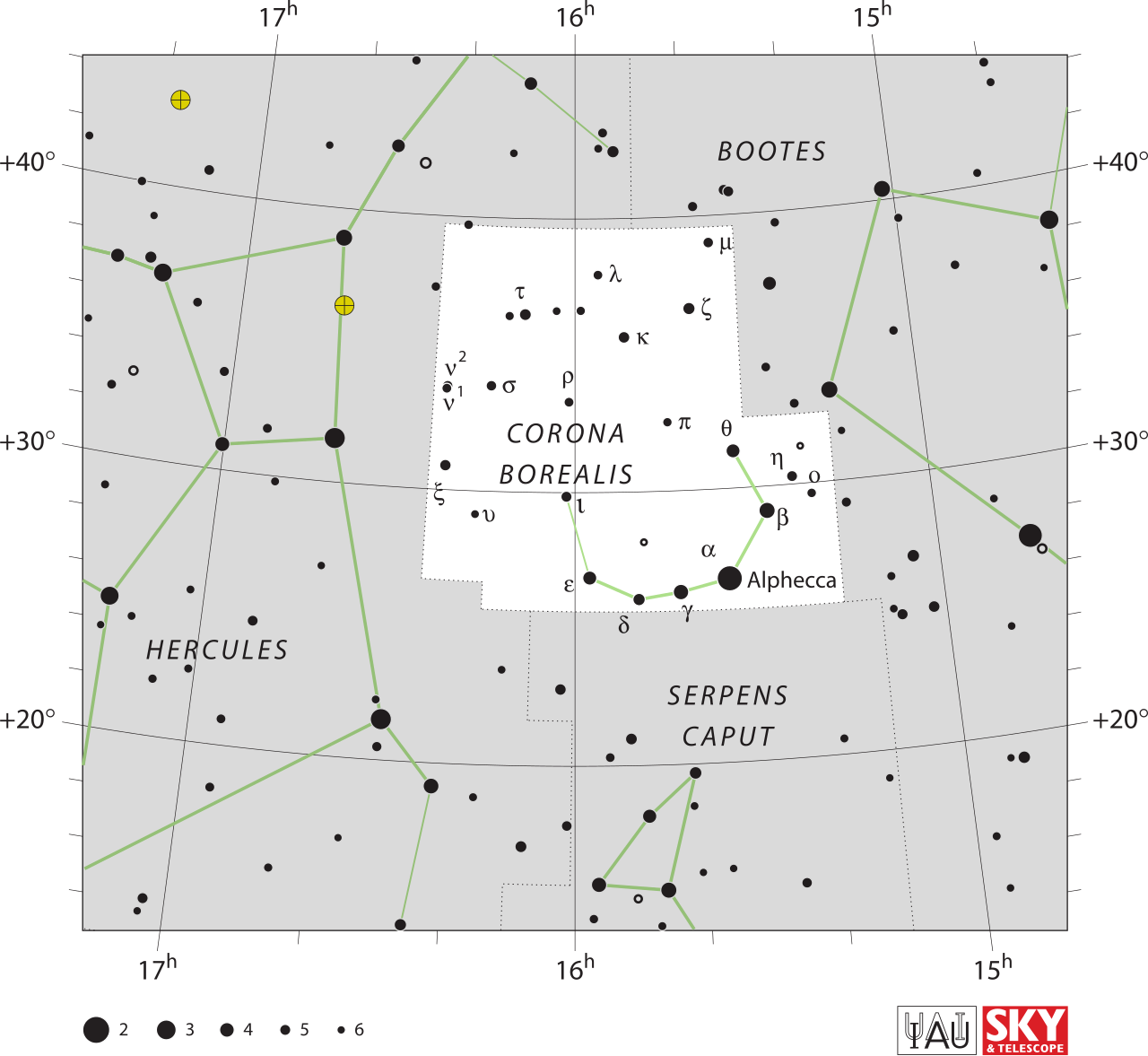
IAU and Sky & Telescope magazine (Roger Sinnott & Rick Fienberg) · CC BY 3.0
Tau Coronae Borealis, also designated τ CrB, is a star system in the northern constellation Corona Borealis that may be both an astrometric and a spectroscopic binary. It is bright enough to be seen without a telescope, with an apparent visual magnitude of 4.76. Parallax measurements place it roughly 112.4 light-years from Earth, and interstellar dust dims its light by an extinction factor of 0.04 at that distance.
The system has a visible companion star of magnitude 13.2, and the two are considered a common proper motion pair. As of 2014, they were separated by 2.20 arcseconds at a position angle of 186°. While the system has also been described as a spectroscopic binary, this has not been confirmed. Its unusual space motion has led to it being called an astrometric binary, though no orbit has been observed.
The primary star, magnitude 4.89, is a K-type star with a stellar classification of K1 III-IV, showing traits of both an evolved subgiant and a giant. It is cataloged as a red clump giant, meaning it likely generates energy through helium fusion in its core. This star has expanded to six times the Sun's radius and shines with 16 times the Sun's luminosity from its photosphere, which has an effective temperature of 4,742 K.
- Bayer designation
- τ Coronae Borealis
- Apparent visual magnitude
- 4.76
- Distance
- 112.4 ly
- Spectral type
- K1 III-IV
- Luminosity
- 16 L☉
- Radius
- 6 R☉
- Effective temperature
- 4,742 K
Lore & Background
Tau Coronae Borealis has a visible companion of visual magnitude 13.2, and the two have been treated as a common proper motion pair. As of 2014, the pair had an angular separation of 2.20 arcseconds along a position angle of 186°. The system has also been described as a spectroscopic binary, though this has not been confirmed. Due to an abnormal space motion, it has been described as an astrometric binary, although no apparent orbit is known.
The primary component is a magnitude 4.89 K-type star with a stellar classification of K1 III-IV, showing mixed traits of an evolved subgiant and giant star. It is catalogued as a red clump giant, indicating it generates energy through helium fusion at its core. The star has expanded to six times the Sun's radius and radiates 16 times the solar luminosity from its photosphere at an effective temperature of 4,742 K.
Reader's Guide
Tau Coronae Borealis is notable as a possible binary system that has been studied both astrometrically and spectroscopically, though neither binary nature has been confirmed. Its visible companion, a much fainter star of magnitude 13.2, shares a common proper motion with the primary, suggesting a physical association. The primary itself is a red clump giant, a stage of stellar evolution where helium fusion occurs in the core, making it an interesting object for studies of evolved stars. The system's abnormal space motion adds to its intrigue, hinting at possible gravitational interactions or an unseen companion. Despite the uncertainties, Tau Coronae Borealis remains a target for further observation to clarify its binary status and to better understand the properties of its evolved primary star.
Did You Know?
- Tau Coronae Borealis is visible to the naked eye with an apparent visual magnitude of 4.76.
- The primary star is a red clump giant, generating energy through helium fusion at its core.
- The system has a visible companion of magnitude 13.2 with an angular separation of 2.20 arcseconds as of 2014.
- It has been described as both a spectroscopic and astrometric binary, but neither has been confirmed.
Mythological Roots & Cultural Echoes
The constellation Corona Borealis carries a name that speaks directly to its visual shape: the Latin phrase translates to "northern crown," a reference to the semicircular arc traced by its brightest stars. In the classical Greek tradition, this celestial crown was the gift that the wine god Dionysus bestowed upon Ariadne, the Cretan princess who aided Theseus in the Labyrinth. After her death, she was placed among the stars, her crown forever suspended in the northern sky. This narrative dominated Western star lore for centuries. Yet the pattern inspired far more than one story. Across different cultures, observers saw a gathering of elders seated in a circle, the nest of an eagle, the den of a bear, or even the smokehole of a dwelling. The 2nd-century astronomer Ptolemy catalogued the figure among his 48 constellations and also noted a southern mirror image, Corona Australis, whose similar arc of stars echoed the northern crown. That Ptolemy's listing has survived into the modern IAU system of 88 constellations testifies to the pattern's enduring recognizability across two millennia of human sky-watching.
A Laboratory of Stellar Anomalies
Within a modest 179-square-degree patch of sky, Corona Borealis harbors some of the most peculiar stellar behavior known to astronomy. R Coronae Borealis, a yellow supergiant, serves as the namesake prototype for an entire rare class of variable stars. These objects are extraordinarily deficient in hydrogen and are believed to be the product of two white dwarfs merging into a single, unstable star. Their dimming events remain a subject of ongoing study. Equally dramatic is T Coronae Borealis, nicknamed the Blaze Star. A recurrent nova, it normally glimmers at a faint magnitude 10, yet in 1946 it erupted to a brilliant magnitude 2, briefly outshining most of its neighbors. Astronomers had predicted a similar outburst for 2025, underscoring the quasi-periodic nature of its violence. The constellation also hosts Alphecca, an Algol-type eclipsing binary whose brightness wobbles by a tenth of a magnitude every 17.4 days, and Nusakan, a spectroscopic pair in which the brighter component pulses as a rapidly oscillating Ap star with a period of just 16.2 minutes. Together, these objects make the northern crown a small but extraordinary showcase of stellar diversity.
The Crown's Seven Stars & the Cartographers' Legacy
The iconic arc of Corona Borealis is built from seven stars, six of which shine at the fourth magnitude while Alpha Coronae Borealis blazes at magnitude 2.2. That brightest member, officially named Alphecca by the IAU, is a blue-white Algol-type eclipsing binary located 75 light-years away. Its primary is an A0V main-sequence star nearly three times the Sun's mass and 57 times its luminosity, encircled by a debris disk extending to roughly 60 astronomical units, while its companion is a smaller yellow G5V star. Alphecca is thought to share a common motion with the Ursa Major Moving Group. The formal cataloguing of these stars stretches back to 1603, when German cartographer Johann Bayer assigned designations from Alpha through Upsilon to twenty stars in his atlas Uranometria. Later, John Flamsteed identified close pairs among what Bayer had listed as single stars. Chinese astronomers, meanwhile, recognized a nine-star asterism by adding Pi and Rho to the pattern. Within the constellation's borders, 37 stars reach or exceed apparent magnitude 6.5, and complex multiple systems like ADS 9731 with six components and Sigma Coronae Borealis with five add further layers of structure to the crown.
Beyond the Stars: Galaxies, Exoplanets & the Sky's Geometry
While the naked-eye crown captures the imagination, Corona Borealis also anchors some of the most massive structures in the observable universe. Abell 2065, a highly concentrated galaxy cluster situated roughly one billion light-years from the Solar System, contains more than 400 member galaxies. It is itself embedded within the larger Corona Borealis Supercluster, a vast web of matter whose name derives from the constellation that lies along its line of sight. Closer to home, five stars within the constellation's boundaries are known to host Jupiter-sized exoplanets, extending the crown's story from ancient star-gazing to modern planetary science. The constellation's geometry is precisely defined. Covering 179 square degrees, or 0.433 percent of the total sky, it ranks 73rd among the IAU's 88 designated constellations. Its borders, fixed by Belgian astronomer Eugène Delporte in 1930, form an eight-segment polygon spanning right ascensions from 15 hours 16 minutes to 16 hours 25 minutes and declinations between 25.54 and 39.71 degrees. Because it sits firmly in the Northern Celestial Hemisphere, the entire figure remains visible to any observer located north of 50 degrees south latitude, flanked by Boötes, Serpens Caput, and Hercules.
Gallery
Frequently Asked Questions
What is Tau Coronae Borealis?
Tau Coronae Borealis (τ CrB) is a star system sitting in the northern constellation Corona Borealis. It is suspected to be both an astrometric and a spectroscopic binary, though its multiple nature has not been fully locked down.
How far is Tau Coronae Borealis from Earth?
Parallax data place the system at roughly 112.4 light-years away. Interstellar dust along that line of sight dims the star's light by a small extinction factor of about 0.04.
What kind of star is Tau Coronae Borealis?
The primary is a K1 III-IV star, occupying the transitional zone between giant and subgiant classifications. It radiates about 16 times the Sun's luminosity and has a radius roughly six times solar.
Is Tau Coronae Borealis a confirmed binary?
Its binary status is still considered probable rather than definitive, with evidence pointing to both astrometric and spectroscopic companions. A faint 13.2-magnitude star shares a common proper motion with the primary, and the two were separated by 2.20 arcseconds as of 2014.
Can you see Tau Coronae Borealis with the naked eye?
Yes—the primary's apparent visual magnitude of 4.76 makes it visible to the unaided eye under decently dark skies. The 13.2-magnitude companion, on the other hand, needs at least a small telescope to pick out.
More in Binary and Multiple Stars, Part 5 1-24
Spotted an error? Know more?
Reader corrections go straight into our review queue. Suggest an edit · How this site is sourced